

Replica of ancient human rights charter on display in city
Advertisement
Read this article for free:
or
Already have an account? Log in here »
To continue reading, please subscribe:
Monthly Digital Subscription
$0 for the first 4 weeks*
- Enjoy unlimited reading on winnipegfreepress.com
- Read the E-Edition, our digital replica newspaper
- Access News Break, our award-winning app
- Play interactive puzzles
*No charge for 4 weeks then price increases to the regular rate of $19.95 plus GST every four weeks. Offer available to new and qualified returning subscribers only. Cancel any time.
Monthly Digital Subscription
$4.99/week*
- Enjoy unlimited reading on winnipegfreepress.com
- Read the E-Edition, our digital replica newspaper
- Access News Break, our award-winning app
- Play interactive puzzles
*Billed as $19.95 plus GST every four weeks. Cancel any time.
To continue reading, please subscribe:
Add Free Press access to your Brandon Sun subscription for only an additional
$1 for the first 4 weeks*
*Your next subscription payment will increase by $1.00 and you will be charged $16.99 plus GST for four weeks. After four weeks, your payment will increase to $23.99 plus GST every four weeks.
Read unlimited articles for free today:
or
Already have an account? Log in here »
Hey there, time traveller!
This article was published 28/10/2013 (4452 days ago), so information in it may no longer be current.
A replica of the Cyrus Cylinder, which some historians believe was one of the earliest known human rights charters, will be on display on Tuesday at the Grant Park Shopping Centre at 10 a.m.-5 p.m.
The clay cylinder, on which was written a series of decrees by the Persian King Cyrus the Great, is being displayed to commemorate the day in 539 BC that the ancient ruler entered the city of Babylon.
The original Cyrus Cylinder is owned by the British Museum in London. It sponsored the expedition in 1879 during which the cylinder was discovered in the ruins of Babylon in Mesopotamia (modern Iraq). It is 22.5 centimetres long and 10 cm wide with over 40 lines of writing on it in Babylonian cuneiform.
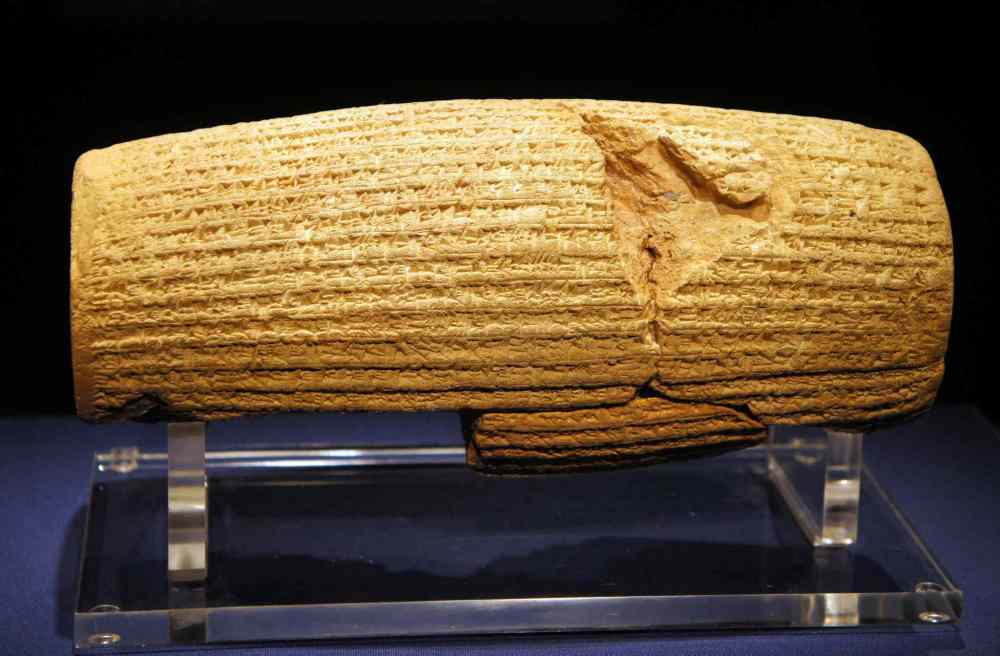
A press release from the Iranian Community of Manitoba (ICM), which is sponsoring the display, stated “the purpose of this event is to take a small step towards promoting cross-cultural understanding, while countering the negative post-1979 view of Iran and Iranian peoples in the west, by highlighting similarities rather than focusing on differences.”
Though the translations and interpretations of the writings on the cylinder are varied, the cylinder is most famous for translations that suggest “it appears to encourage freedom of worship throughout the Persian Empire and to allow deported people to return to their homelands.”
“The excitement is because it is commemorating a historical event and to let people know what a great event it was to have the first declaration of human rights,” said Mitra Tirandaz, one of the event organizers. She said this replica of the cylinder is privately owned by an individual from Winnipeg. “Human rights have been important for ages, as we can see from the 539 BC date, it was declared by Cyrus the Great and it was mentioned in the Holy Bible.”
Some historians say the text on the cylinder is a statement of the time by a new ruler with praise for the new king, detraction of the previous ruler and plans for the restoration of the city of Babylon.
Neil MacGregor, the director of the British Museum, said the cylinder is “the first serious attempt that we know about running a society estate in which there were people of different nationalities and different types, because the ancient Persian empire was the first empire to address that.”
There is a replica of the cylinder at the United Nations headquarters in New York City.