Partnership ends for churches
Ecumenical experiment ends after 45 years

Advertisement
Read this article for free:
or
Already have an account? Log in here »
To continue reading, please subscribe:

Digital Subscription
One year of digital access for only $205*
- Enjoy unlimited reading on winnipegfreepress.com
- Read the E-Edition, our digital replica newspaper
- Access News Break, our award-winning app
- Play interactive puzzles
*First annual payment billed as $205.00 + GST for one year. This annual subscription will automatically renew at $233.00 + GST every 52 weeks (10% off the regular annual price of $259.35). Offer available to new and qualified returning subscribers only. Cancel any time.
To continue reading, please subscribe:
Add Free Press access to your Brandon Sun subscription for only an additional
$1 for the first 4 weeks*
- Enjoy unlimited reading on winnipegfreepress.com
- Read the E-Edition, our digital replica newspaper
- Access News Break, our award-winning app
- Play interactive puzzles
*Your next Brandon Sun subscription payment will increase by $1.00 and you will be charged $17.95 plus GST for four weeks. After four weeks, your payment will increase to $24.95 plus GST every four weeks.
Read unlimited articles for free today:
or
Already have an account? Log in here »
Hey there, time traveller!
This article was published 16/11/2013 (4691 days ago), so information in it may no longer be current.
A unique experiment in ecumenism stretching back nearly five decades ended last month due to a shortage of funds.
After 45 years of sharing a building with the Roman Catholic Parish of Blessed John XXIII, St. Chad’s Anglican Church officially withdrew from its partnership in the Assiniboia Christian Centre, 3390 Portage Ave., on Oct. 31.
“This is a very expensive building” to run, explains Rev. Susan Titterington of St. Chad’s, referring to the $150,000 annual budget for maintenance, repairs and staff.
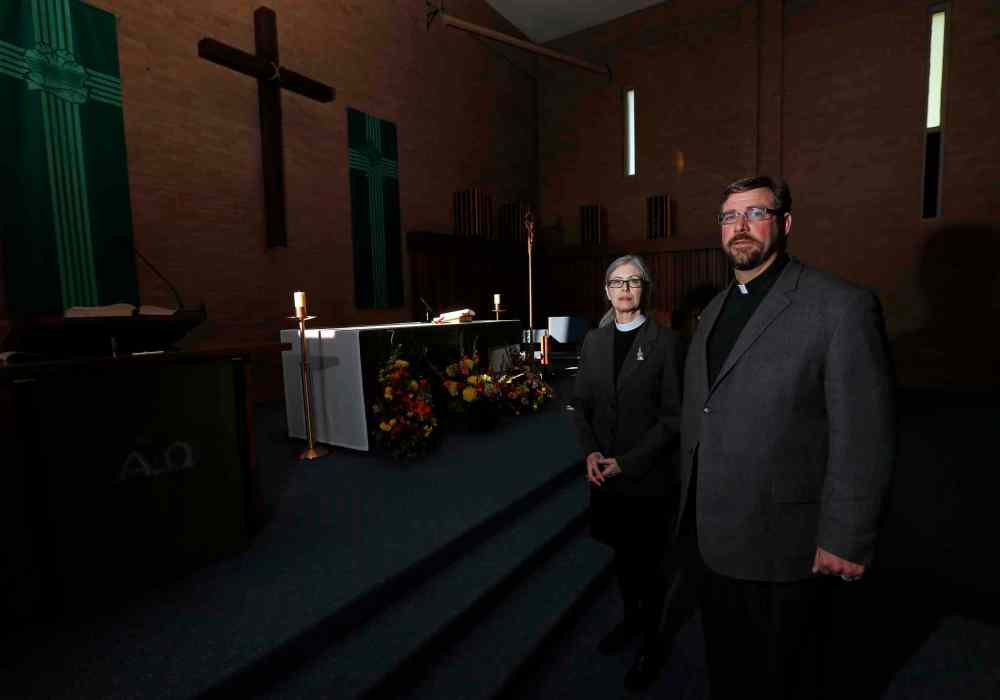
“When you get to a certain size, you have to ask if you can sustain yourself in this building or should you consider another place?”
After several years of discussions, the Anglican congregation of about 120 households decided to sell their share of the Westwood-area building to the Roman Catholics for an undisclosed sum. The Anglicans moved to a rented space at nearby Kirkfield Park United Church.
The two congregations formally marked the end of their long association with an ecumenical prayer service on Saturday, Nov. 2, attended by Roman Catholic Archbishop Emeritus James Weisgerber of Winnipeg and Anglican Bishop Donald Phillips of the Diocese of Rupert’s Land.
The partnership dates back to the 1960s, when both congregations were planted in the new neighbourhood of Westwood. The two new parishes agreed to build one building to serve both groups. The Assiniboia Christian Centre was the first ecumenical venture between Anglicans and Catholics in Winnipeg and is thought to be the first of its kind in Canada.
Designed by the architectural firm of Pratt, Lindgren, Snider, Tomcej & Associates, the 20,000-square-foot building features shared office space, two chapels, a lower level gymnasium and a 5,000-sq.-ft. sanctuary. It was completed in 1968 at a cost of $675,000.
As it nears the half-century mark, the roof, boilers and other systems in the building are nearing the end of their lifespan and need replacing, explains Claude Precourt, chairman of the ACC board.
With a declining population to pay their share of the rent and the upkeep, the Anglicans decided to sell and consider other options.
“What we wanted is a right-sized building for our community,” says Titterington, who was appointed two years ago to assist the congregation in the transition.
“We’ll rent for a year and just heal and reflect and discuss what God calls us to.”
Although the Catholics retain sole responsibility and ownership of the building, they haven’t ruled out the possibility of sharing it with another congregation, says Rev. Gerald Langevin.
For now, Catholic masses will remain at 9 a.m. and 1 p.m. on Sundays, with the prime 11 a.m. spot vacant for the time being, says Langevin.
“We’re not in a decision-making mode at the moment. We’re just going to discuss the possibilities.”
Some of the joint ministries, including the food bank, rummage sale and book club, will continue, while others may not survive the transition, says Titterington, who acknowledges some Anglicans are grieving the loss of the place where they held baptisms, weddings and funerals.
Both leaders agree what was billed as an ecumenical experiment in 1968 has grown into a relationship of mutual respect and appreciation.

“There have been tremendous relationships formed,” says Langevin of connections between the parishes, which shared many social events, worship services and even a few weddings over the years.
But the loss of a common space does not mean the end of co-operation between the congregations, insists Titterington.
“I’ve never believed that the Christian church is defined by a building,” says Titterington.
“Our relationship hasn’t ended. We’re just worshipping in a different building.”
brenda@suderman.com
The Free Press is committed to covering faith in Manitoba through our Religion in the News project. This reporting continues because readers like you step forward to fund it.
Donate now to support our reporting on religion.
Your donation is eligible for a charitable tax receipt.
BECOME A FAITH JOURNALISM SUPPORTER
Brenda Suderman has been a columnist in the Saturday paper since 2000, first writing about family entertainment, and about faith and religion since 2006.
Our newsroom depends on a growing audience of readers to power our journalism. If you are not a paid reader, please consider becoming a subscriber.
Our newsroom depends on its audience of readers to power our journalism. Thank you for your support.
The Free Press is committed to covering faith in Manitoba through our Religion in the News project. This reporting continues because readers like you step forward to fund it.
Donate now to support our reporting on religion.
Your donation is eligible for a charitable tax receipt.
BECOME A FAITH JOURNALISM SUPPORTER
Brenda Suderman has been a columnist in the Saturday paper since 2000, first writing about family entertainment, and about faith and religion since 2006.
Our newsroom depends on a growing audience of readers to power our journalism. If you are not a paid reader, please consider becoming a subscriber.
Our newsroom depends on its audience of readers to power our journalism. Thank you for your support.
Advertisement Advertise With Us
Advertisement Advertise With Us
History
Updated on Saturday, November 16, 2013 12:19 PM CST: added colour photo
The Free Press acknowledges the financial support it receives from members of the city’s faith community, which makes our coverage of religion possible.