

Ex-AP writer recalls serving as Oswald pallbearer, rare talks with assassin’s press-shy wife
Advertisement
Read this article for free:
or
Already have an account? Log in here »
To continue reading, please subscribe:

Digital Subscription
One year of digital access for only $205*
- Enjoy unlimited reading on winnipegfreepress.com
- Read the E-Edition, our digital replica newspaper
- Access News Break, our award-winning app
- Play interactive puzzles
*First annual payment billed as $205.00 + GST for one year. This annual subscription will automatically renew at $233.00 + GST every 52 weeks (10% off the regular annual price of $259.35). Offer available to new and qualified returning subscribers only. Cancel any time.
To continue reading, please subscribe:
Add Free Press access to your Brandon Sun subscription for only an additional
$1 for the first 4 weeks*
- Enjoy unlimited reading on winnipegfreepress.com
- Read the E-Edition, our digital replica newspaper
- Access News Break, our award-winning app
- Play interactive puzzles
*Your next Brandon Sun subscription payment will increase by $1.00 and you will be charged $17.95 plus GST for four weeks. After four weeks, your payment will increase to $24.95 plus GST every four weeks.
Read unlimited articles for free today:
or
Already have an account? Log in here »
Hey there, time traveller!
This article was published 21/11/2013 (4694 days ago), so information in it may no longer be current.
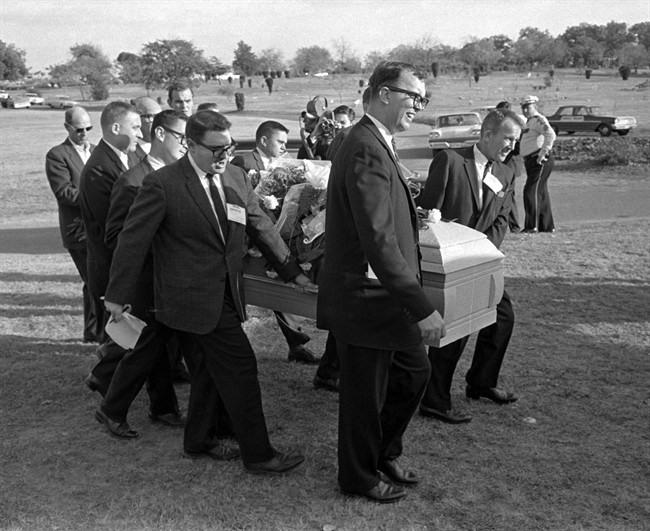
FORT WORTH, Texas – On a gloomy November afternoon, I helped carry the inexpensive wooden casket of Lee Harvey Oswald to a grave on a slight rise dotted with dying grass.
With no mourners around to serve as pallbearers, it was a task that fell to me and a few other reporters covering the funeral of John F. Kennedy’s assassin. Fifty years later, I remain a reluctant and minor footnote in American history.
It was a story that began with a tip: Oswald would be buried at Rose Hill Cemetery in Fort Worth, where he had spent part of his childhood, just one day after nightclub owner Jack Ruby shot and killed him during a jail transfer on Nov. 24, 1963, itself just two days after Kennedy’s death.
As the Fort Worth correspondent for The Associated Press, I drew the assignment.
I arrived to discover dozens of police and federal agents, writers and photographers, but no mourners waiting to bid Oswald goodbye or good riddance. A police escort delivered Oswald’s casket in the early afternoon. Much later, officers arrived with his family: mother Marguerite, brother Robert, widow Marina and her two daughters, June Lee, 2, and infant Rachel.
No one else would follow; even the minister failed to show. Shaking his head ever so slightly, Jerry Flemmons of the Fort Worth Star-Telegram turned to me and said, “Cochran, if we’re gonna write a story about the burial of Lee Harvey Oswald, we’re gonna have to bury the son of a bitch ourselves.”
Sure enough, officials asked the gathered reporters to serve as pallbearers. I was among the first they asked, my reply not just “No!” but “Hell no!” Then Preston McGraw of United Press International stepped forward and volunteered, and with my top competition for scoops accepting the duty, I realized my error and joined McGraw and other reporters.
The ceremony itself was as brief as it was simple. The Rev. Louis Saunders, executive secretary of the Fort Worth Council of Churches, had been drafted to fill in for the missing minister. His words — “we are not here to judge, only to commit for burial Lee Harvey Oswald” — were barely audible, mingled with muffled sobs by Oswald’s mother and widow. Her eyes red and swollen, Marina Oswald stepped beside her husband’s casket and quietly whispered something.
Not long after the nation’s slain president was laid to rest at Arlington National Cemetery with tearful family members and millions of television viewers around the world looking on, Oswald’s body was lowered into his grave at 4:28 p.m.
For years, I would continue to report on the assassination, interviewing Oswald’s mother, investigating conspiracy theories and writing stories on the anniversary of that dreadful day in Dallas.
For one of the first of those anniversary stories, I wanted to interview Oswald’s widow. She had remarried, moved to suburban Dallas and rarely spoke to reporters. Her new husband had reportedly brandished a pistol and chased one writer away.
Early on a cloudy November morning, I staked out their house and trudged up the steps after he left for work. I had not called ahead, but identified myself as an AP reporter when Marina Oswald opened the door.
“I am no longer news,” she said, making it clear she did not intend to talk with me.
She was slim and blonde, with arresting eyes of an intense blue-green and a distinctive Russian accent. She was 24 and I must have stared like a smitten dolt.
“Is something wrong?” she asked.
Embarrassed, I babbled something about not having seen her since that day at Rose Hill.
“You were there?” she asked. I told her I was a pallbearer.
Surprised, she said the least she could do was invite me in for coffee. Several hours later, we were still talking and smoking. Denied cigarettes by Oswald during their marriage, she was now a chain smoker.
“Have you ever tried to analyze yourself?” she asked me at one point, then added: “It’s very hard to do.”
Asked about the Warren Commission’s conclusion that her husband was the lone assassin, she said: “I think about it a lot. I try to forget. It is very difficult. It is like a nightmare. … I have nightmares.”
Years later, in 1983, when working on a story about the 20th anniversary, I interviewed Marina Oswald for the second and last time. She was no less candid and still a heavy smoker.
“For a while I thought it would all blow over, just go away,” she said. “But now I accept the fact that I must live with this the rest of my life.
“I may still be naive, but I’m not stupid.”
___
Editor’s Note: Mike Cochran was AP’s Fort Worth correspondent in 1963 and retired from the company in 1999.
Related Articles
'Live' coverage of the assassination of JFK
Advertisement Advertise With Us
Advertisement Advertise With Us