New research aims to teach computers common sense

Advertisement

Advertise with us

PITTSBURGH, Pa. - Researchers are trying to plant a digital seed for artificial intelligence by letting a massive computer system browse millions of pictures and decide for itself what they all mean.

Read this article for free:


or

Already have an account? Log in here »

To continue reading, please subscribe:

Subscribe and receive a limited-edition Free Press branded hat or tote.

Digital Subscription

One year of digital access for only $205*

  • Enjoy unlimited reading on winnipegfreepress.com
  • Read the E-Edition, our digital replica newspaper
  • Access News Break, our award-winning app
  • Play interactive puzzles

*First annual payment billed as $205.00 + GST for one year. This annual subscription will automatically renew at $233.00 + GST every 52 weeks (10% off the regular annual price of $259.35). Offer available to new and qualified returning subscribers only. Cancel any time.

To continue reading, please subscribe:

Add Free Press access to your Brandon Sun subscription for only an additional

$1 for the first 4 weeks*

  • Enjoy unlimited reading on winnipegfreepress.com
  • Read the E-Edition, our digital replica newspaper
  • Access News Break, our award-winning app
  • Play interactive puzzles
Start now

*Your next Brandon Sun subscription payment will increase by $1.00 and you will be charged $17.95 plus GST for four weeks. After four weeks, your payment will increase to $24.95 plus GST every four weeks.

Hey there, time traveller!
This article was published 24/11/2013 (4651 days ago), so information in it may no longer be current.

PITTSBURGH, Pa. – Researchers are trying to plant a digital seed for artificial intelligence by letting a massive computer system browse millions of pictures and decide for itself what they all mean.

The system at Carnegie Mellon University is called NEIL, short for Never Ending Image Learning. In mid-July, it began searching the Internet for images 24/7 and, in tiny steps, is deciding for itself how those images relate to each other. The goal is to recreate what we call common sense — the ability to learn things without being specifically taught.

It’s a new approach in the quest to solve computing’s Holy Grail: getting a machine to think on its own using a form of common sense. The project is being funded by Google and the Department of Defence’s Office of Naval Research.
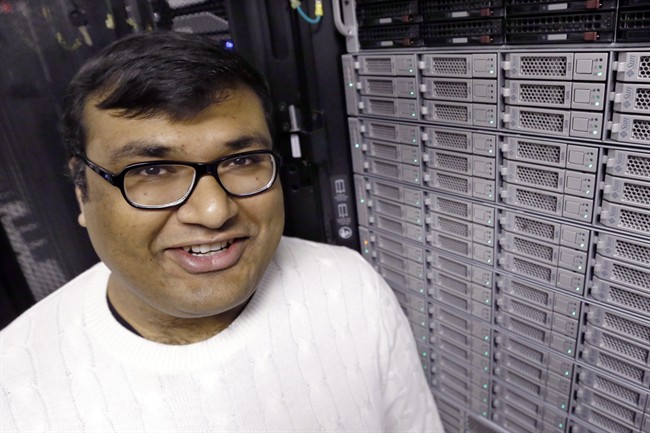
In this Thursday, Nov. 21, 2013 photo, Abhinav Gupta stands near one of the computer clusters used in his research at one of the computer server areas on campus at Carnegie Mellon University in Pittsburgh. The school is letting hundreds of computers run constantly to scan millions of images off the Internet, and have the computers make connections on their own. The plan is to let the system run forever. (AP Photo/Keith Srakocic)

“Any intelligent being needs to have common sense to make decisions,” said Abhinav Gupta, a professor in the Carnegie Mellon Robotics Institute.

NEIL uses advances in computer vision to analyze and identify the shapes and colours in pictures, but it is also slowly discovering connections between objects on its own. For example, the computers have figured out that zebras tend to be found in savannahs and that tigers look somewhat like zebras.

In just over four months, the network of 200 processors has identified 1,500 objects and 1,200 scenes and has connected the dots to make 2,500 associations.

Some of NEIL’s computer-generated associations are wrong, such as “rhino can be a kind of antelope,” while some are odd, such as “actor can be found in jail cell” or “news anchor can look similar to Barack Obama.”

But Gupta said having a computer make its own associations is an entirely different type of challenge than programing a supercomputer to do one thing very well, or fast. For example, in 1985, Carnegie Mellon researchers programed a computer to play chess; 12 years later, a computer beat world chess champion Garry Kasparov in a match.

Catherine Havasi, an artificial intelligence expert at the Massachusetts Institute of Technology, said humans constantly make decisions using “this huge body of unspoken assumptions,” while computers don’t. She said humans can also quickly respond to some questions that would take a computer longer to figure out.

“Could a giraffe fit in your car?” she asked. “We’d have an answer, even though we haven’t thought about it” in the sense of calculating the giraffe’s body mass.

Robert Sloan, an expert on artificial intelligence and head of the Department of Computer Science at the University of Illinois, Chicago, said the NEIL approach could yield interesting results because just using language to teach a computer “has all sorts of problems unto itself.”

“What I would be especially impressed by is if they can consistently say ‘zebra, zebra, zebra’ if they see the animal in different locations,” Sloan said of the computers.

Gupta is pleased with the initial progress. In the future, NEIL will analyze vast numbers of YouTube videos to look for connections between objects.

“When we started the project, we would not sure it would work,” he said. “This is just the start.”

Neither Mountain View, Calif.-based Google Inc. nor the Office of Naval Research responded to questions about why they’re funding NEIL, but there are some hints. The Naval Research website notes that “today’s battlespace environment is much more complex than in the past” and that “the rate at which data is arriving into the decision-making system is growing, while the number of humans available to convert the data to actionable intelligence is decreasing.”

In other words, computers may make some of the decisions in future wars. The Navy’s website notes: “In many operational scenarios, the human presence is not an option.”

NEIL’s motto is “I Crawl, I See, I Learn,” and the researchers hope to keep NEIL running forever. That means the computer might get a lot smarter.

Or it might not.

___

Online:

www.neil-kb.com
Report Error Submit a Tip

More Stories

Researchers try to teach computers common sense

Kevin Begos, The Associated Press 4 minute read Preview

Researchers try to teach computers common sense

Kevin Begos, The Associated Press 4 minute read Monday, Nov. 25, 2013

PITTSBURGH, Pa. - Researchers are trying to plant a digital seed for artificial intelligence by letting a massive computer system browse millions of pictures and decide for itself what they all mean.

The system at Carnegie Mellon University is called NEIL, short for Never Ending Image Learning. In mid-July, it began searching the Internet for images 24/7 and, in tiny steps, is deciding for itself how those images relate to each other. The goal is to recreate what we call common sense — the ability to learn things without being specifically taught.

It's a new approach in the quest to solve computing's Holy Grail: getting a machine to think on its own using a form of common sense. The project is being funded by Google and the Department of Defence's Office of Naval Research.

"Any intelligent being needs to have common sense to make decisions," said Abhinav Gupta, a professor in the Carnegie Mellon Robotics Institute.

Read
Monday, Nov. 25, 2013

Daycare, family centre addition will turn care home into intergenerational community hub

Maggie Macintosh 4 minute read Preview

Daycare, family centre addition will turn care home into intergenerational community hub

Maggie Macintosh 4 minute read Monday, Aug. 17, 2026

Seven-year-olds and 70-somethings will socialize daily when a 152-spot daycare opens inside of a seniors’ residence in Winnipeg in a couple of years.

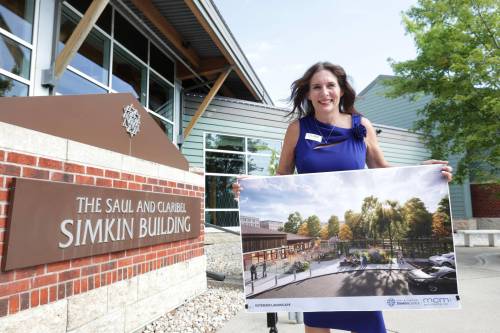
Construction on a new wing of the Saul and Claribel Simkin Centre is scheduled to begin this fall, it was announced Monday.

The project won’t be complete for at least 22 months, but it’s already being touted as a made-in-Manitoba model for intergenerational community hubs across the country.

“It’s a real good idea to mix the younger generation with the older generation,” said Allan Rutherford, a 79-year-old resident of the 200-bed personal care home in Linden Ridge.

Read
Monday, Aug. 17, 2026

Paralyzed foster girl has system under a microscope

Chris Kitching 6 minute read Preview

Paralyzed foster girl has system under a microscope

Chris Kitching 6 minute read Yesterday at 2:00 AM CDT

An internal investigation by Manitoba’s Families Department is nearly complete in the case of a six-year-old girl who is paralyzed after being assaulted by her foster mother in Winnipeg.

The review by child-welfare officials is intended to prevent similar incidents, but it’s unlikely the public will learn the findings or recommendations.

“We’re working closely with the (child and family services) authority to make sure that every recommendation is taken seriously and implemented,” Families Minister Nahanni Fontaine said Monday.

“They’re important (investigations) because they help us identify what went wrong so we can make those changes to ensure something like this tragedy never happens again.”

Read
Yesterday at 2:00 AM CDT

Close to 5,000 net new health-care workers added since 2023 election, province says

Chris Kitching 7 minute read Preview

Close to 5,000 net new health-care workers added since 2023 election, province says

Chris Kitching 7 minute read Updated: Yesterday at 6:43 PM CDT

More doctors and nurses are working in Manitoba than ever before but health-care challenges remain, Premier Wab Kinew says.

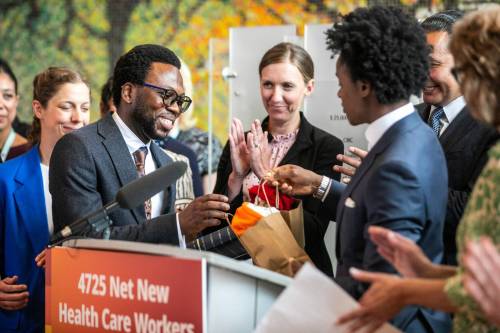
The province has added 4,725 net new health-care workers to the provincial system since the NDP won the October 2023 election, Kinew told reporters Tuesday.

The government’s total includes 370 doctors, 1,464 nurses, 2,152 health-care aides and 607 allied health professionals, a group that includes physiotherapists, dietitians, paramedics, medical lab technologists and others.

Kinew said more doctors and nurses are working in Manitoba than ever before.

Read
Updated: Yesterday at 6:43 PM CDT

Pharmacist who failed to disclose addiction, couldn’t account for ‘staggering’ amount of drugs fined $100K by disciplinary panel

Scott Billeck 4 minute read Preview

Pharmacist who failed to disclose addiction, couldn’t account for ‘staggering’ amount of drugs fined $100K by disciplinary panel

Scott Billeck 4 minute read Yesterday at 12:50 PM CDT

A June 9 disciplinary decision found more than 39,000 doses went unaccounted for while Glen Pauch, who worked at a Portage la Prairie pharmacy, was consuming drugs and improperly dispensing controlled substances — including opioids oxycodone and hydromorphone, and Concerta, a stimulant prescribed for ADHD — to 11 patients.

Read
Yesterday at 12:50 PM CDT

Dream season for Ponder who has yet to miss a cut on PGA Tour Americas

Mike McIntyre 6 minute read Preview

Dream season for Ponder who has yet to miss a cut on PGA Tour Americas

Mike McIntyre 6 minute read Yesterday at 8:13 PM CDT

He may not be a household name to average golf fans just yet, but that’s likely about to change rather quickly.

And local lovers of the sport might want to hurry down to Elmhurst this week to catch a glimpse of Thomas Ponder before he’s off to play where the grass is even greener. Or, at the very least, where the paycheques are much bigger.

Ponder enters this year’s Manitoba Open atop the PGA Tour Americas points list and is a virtual lock to, at the very least, earn promotion to the Korn Ferry Tour for 2027, which is awarded to the top 10 finishers.

A jump directly to the PGA Tour — the way recent Manitoba Open winners such as Hayden Springer and Johnny Keefer, and other competitors such as Neal Shipley and Michael Brennan, have made — wouldn’t be a huge surprise, either.

Read
Yesterday at 8:13 PM CDT