

Lost Boy going home
Former child soldier returning to South Sudan to see family, find closure

Advertisement
Read this article for free:
or
Already have an account? Log in here »
To continue reading, please subscribe:

Digital Subscription
One year of digital access for only $205*
- Enjoy unlimited reading on winnipegfreepress.com
- Read the E-Edition, our digital replica newspaper
- Access News Break, our award-winning app
- Play interactive puzzles
*First annual payment billed as $205.00 + GST for one year. This annual subscription will automatically renew at $233.00 + GST every 52 weeks (10% off the regular annual price of $259.35). Offer available to new and qualified returning subscribers only. Cancel any time.
To continue reading, please subscribe:
Add Free Press access to your Brandon Sun subscription for only an additional
$1 for the first 4 weeks*
- Enjoy unlimited reading on winnipegfreepress.com
- Read the E-Edition, our digital replica newspaper
- Access News Break, our award-winning app
- Play interactive puzzles
*Your next Brandon Sun subscription payment will increase by $1.00 and you will be charged $17.95 plus GST for four weeks. After four weeks, your payment will increase to $24.95 plus GST every four weeks.
Read unlimited articles for free today:
or
Already have an account? Log in here »
Hey there, time traveller!
This article was published 29/11/2013 (4674 days ago), so information in it may no longer be current.
As a child, the Lost Boy left his village in southern Sudan and walked for weeks to safety in Ethiopia.
Now a grown man, Winnipeg’s Reuben Garang is going home for the first time in mid-December.
“I’ve been thinking about this for a long time,” said Garang, a Christian minister. “The voice of my mother keeps echoing back to me.”
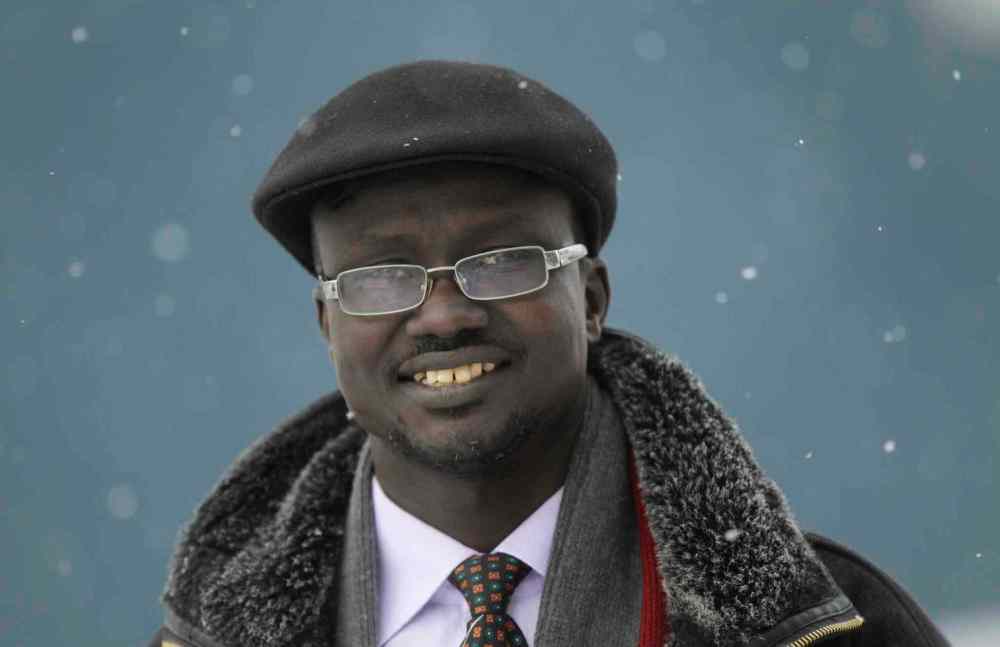
Garang leaves Winnipeg Dec. 15 and flies to Belgium then Uganda where he’ll board a bus for the 21/2-day road trip that may take longer but he doesn’t mind.
“It’s a beautiful country.”
He’ll be part of South Sudan’s annual homecoming migration of people returning to their villages for the festive season.
“Christmas is a huge thing,” he said.
The main event? Wrestling.
“It’s clan by clan and draws a crowd.”
He has four kids of his own, just completed a master’s degree in development practice and sustainability and felt he had to go back so he can get on with his life.
Garang, 41, is from Twic, a village in what is now South Sudan. The country of eight million gained its independence from Sudan two years ago in a referendum following decades of civil war that killed more than two million people and displaced millions more.
“All these years, I’m thinking in my bones, in my blood, in my mind that my village is somewhere.”
He’s being pulled back there by many forces.
“Although my parents died, I still want to sit by their graves and talk to them.”
A few years ago, his 10-year-old daughter started asking him about his childhood and what happened to his parents.
” ‘When did you graduate?’ I was 30. That doesn’t make sense to her at all.”
She asked what happened to his parents. “I was afraid to tell her, so I said ‘They’re lost.’ “
That didn’t make sense to her either: ” ‘They don’t have phones? Are they lost in a forest? You have to find them.’ “
His daughter now knows about his childhood, said Garang, who is going back to see siblings and cousins and to find closure.
He remembers his village was once a vibrant, tight-knit farming community.
“People were living closely — it was so full of life.”
Not anymore. Much of it was destroyed and whole families killed, he said. The Arabic-speaking government of Sudan based in the north was trying to wipe out the southern Sudanese, bombing and raiding villages, he said.
“In a village, if you’re a boy, they will kill you.”
Boys fled their villages by the thousands and headed for refugee camps in neighbouring countries, he said. He didn’t know exactly where he was going or where he’d end up, he was just told, “Go the direction where the sun comes from,” he said. “You don’t know what it looks like, what kind of food will be there — are you going to die there?”
After the long, exhausting walk to a refugee camp in Ethiopia, his journey wasn’t over. He and the other boys who were big enough to hold an AK-47 were recruited by the rebels trying to gain independence from the Sudanese government.
“It was difficult.” Garang remembers being separated from boys in his village and not understanding the language of the child soldiers in his unit. He doesn’t offer any specific recollections of fighting.

“There are so many bad memories that live with you. You try but they don’t go away. The trauma doesn’t go away,” he said. “The good part is it makes you a global citizen — you’re concerned with any situation where there’s war. You know exactly what it is — you know how children suffer and mothers suffer.”
Garang said 300 Lost Boys came to Winnipeg. Some may be quietly suffering from post-traumatic stress disorder, he said. They’ve settled here, studied, become successful and now are facing their troubled past, he said.
“What has helped me is talking,” he said.
“One person’s life story is a lesson,” he said. “It’s a good time for me to let people know I’m going back to my village for the first time.”
carol.sanders@freepress.mb.ca
Carol Sanders
Legislature reporter
Carol Sanders is a reporter at the Free Press legislature bureau. The former general assignment reporter and copy editor joined the paper in 1997. Read more about Carol.
Every piece of reporting Carol produces is reviewed by an editing team before it is posted online or published in print — part of the Free Press‘s tradition, since 1872, of producing reliable independent journalism. Read more about Free Press’s history and mandate, and learn how our newsroom operates.
Our newsroom depends on a growing audience of readers to power our journalism. If you are not a paid reader, please consider becoming a subscriber.
Our newsroom depends on its audience of readers to power our journalism. Thank you for your support.
Carol Sanders
Legislature reporter
Carol Sanders is a reporter at the Free Press legislature bureau. The former general assignment reporter and copy editor joined the paper in 1997. Read more about Carol.
Every piece of reporting Carol produces is reviewed by an editing team before it is posted online or published in print — part of the Free Press‘s tradition, since 1872, of producing reliable independent journalism. Read more about Free Press’s history and mandate, and learn how our newsroom operates.
Our newsroom depends on a growing audience of readers to power our journalism. If you are not a paid reader, please consider becoming a subscriber.
Our newsroom depends on its audience of readers to power our journalism. Thank you for your support.
Advertisement Advertise With Us
Advertisement Advertise With Us