

Display a fascinating look at Winnipeg’s beginnings

Advertisement
Read this article for free:
or
Already have an account? Log in here »
To continue reading, please subscribe:
Monthly Digital Subscription
$0 for the first 4 weeks*
- Enjoy unlimited reading on winnipegfreepress.com
- Read the E-Edition, our digital replica newspaper
- Access News Break, our award-winning app
- Play interactive puzzles
*No charge for 4 weeks then price increases to the regular rate of $19.95 plus GST every four weeks. Offer available to new and qualified returning subscribers only. Cancel any time.
Monthly Digital Subscription
$4.99/week*
- Enjoy unlimited reading on winnipegfreepress.com
- Read the E-Edition, our digital replica newspaper
- Access News Break, our award-winning app
- Play interactive puzzles
*Billed as $19.95 plus GST every four weeks. Cancel any time.
To continue reading, please subscribe:
Add Free Press access to your Brandon Sun subscription for only an additional
$1 for the first 4 weeks*
*Your next subscription payment will increase by $1.00 and you will be charged $16.99 plus GST for four weeks. After four weeks, your payment will increase to $23.99 plus GST every four weeks.
Read unlimited articles for free today:
or
Already have an account? Log in here »
Hey there, time traveller!
This article was published 17/01/2014 (4368 days ago), so information in it may no longer be current.
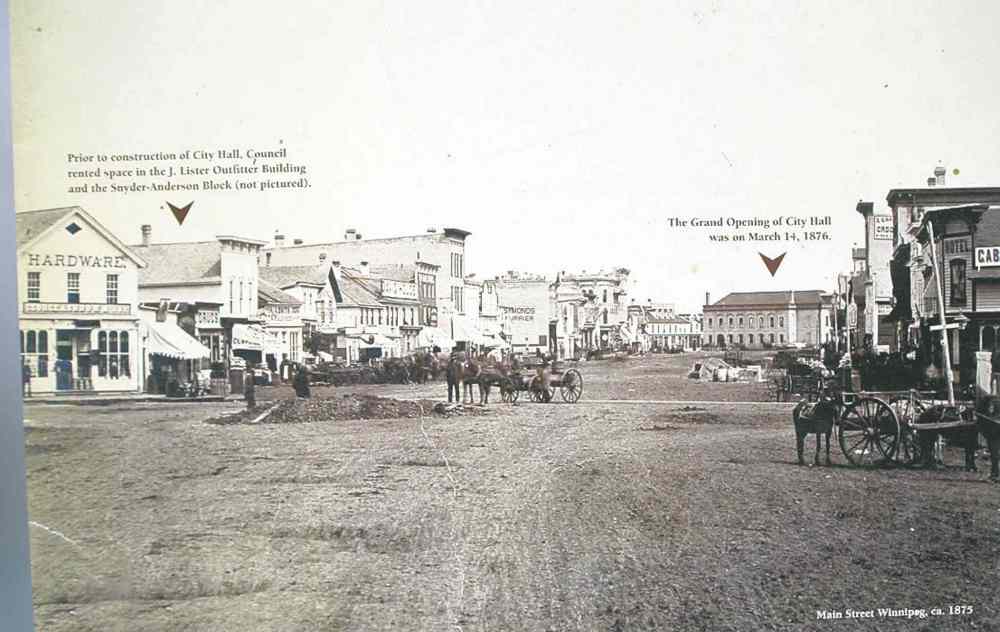
Go figure that a couple of city politicians looking at a 140-year-old photo of Main Street wouldn’t be zeroing in on the scenery.
No, they’ve already spotted something far more familiar to the 21st century.
“See those there?” said Sam Katz, Winnipeg’s current mayor, pointing at the black-and-white photo of Winnipeg’s main drag, circa 1874. “Potholes.”
Sure enough, the dirt street is pockmarked. It’s also lined with teams of horses and businesses that have long ago vanished. Proof, according to Katz, that “a lot of things have changed, but a lot of things haven’t changed.”
The photos will be part of a display in the mayor’s foyer at city hall, beginning today and lasting until the end of the month. It will pay tribute to the 140th anniversary of the city’s inaugural council meeting, held Jan. 19, 1874, in a rented space on the second floor of the J. Lister Outfitter building.
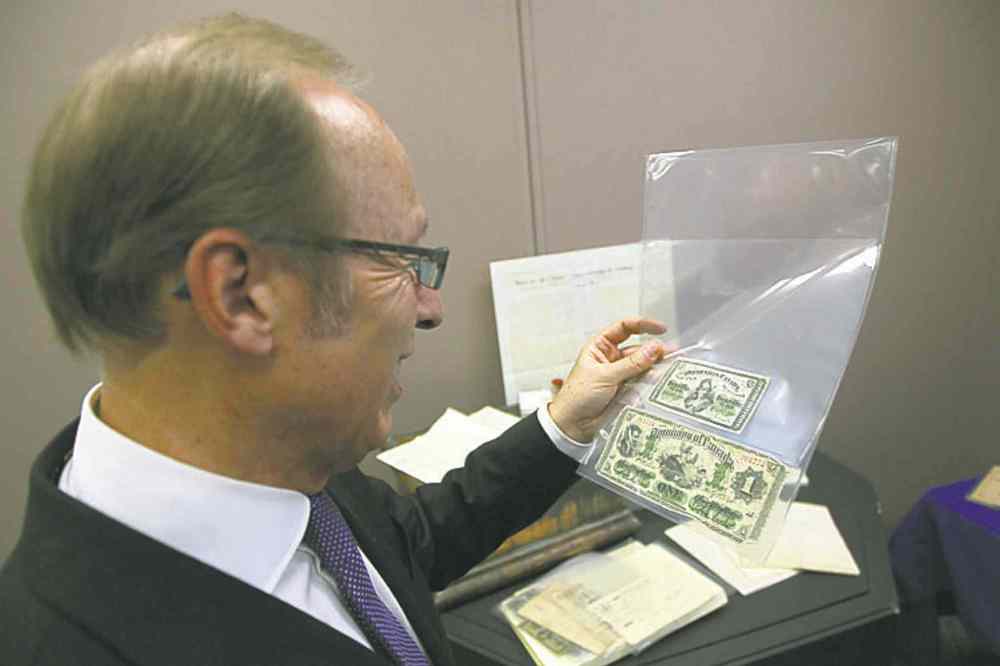
Katz and deputy mayor Justin Swandel got a sneak peek of the display items Thursday. They include time-capsule items — coins, newspapers, voters’ lists, photos — along with records and council correspondence from the initial meetings.
Swandel couldn’t resist joking, while leafing through the thick book of minutes dating back to 1874: “Is Harvey (Smith) in there?”
Coun. Smith is the 77-year-old fixture of Winnipeg’s current city hall. But even Smith was first elected more a century after Winnipeg’s first mayor, Francis Cornish, convened the first meeting of 12 city councillors.
They were elected from a voters’ roll of just 398 of the city’s 1,869 residents. Back then, voters had to be property owners, British citizens and male.
Katz was particularly taken by a letter to council submitted by prominent city businessman William Ashdown that read: “Gentlemen, I would beg leave to draw your attention to the fact that there is a dead horse which will be soon getting very offensive, lying a short distance from the Methodist Church in the North Ward. Hoping it will soon be removed.”
Said Katz: “Come on, that’s absolutely amazing!”
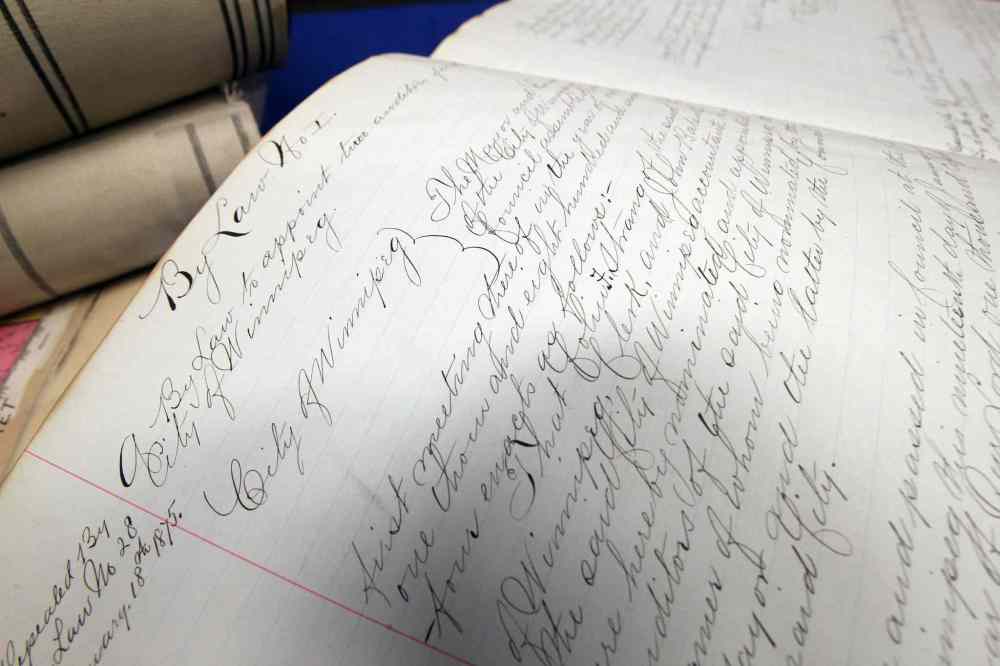
Even more impressive, agreed the mayor and his deputy, are the elaborate handwritten minutes of clerk Alexander McDougal Brown. The records are meticulous and stood the test of both technology and time.
“It’s remarkable,” Katz said, noting, “We could be paper-free today. Everything’s recorded. If you have a laptop or an iPad, you can get everything from city hall. Paper is the backup if everything else breaks down.”
City archivist Jody Baltessen said the display is designed to give curious visitors a glimpse of how the city was formed, and by whom.
After all, the surnames of the first council are littered with names that now grace city street signs: Logan, Ashdown, Higgins.
“I think if you have a sense of history, you can better understand the nature of your own city,” Baltessen said. “I think it’s an eye-opener to see we had such humble beginnings.”
There are stories behind the photos. For example, the collection of portraits of the first city council also includes administrators. But two of the photos were covered with white-out.
One was of a councillor who resigned mid-term. The other was of former police chief John Ingram.
Why? “He wasn’t applying the laws regarding houses of ill repute,” Baltessen explained. “He was found in one of them.”
There is a pamphlet entitled Winnipeg as it was in 1874, which archivists describe as an unofficial travel guide describing available services — education, fire and police, businesses.
“It’s a real interesting snapshot of what it was like,” Baltessen said.
The is a section entitled Fashion and Society, which opens, “The streets at all hours of the day present a curious mix of civilization and savagery… “
Indeed, Winnipeg in 1874 was a frontier city. It was before the railroad opened up the West and catapulted the capital into Canada’s major travel hub.
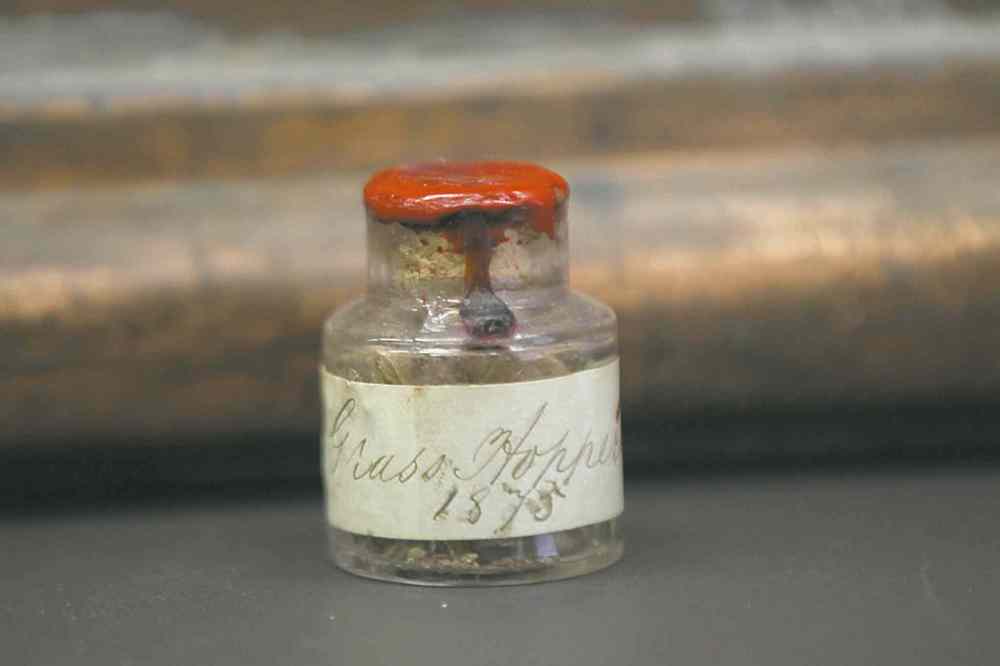
Consider that one of the major artifacts from that era was grasshoppers. The insects were ravaging wheat crops at the time, and so the 1874 capsule includes a small glass specimen jar of the critters, sealed with red wax.
Of the 21 photos in the time capsule, three are of grasshoppers. And one of Louis Riel’s cabinet.

There are also “council communications,” which is essentially a collection of letters written by citizens to their city council, including their complaints, their ideas, their opinions, their petitions.
Said Baltessen: “It’s 100 years of people of the city talking to their council. It’s a real social history.”
So is the health inspector’s report of 1874, which requests “steps be taken to restrain pigs from running at large, as he finds that when water is pumped out of cellars and after a shower of rain, these troublesome animals root, roll and bury themselves in the drains, this producing the worst kind of stagnant waters.”
Oh, and don’t forget the potholes.
randy.turner@freepress.mb.ca
Randy Turner
Reporter
Randy Turner spent much of his journalistic career on the road. A lot of roads. Dirt roads, snow-packed roads, U.S. interstates and foreign highways. In other words, he got a lot of kilometres on the odometer, if you know what we mean.
Our newsroom depends on a growing audience of readers to power our journalism. If you are not a paid reader, please consider becoming a subscriber.
Our newsroom depends on its audience of readers to power our journalism. Thank you for your support.
Randy Turner
Reporter
Randy Turner spent much of his journalistic career on the road. A lot of roads. Dirt roads, snow-packed roads, U.S. interstates and foreign highways. In other words, he got a lot of kilometres on the odometer, if you know what we mean.
Our newsroom depends on a growing audience of readers to power our journalism. If you are not a paid reader, please consider becoming a subscriber.
Our newsroom depends on its audience of readers to power our journalism. Thank you for your support.
Advertisement Advertise With Us
Advertisement Advertise With Us