Oscars underline the ascendancy of celebrities over heroes
Advertisement
Read this article for free:
or
Already have an account? Log in here »
To continue reading, please subscribe:

Digital Subscription
One year of digital access for only $205*
- Enjoy unlimited reading on winnipegfreepress.com
- Read the E-Edition, our digital replica newspaper
- Access News Break, our award-winning app
- Play interactive puzzles
*First annual payment billed as $205.00 + GST for one year. This annual subscription will automatically renew at $233.00 + GST every 52 weeks (10% off the regular annual price of $259.35). Offer available to new and qualified returning subscribers only. Cancel any time.
To continue reading, please subscribe:
Add Free Press access to your Brandon Sun subscription for only an additional
$1 for the first 4 weeks*
- Enjoy unlimited reading on winnipegfreepress.com
- Read the E-Edition, our digital replica newspaper
- Access News Break, our award-winning app
- Play interactive puzzles
*Your next Brandon Sun subscription payment will increase by $1.00 and you will be charged $17.95 plus GST for four weeks. After four weeks, your payment will increase to $24.95 plus GST every four weeks.
Read unlimited articles for free today:
or
Already have an account? Log in here »
Hey there, time traveller!
This article was published 01/03/2014 (4574 days ago), so information in it may no longer be current.
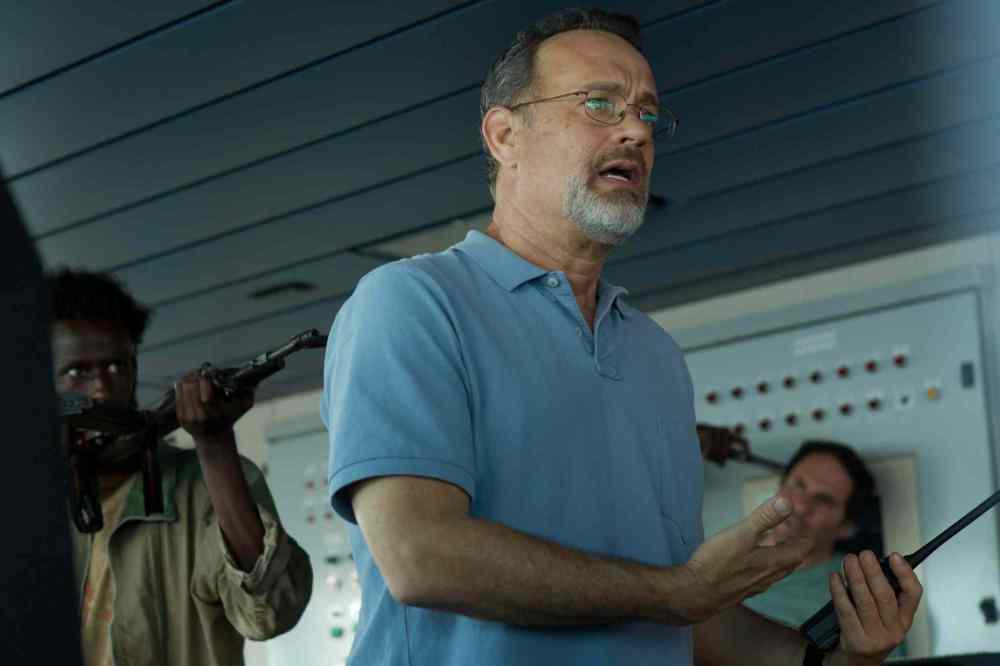
Is Tom Hanks more or less worthy of our admiration than the man he portrays in Captain Phillips?
Hanks will head down the red carpet this weekend with his film up for six Academy Awards, including best picture. He’s already a two-time Oscar winner and the youngest recipient of the American Film Institute’s Life Achievement Award. Astronomers named an asteroid in his honor after Apollo 13. The U.S. Army Ranger Hall of Fame inducted him as an honorary member after Saving Private Ryan. Polls peg him as the most likable man in Hollywood and the most trusted man in America.
Richard Phillips, meanwhile, has been hailed as a hero and honoured at the White House — and immortalized by Hanks on film. But questions linger about how heroic he actually was when Somali pirates hijacked his container ship and held him hostage in April 2009. While the movie portrays him as a modest merchant mariner who kept his crew safe and remained quick thinking throughout the ordeal, some real-life crewmates describe him as “arrogant “ and accuse him of ignoring warnings and taking unnecessary risks. That scene in the movie where he offers himself to the pirates? (“If you’re gonna shoot somebody, shoot me!”) They say it didn’t happen.
So do we throw our allegiances behind the celebrity or the potentially flawed hero? There was a time when we didn’t have to choose, when American celebrities and heroes tended to be one and the same. People became famous for great deeds. Think George Washington, Thomas Edison, Amelia Earhart, Neil Armstrong. But celebrity and heroism went their separate ways some time ago. It’s easier to obtain celebrity status, harder to be a hero. And when celebrity worship goes up against hero worship, the celebrities usually win.
That will be true at this year’s Oscars. The theme of the show is “a celebration of movie heroes,” the producers say. Yet even as movie stars honour worthy heroes, the spotlight inevitably shines on the celebrities themselves.
I witnessed, and at times enthusiastically abetted, the multiple G-force rise of celebrity culture during my 23 years as a staffer and eventually managing editor at People magazine. People published its first issue on March 4, 1974 — 40 years ago this week — and I joined as an overworked junior writer a few weeks later.
The cover of that first issue had an Old Hollywood look. It featured Mia Farrow, dressed in gauzy white, her hair in pincurls, portraying Daisy Buchanan in The Great Gatsby. It was remarkably similar to how Farrow’s mother, actress Maureen O’Sullivan, had appeared on the cover of Film Pictorial in 1933.
But we quickly learned that American culture’s fascination with celebrities had changed since Hollywood’s golden era. Readers were more interested in Mia Farrow the woman, mother and personality than in Mia Farrow the actress. That first issue of People didn’t even sell enough copies to make its advertising rate-base guarantee, though the article inside, written by F. Scott Fitzgerald’s daughter, included the salacious tidbit that Farrow “became pregnant during the production (which would bring her a fourth child under the age of four), and I heard there was some talk of an abortion.” Readers were assured that for Farrow, “that idea would have been unthinkable.”
What the public felt entitled to know about the lives of famous people, and what the news media felt entitled to report, expanded in the wake of Watergate. Gerald and Betty Ford took up residence in the White House that August, and a month later the new first lady received a breast cancer diagnosis. She spoke frankly about it to the news media, inviting photographers to take pictures of her in her hospital room, wearing a housecoat. “Radical mastectomy,” People wrote in October 1974. “Suddenly, in the aftermath of Betty Ford’s surgery, millions of Americans knew what it meant.”
Ford rewrote the script not just for first ladies but for all public figures. In a 1975 interview with 60 Minutes, she said she wouldn’t be surprised or especially concerned to hear that her daughter, then 18, was having premarital sex. During a televised White House tour, she noted that she and the president shared the same bed, and she told McCall’s that she slept with her husband “as often as possible.” Eventually, she would talk about her alcohol and painkiller addictions. For Ford, private problems were nothing to be embarrassed about. Opening up about them was honest, healthy, potentially inspiring.
For the news media, it was a short leap from covering Ford’s cooperative candour to bringing more private lives into public view. If celebrities didn’t want their problems turned into public fodder, too bad. It was the duty of the press to be accurate about the lives of the rich and famous. And readers demanded to be inspired and moved, but also titillated and amused.
As editor of People, I struggled to balance the magazine’s dual mission: telling the stories of extraordinary people and the stories of ordinary people who did extraordinary things. Covers showcasing bona fide heroes — say, the first responders to the 1989 San Francisco earthquake or young mothers in the military who were mobilized during the Persian Gulf War — languished on newsstands. We had to rely on celebrity covers to make our circulation goals. And so I oversaw, in consecutive years, the anointment of Sean Connery, Tom Cruise, Patrick Swayze, Nick Nolte, Brad Pitt, Denzel Washington and George Clooney as the sexiest men alive. I published a complete guide to the O.J. Simpson trial and photographs of a nearly naked Demi Moore.
Yes, we admire heroes, but we are mesmerized by celebrities. When Vaclav Havel met Paul Newman in 1990, the revered Czech leader marvelled that the actor was “such a big legend that I didn’t believe he physically exists.”
It can be thrilling to be near celebrity’s white-hot flame — even if we don’t always know exactly why it’s thrilling. On separate occasions, I interviewed two of the most famous women in the world: Elizabeth Taylor and Princess Diana. I still remember nervously dropping my tape recorder on the floor of Taylor’s Bel Air home. Both encounters were fascinating. In the end, though, the strongest impression both women left me with was of their fragility.
Learning about the frailties of movie stars, rock stars, sports superstars and royals can humanize them. We gain a seeming intimacy that makes us comfortable judging them. When I first interviewed Hillary Clinton, in 1992, I brought along the newest issue of People. Princess Diana was on the cover, with a story about her troubled marriage. “Oh, I knew she married too young!” Clinton exclaimed.
But the tell-all era has been harder on heroes than on celebrities. We have less tolerance for flaws in our heroes. It is as if we measure them by entertainment values. The story lines we assign to them want excitement and triumph, but do not allow for the inconsistencies and failings the Greeks knew we all have. We struggle to reconcile the shining image of Nelson Mandela with his quick temper, multiple marriages and often-discomforting political alliances. The flaw the public is least likely to forgive is lack of candor; goodbye, Lance Armstrong.
And so we end up with a scarcity of universally accepted public heroes amid an overabundance of celebrities.
At the same time, the Internet and the constantly churning news cycle have eliminated the need for media gatekeepers to determine who will be made famous. There is a thriving international marketplace for proliferating celebrities. And high demand has generated even higher supply, along with a kind of Gresham’s law of fame: Just as bad money drives out the good, celebrities are crowding out heroes.
To visualize this phenomenon, go to Google Ngram and plot the yearly count of the words “hero” and “celebrity” in books published since 1970. The word “hero” is on a steady downslope, while “celebrity” is rising rapidly.
You can also see the result of this trend on the landing page of People’s online archive of its covers. The category “real people” is dominated by crime victims and reality-show stars. Finding more stirringly heroic real people, such as captain Chesley Sullenberger, the pilot of the US Airways flight that safely crash-landed in the Hudson River, requires searching the database.
Or check out the Pew Research Center’s 2007 survey of millennials. When asked whom they most admire, a heartening number of them mentioned people close to them. Yet they were almost twice as likely to cite entertainers as they were to mention political figures. And compared with older cohorts, they were more likely to have entertainers and much less likely to have political, religious or business leaders at the top of the list.
I used to hear a variation on the most-admired question when I attended focus groups to find out what People readers were interested in. “Who are your heroes?” the moderators would ask as they warmed up the groups. But about a decade ago, they stopped asking about heroes. “They can’t think of any,” one moderator explained to me.
Perhaps that’s because today’s definition of “heroes” is drawn so narrowly. To find them, we tend to default to the military or superheroes, or to great figures in history.
After I retired from People, I chose to write about a historical hero: William Clark of the Lewis and Clark expedition. He was appealing, in part, because he was unencumbered by publicity agents or smoking-gun emails. Several of my friends among recovering weekly magazine editors have done the same, including Walter Isaacson of Time (Benjamin Franklin, Albert Einstein), Jim Gaines of Time (Johann Sebastian Bach, Frederick the Great) and Evan Thomas of Newsweek (Dwight Eisenhower, John Paul Jones).
But we could all do more to identify the heroes living among us. They are our founders and builders. They lead us forward. They encourage us to stop thinking only about ourselves and our narrow interests and to think about a larger purpose.

Many celebrities do take on worthy causes. As the joke goes, a movie star without a cause is like a woodpecker without a tree. But celebrities do not typically help us to better understand ourselves and our world. They are more likely to reinforce our preconceptions than to lead us to new ideas.
So as we settle in to watch the Academy Awards on Sunday night, we can admire the parade of celebrities on the red carpet with a shiver of guilty pleasure. But it’s also worth remembering that, as John Milton wrote about Lycidas, “Fame is no plant that grows on mortal soil.” We’ll need to look elsewhere for people who help us bridge the gap between who we are and who we want to be.
Langdon Jones was the managing editor of People magazine from 1989 to 1997 and is the author of The Essential Lewis and Clark and William Clark and the Shaping of the West.
Related Articles
Trending that caught Doug's eye... Odd Oscar moments
Advertisement Advertise With Us
Advertisement Advertise With Us