

The fourth R: Improving reading, writing, arithmetic
To improve reading, writing and arithmetic, Lakeshore division decided -- with much success -- to be revolutionary

Advertisement
Read this article for free:
or
Already have an account? Log in here »
To continue reading, please subscribe:
Monthly Digital Subscription
$1 per week for 24 weeks*
- Enjoy unlimited reading on winnipegfreepress.com
- Read the E-Edition, our digital replica newspaper
- Access News Break, our award-winning app
- Play interactive puzzles
*Billed as $4.00 plus GST every four weeks. After 24 weeks, price increases to the regular rate of $19.95 plus GST every four weeks. Offer available to new and qualified returning subscribers only. Cancel any time.
Monthly Digital Subscription
$4.99/week*
- Enjoy unlimited reading on winnipegfreepress.com
- Read the E-Edition, our digital replica newspaper
- Access News Break, our award-winning app
- Play interactive puzzles
*Billed as $19.95 plus GST every four weeks. Cancel any time.
To continue reading, please subscribe:
Add Free Press access to your Brandon Sun subscription for only an additional
$1 for the first 4 weeks*
*Your next subscription payment will increase by $1.00 and you will be charged $16.99 plus GST for four weeks. After four weeks, your payment will increase to $23.99 plus GST every four weeks.
Read unlimited articles for free today:
or
Already have an account? Log in here »
Hey there, time traveller!
This article was published 03/05/2014 (4365 days ago), so information in it may no longer be current.
LUNDAR — Can you imagine a school of 1,195 students the size of Prince Edward Island?
A school in which the teachers all know your name, and know your needs and know your strengths and meet regularly to stay on top of your education?
A school in which teachers aren’t afraid to try something new, a school in which it isn’t done the way it’s always been done?
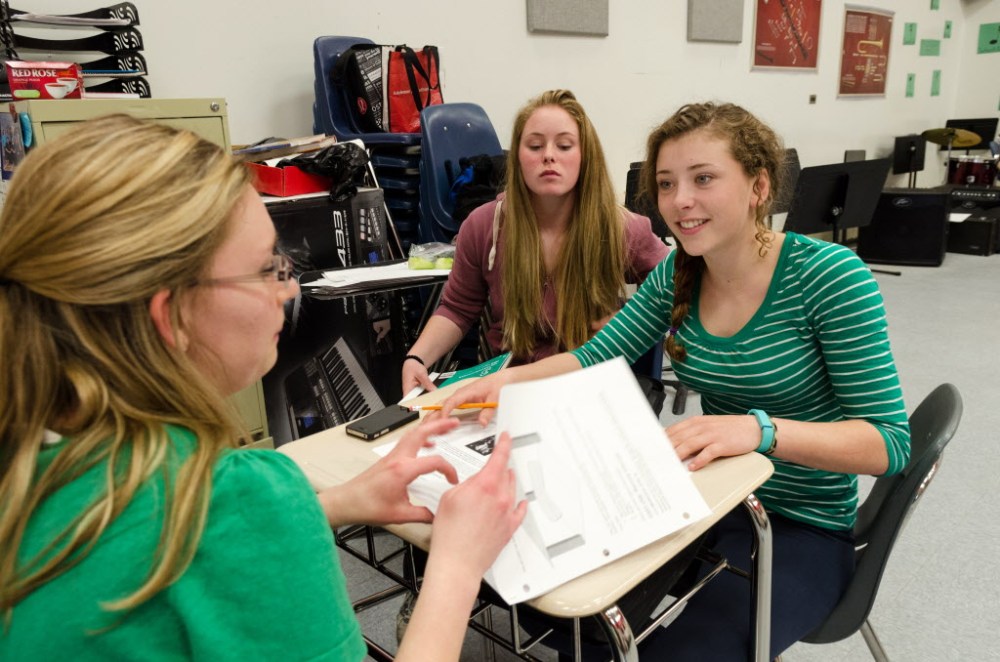
A school in which the high school graduation rate went from 50 per cent five years ago to 92 per cent last June, and has averaged in the high 70s over those five years?
“The biggest thing we’ve looked at is the needs of the students,” said Janet Martell, superintendent of the Lakeshore School Division and architect of reimagining education in Lakeshore.
The province’s fifth-smallest school division is strung out along Highway 6, spread out over an area the size of P.E.I,, but the division treats its entire student body as though all those children, from Moosehorn and Lake Manitoba First Nation to Lundar, from Fisher Branch and Eriksdale and Ashern, over to Inwood and two Hutterite Colonies, as though they all attend one school — sharing the resources, sharing the teachers, each as vital as everyone else.
“We, in fact, have a school of 1,200 students,” declared assistant superintendent Leanne Peters.
Five years ago, in conjunction with the province and Brandon University, Lakeshore launched a “student success initiative” aimed at finding new ways to meet students’ education needs — a higher graduation rate being the ambitious overt symbol.
Then came a cold and snowy night on Dec. 17, 2012, when more than half the division’s 100 teachers showed up to hear Martell challenge them to reimagine the education system — to take risks on innovative ideas that could fail, to put classrooms and subjects together in multi-teacher settings, to undertake large group projects that covered the gamut of curricula.
Meanwhile, “We looked at early-warning-system data,” said Martell.
Weekly in each school, monthly across the division, teachers gather to talk about their students — red flags go up over attendance and absenteeism, behaviour, reading and numeracy weaknesses.
“Two or three weeks in, based on the data, we see students struggling and pull them out” for special attention, Martell said. “They discuss how the students are doing — before the student considers dropping out, they’re on top of it.”
And where there are issues, Lakeshore sends in help, such as success coaches — they’re teachers able to float from class to class, maybe working with a handful of kids struggling with math, then on to another class to help readers, even working over lunch with high achievers looking for an extra challenge in pre-calculus.
“We stopped looking at ourselves individually,” said Fisher Branch Collegiate principal Shaun Lindal. Her students had a higher graduation rate than students at Lundar School or Ashern Central School, but Lindal had no problem seeing resources concentrated where they were needed most.
Prior to that, “We didn’t do a lot of sharing,” she said.
“It really is kind of amazing,” said Ashern Central principal Neil MacNeil.
If a high school student has a reading problem, there’s nothing to be gained by blaming elementary school teachers and shrugging off any responsibility, MacNeil said. “We need to begin working with those kids as soon as we get them. Every teacher, it’s their responsibility to inculcate those skills.”
Lundar success coach Darlene Willetts may work with kids on their lunch hour, she may also go to their homes and work with the family.
That includes Lakeshore students from Lake Manitoba First Nation, where Willetts starts with a meeting in the band hall, then follows up with arranged home visits.
“We do home visits, in conjunction with the community liaison person,” she explained. “We have coffee, we visit and make connections. We want to problem-solve together.”
School board chairman Kris Vigfusson said trustees bought into the plan and supported it by providing teachers with resources. Though he was initially skeptical, Vigfusson enthused, “These teachers blew me away with how they interact with each other.”
Said MacNeil: “We didn’t have social workers in the division, yet we have a crying need for social workers; now we have two.”
Peters said each school was asked to identify what it wanted to fix, then teachers formed into small research groups to figure out how to do it.
In Ashern, she said, Grade 9 students from four or five smaller communities felt isolated starting high school, so the language arts and social studies teachers put all their kids together into one large group.
It’s a given that many young teachers in rural Manitoba have their resumés in at all the city school divisions.
Martell pointed out Lakeshore has bucked the rural trend of regular teacher turnover, younger teachers and specialists staying in the division thanks largely to the professional development support and the autonomy teachers enjoy along Highway 6 — “This year, I hired one teacher,” said Martell.
Lundar principal Susan Hayward said she’s been able to recruit and retain a music teacher, a skill in enormous demand. “She has a five-year plan. She can grow something here,” Hayward said.
Peters cited 77-student K-12 Inwood School, which put language arts, technology and art together for a group project: “They used Claymation to demonstrate the outcomes the teacher wanted,” she said.
Martell emphasized teachers get a lunch hour every day, even though they may work with kids during the students’ lunch period, and no one’s required to work nights and weekends or pressured to do anything involuntarily — Lakeshore follows its collective agreement while pursuing innovation, she said.
You can’t succeed by putting children and teachers in boxes and labelling them, Martell said.

“We know a lot more about what motivates people — it’s autonomy,” said MacNeil.
Lakeshore even asks students what they want.
That’s why schools such as Lundar have transformed a stereotypical library into a learning commons with comfortable seating and computer terminals. They’re trying out low seating, high seating and swivelling seating.
MacNeil said students told him they didn’t like the colour scheme or the aged school logos on the walls of the multipurpose room in Ashern, so out came the paint. “We did that together one spring break, the kids and I.”
nick.martin@freepress.mb.ca
Nick Martin
Former Free Press reporter Nick Martin, who wrote the monthly suspense column in the books section and was prolific in his standalone reviews of mystery/thriller novels, died Oct. 15 at age 77 while on holiday in Edinburgh, Scotland.
Our newsroom depends on a growing audience of readers to power our journalism. If you are not a paid reader, please consider becoming a subscriber.
Our newsroom depends on its audience of readers to power our journalism. Thank you for your support.
Going against the semester tide
But they can also end up taking fewer courses, though everyone gets enough credits to graduate.
Warren Collegiate and Stonewall Collegiate appear to be the only high schools in Manitoba that don’t use the semester system, although the Department of Education doesn’t track such things.
“Stonewall Collegiate and Warren Collegiate have full-year schedules,” explained Warren Nickerson, in charge of program support for curriculum in the Interlake School Division. “It just never changed — when many schools changed to the semester system in the ’80s, Stonewall and Warren never changed.”
Stonewall and Warren offer eight credits a year — four subjects each day, each subject timetabled every second day. By the end of Grade 12, a student could have 32 credits, with only 30 needed for a provincial diploma.
By contrast, a high school with semesters will have five credits a day for half the year, write two weeks of exams, then start another five courses.
“The folks in the English department said kids read more books — you have classes every second day, drawn out over the whole year,” Nickerson said. “Kids get a minimum of 600 hours (in English language arts over four years).”
Some students on a semester system could get 40 or so credits, Nickerson acknowledged, but how many choose that route?
Students load up on credits in grades 9 and 10, then take spares in 11 and 12, he said: “Your weakest two years are the years when kids should be smart enough cognitively” to take on a heavy load. “They take spares instead. We shouldn’t allow this slack year in Grade12-itis.”
As long as schools meet the requirements, the Department of Education doesn’t track how they do it, said Darrell Gervais, the director of instruction, curriculum and assessment.
A school must meet the number of school and instructional days, have 5.5 hours of classes daily and schedule 110 hours for each credit, Gervais said. “The important thing is the educational outcomes. They can choose how to arrange the schedule to meet students’ needs.”
It appears no rural schools still use the Copernican system, popular in the 1990s — students would take one subject all morning and a second subject all afternoon for 10 or 11 weeks, then start two more daily subjects.
Nick Martin
Former Free Press reporter Nick Martin, who wrote the monthly suspense column in the books section and was prolific in his standalone reviews of mystery/thriller novels, died Oct. 15 at age 77 while on holiday in Edinburgh, Scotland.
Our newsroom depends on a growing audience of readers to power our journalism. If you are not a paid reader, please consider becoming a subscriber.
Our newsroom depends on its audience of readers to power our journalism. Thank you for your support.
Advertisement Advertise With Us
Advertisement Advertise With Us