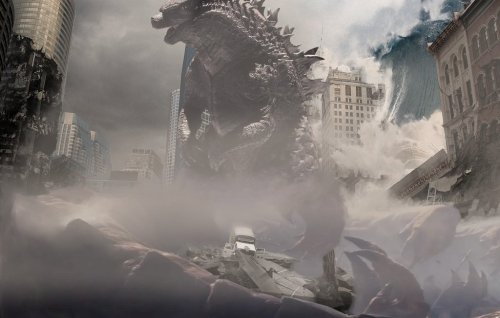
Godzilla returns to save humanity in serious summer spectacle

Advertisement
Read this article for free:
or
Already have an account? Log in here »
To continue reading, please subscribe:

Digital Subscription
One year of digital access for only $205*
- Enjoy unlimited reading on winnipegfreepress.com
- Read the E-Edition, our digital replica newspaper
- Access News Break, our award-winning app
- Play interactive puzzles
*First annual payment billed as $205.00 + GST for one year. This annual subscription will automatically renew at $233.00 + GST every 52 weeks (10% off the regular annual price of $259.35). Offer available to new and qualified returning subscribers only. Cancel any time.
To continue reading, please subscribe:
Add Free Press access to your Brandon Sun subscription for only an additional
$1 for the first 4 weeks*
- Enjoy unlimited reading on winnipegfreepress.com
- Read the E-Edition, our digital replica newspaper
- Access News Break, our award-winning app
- Play interactive puzzles
*Your next Brandon Sun subscription payment will increase by $1.00 and you will be charged $17.95 plus GST for four weeks. After four weeks, your payment will increase to $24.95 plus GST every four weeks.
Read unlimited articles for free today:
or
Already have an account? Log in here »
Hey there, time traveller!
This article was published 16/05/2014 (4486 days ago), so information in it may no longer be current.
Here in the west, there is a good reason we tend to regard the Japanese kaiju (giant monster) movie with tongue in cheek. The genre was permeated with silliness in the 1960s and ’70s with an ever-increasing cast of goofy giant creatures. Remember the Smog Monster? Remember Mechagodzilla? Remember the moth monster Mothra with its two tiny fairy servants?
It is important to remember that the granddaddy of all Japanese kaiju movies, Gojira, was dead serious. Released in 1954, just nine years after atomic bombs were dropped on Hiroshima and Nagasaki, it was a film upfront about its sombre inspiration. Born of nuclear radiation, the monster was a sledgehammer metaphor for the destructive power of nuclear weaponry. Gojira (retitled Godzilla for American audiences) not only devastated cities, it left radiation-burned victims in its radioactive wake.
In claiming Godzilla for its own, Hollywood inevitably got it wrong in its first attempt. Roland Emmerich’s 1998 movie Godzilla hit the ground in a state of giddy idiocy. (Remember Mayor Ebert and his assistant Gene?) But, stupid as it was, the movie was actually a box-office hit, yet it was so critically reviled, sequel plans were eventually scrubbed. It’s safe to say Emmerich’s heart certainly wasn’t in it.
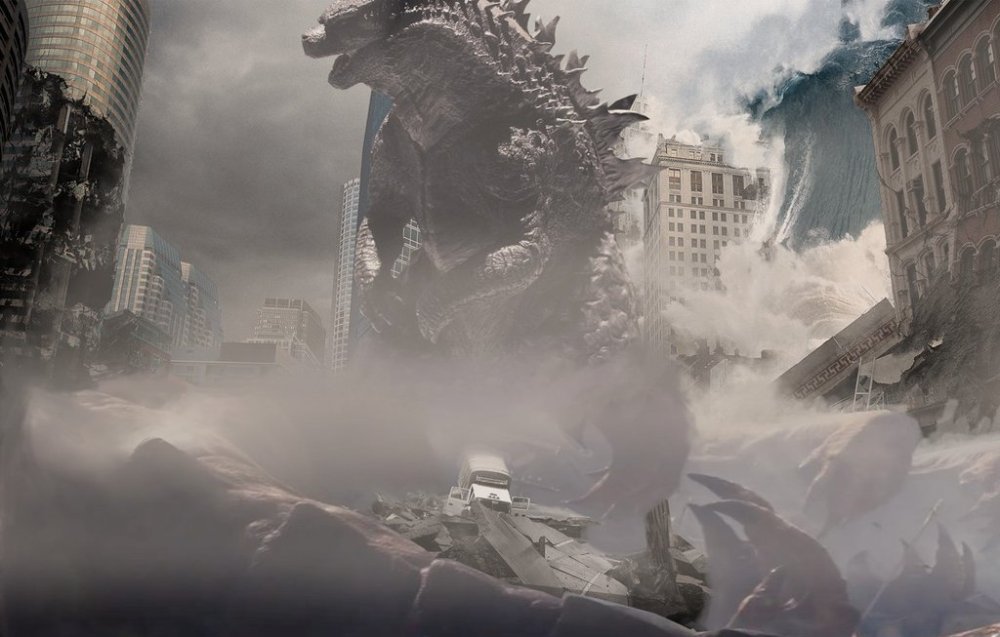
This new Godzilla, directed by Gareth Edwards, at least tries to return the monster to its serious roots. Edwards demonstrated his love of the genre his first time out with his 2010 movie Monsters. It was an indie kaiju movie, of all things, for which the Brit served not only as writer-director, but visual-effects artist.
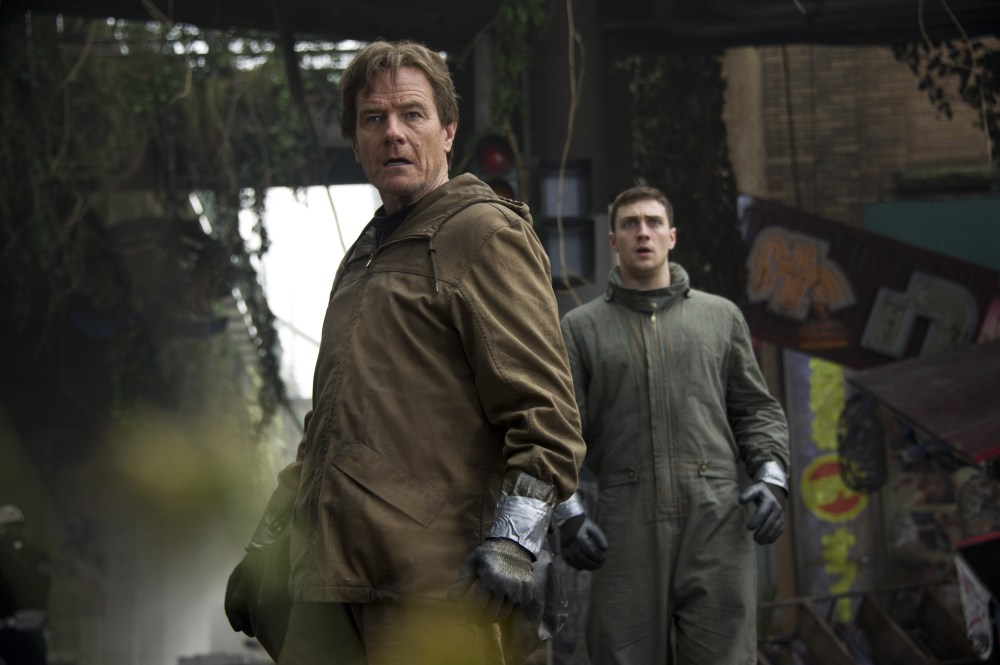
Working from a script by Max Borenstein, Edwards returns to the proper, sober tone with his Godzilla. It begins in Japan at a nuclear facility where an unknown entity causes havoc. In the earth-trembling devastation, the facility’s American honcho Joe Brody (Bryan Cranston, bringing the thespian intensity) loses his wife. Afterwards, he is not content to accept the official explanation that the accident was caused by a mere earthquake. In the intervening 14 years, Joe takes on the demeanour of a crazed conspiracy theorist trying to prove a government coverup while his only son Ford (Aaron Taylor-Johnson) moves on, moves to America, becomes an expert in disarming bombs and starts his own family with devoted wife Elle (Elizabeth Olsen).
When crazy old dad is arrested for trespassing in the ruins of the city that housed that nuclear facility, Ford flies to Japan to try to coax him back stateside. Instead, father and son find themselves back at the nuclear facility only to discover that dad was actually right about the whole coverup thing, a truth hammered home when an enormous winged kaiju makes its presence known.
Ford signs on to join the battle against the creature thanks to the intervention of haunted scientist Dr. Serizawa (Ken Watanabe). (“Serizawa” is the name of the scientist who conquered the creature in the original 1954 film.) It is revealed the creature is one of three known kaiju, and all are on a collision course to the United States, where their union could have apocalyptic consequences for all the world.
The American military — represented by David Strathairn’s cool-headed Admiral Stenz — develops a strategy of bringing the monsters together so they can be nuked. Serizawa’s more holistic approach is to let the creatures slug it out and let the chips fall where they may, a tactic that seems a tad reckless, but will certainly pay off in spectacle for Edwards’ cameras, which almost invariably favour subjective human points of view to the monster mayhem.
As a director, Edwards’ approach is to ground Godzilla in physical reality while removing it from any metaphoric significance. (It is revealed the monsters are ancient creatures that feed on radioactive energy and that early atomic bomb tests were actually top-secret attempts to destroy the creatures.)
That leaves audiences with little else besides the big monster spectacle. On that score, Godzilla delivers the goods. The creature itself is a triumph of computer-generated awesomeness with touches of the old-school rubber reptile.
But the absence of any thematic significance is missed. Any memory of the movie will likely disappear by the time Godzilla’s trademark roar stops ringing in your ears.
randall.king@freepress.mb.ca
Our newsroom depends on a growing audience of readers to power our journalism. If you are not a paid reader, please consider becoming a subscriber.
Our newsroom depends on its audience of readers to power our journalism. Thank you for your support.
Movie Review
Godzilla
Starring Aaron Taylor-Johnson and Bryan Cranston
Grant Park, Kildonan Place, McGillivray, McGillivray VIP, Polo Park, Polo Park Imax, St. Vital, Towne
PG
123 minutes
3 stars out of five
Other voices
One of the pleasures the movie offers is the thought that actors who have done splendid work elsewhere… are being paid well for shouting, grimacing and spouting expository claptrap.
— A.O. Scott, New York Times
Edwards wants to do more than make our eyes bulge and our popcorn crunch.
— Peter Howell, Toronto Star
Manages to deliver all the big crowd-pleasing moments we want from our blockbuster devastation epics and leave us wanting more, in the best possible way.
— William Bibbiani, CraveOnline
No previous Godzilla movie has worried much about the issue of plausibility, but it seems to be an almost crippling concern here… (but Godzilla movies) are ultimately judged by the quality of the mayhem, and Edwards excels at blowing things up.
— Peter Debruge, Variety
As cities are reduced to dusty ruins and fleeing survivors jam highways, echoes of Sept. 11 resonate unmistakably, and that significantly dilutes the fun factor.
— Soren Anderson, Seattle Times
A drive-in would be perfect.
— Chris Hewitt, St. Paul Pioneer Press
Our newsroom depends on a growing audience of readers to power our journalism. If you are not a paid reader, please consider becoming a subscriber.
Our newsroom depends on its audience of readers to power our journalism. Thank you for your support.
Related Articles
Godzilla, Bruce team for movie, fossil museum
Advertisement Advertise With Us
Advertisement Advertise With Us