Montreal artist merges art and alchemy in darkly fanciful exhibition

Advertisement

Advertise with us

For most of human history, the boundaries separating science, art and the occult were less than clear. From pottery to poetry, art was often tied to its use in magic, ceremony and ritual.

Read this article for free:


or

Already have an account? Log in here »

To continue reading, please subscribe:

Subscribe and receive a limited-edition Free Press branded hat or tote.

Digital Subscription

One year of digital access for only $205*

  • Enjoy unlimited reading on winnipegfreepress.com
  • Read the E-Edition, our digital replica newspaper
  • Access News Break, our award-winning app
  • Play interactive puzzles

*First annual payment billed as $205.00 + GST for one year. This annual subscription will automatically renew at $233.00 + GST every 52 weeks (10% off the regular annual price of $259.35). Offer available to new and qualified returning subscribers only. Cancel any time.

To continue reading, please subscribe:

Add Free Press access to your Brandon Sun subscription for only an additional

$1 for the first 4 weeks*

  • Enjoy unlimited reading on winnipegfreepress.com
  • Read the E-Edition, our digital replica newspaper
  • Access News Break, our award-winning app
  • Play interactive puzzles
Start now

*Your next Brandon Sun subscription payment will increase by $1.00 and you will be charged $17.95 plus GST for four weeks. After four weeks, your payment will increase to $24.95 plus GST every four weeks.

Hey there, time traveller!
This article was published 22/05/2014 (4503 days ago), so information in it may no longer be current.

For most of human history, the boundaries separating science, art and the occult were less than clear. From pottery to poetry, art was often tied to its use in magic, ceremony and ritual.

Modern disciplines like chemistry, astronomy and medicine likewise all have roots in more shadowy endeavours of alchemy, astrology, folk healing and witchcraft.

In La Clinique alchimique, her exhibition at the Maison des artistes, Montreal-based artist Véronique La Perrière M. reflects on these intertwining histories, looking to the past in order to imagine a contemporary situation where they might come together once again.

Véronique La Perrière M. 
Jardin des temps
Véronique La Perrière M. Jardin des temps

To do this, La Perrière M. cast herself in a role that’s part artist, part anthropologist, part alchemist. Her “findings” take the form of drawing, performance and video, darkly fanciful works that chart connections between the natural world, the unconscious mind, the cosmos and the supernatural.

The exhibition is laid out to resemble something between a Victorian curiosity cabinet and a natural history museum, with various “artifacts” and “specimens” lining the walls in dense clusters. Several document La Perrière M.’s experiments in Klecksgraphy, the 18th-century practice of “reading” inkblot tests that would inspire the psychoanalyst Hermann Rorschach to devise his eponymous diagnostic in the 1920s. La Perrière M. made dozens of inkblots at different Swedish historical sites in an effort, we’re told, to commune with long-dead Vikings. These are exhibited alongside black-and-white photographs documenting her “sessions.”

The rest of her drawings are more conventional (and less silly), careful, competent and highly detailed pastel and coloured pencil illustrations on black paper.

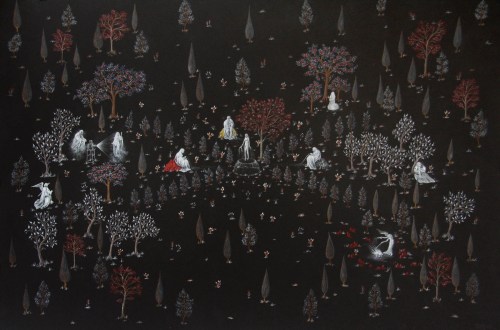
Works in the ongoing series Jardin des temps recall medieval tapestries or illuminated manuscripts. In one otherworldly bird’s-eye view, we look down at a nighttime garden populated by a cast of angels, witches, ghosts and martyrs. In a pair of eerie vignettes, we watch as a faceless figure is rolled up in a Persian carpet. Its intricate pattern spread to other drawings, including the cloak of a hooded ferryman — presumably Charon, the underworld gatekeeper of Greek mythology.

Other works merge alchemical themes with the esthetics of new-age spirituality and science fiction. Vistas emerge and galaxies swirl inside celestial spheres, while the spectral figure of “cosmic solitude” dissolves into a background of distant stars.

La Perrière M.’s approach is more than a bit theatrical, with crystal-tipped wands and bits of fur interspersed among the framed drawings and documents. The bulk of the main gallery space is filled with Plexiglas vitrines housing a collection of dazzling mineral specimens on loan from local collector Tony Smith. (La Perrière M.’s own drawings of crystal structures end up looking a bit anemic by comparison). La Clinique’s witchy ambience can be a bit self-conscious at times, but it’s engaging and fun just the same (full disclosure: I was a nerdy teenage Wiccan — self-conscious, witchy ambience is my favourite ambience).

Véronique La Perrière M. 
Spectral drawing
Véronique La Perrière M. Spectral drawing

One breathtaking standout work fully transcends the exhibition’s commitment to style and surface, though. Referencing the mythical Greek muse of astronomy, Le souffle d’Uranie (“Urania’s Breath”) is a gorgeous animated sequence that brings La Perrière M.’s pastel drawings vividly to life. A gently rhythmic procession of heavenly bodies, painstakingly rendered in loose white powder, blow on- and offscreen in diaphanous whorls and eddies. Though the materials and setup seem simple, the effect is astonishing. Over nine spellbinding minutes, La Perrière M. works an elemental transformation that would put any alchemist to shame.


Steven Leyden Cochrane was a nerdy teenage Wiccan in the late ’90s.
Report Error Submit a Tip

More Stories

Gillingham in lead with decided voters

Nicole Buffie 6 minute read Preview

Gillingham in lead with decided voters

Nicole Buffie 6 minute read Yesterday at 6:55 PM CDT

A cloud of uncertainty is hanging over Winnipeg as October’s municipal election nears.

Three months after a poll showed more than 40 per cent of Winnipeggers wanted to see someone other than current mayor Scott Gillingham elected, a new Abacus Data poll indicates more than half of Winnipeg voters are undecided heading into next month’s civic election.

Of decided voters, 55 per cent favour Gillingham compared to 23 per cent for former councillor and provincial cabinet minister Kevin Klein and 11 per cent for funeral director Mike Vogiatzakis.

Of all respondents, just over 50 per cent said they were unsure while 13 per cent said they will not vote.

Read
Yesterday at 6:55 PM CDT

Near-future U.S. the setting for surreal dual-world storyline

Reviewed by Morley Walker 4 minute read Preview

Near-future U.S. the setting for surreal dual-world storyline

Reviewed by Morley Walker 4 minute read 2:01 AM CDT

It’s not every day you encounter a seriously intended literary novel that attempts to dramatize a mind-bending physics theory like quantum entanglement.

But then the B.C.-born-and-raised Emily St. John Mandel is not your everyday Canadian literary writer.

In her late 40s, she has lived in the U.S. for her entire writing career. She is best known for her 2014 dystopian novel Station Eleven, about a Shakespearean acting troupe navigating a pandemic-ravaged America.

Her new outing, her seventh, Exit Party, shares DNA with detective and sci-fi genres more than with conventional literary fiction.

Read
2:01 AM CDT

Family account spiced with magic realism, geopolitical intrigue and a ghost story

Reviewed by Zilla Jones 4 minute read Preview

Family account spiced with magic realism, geopolitical intrigue and a ghost story

Reviewed by Zilla Jones 4 minute read 2:01 AM CDT

Tom Lin’s second novel Babylon, South Dakota moves beyond a historical account of an immigrant family’s struggle, delightfully blending and bending genres.

Lin is a Chinese-born novelist whose family emigrated to the U.S. when he was four years old. His debut novel, The Thousand Crimes of Ming Tsu, won the 2022 Andrew Carnegie Medal for Excellence in Fiction, making him the youngest ever recipient of that award. He earned a PhD in English from the University of California Davis and is currently an assistant professor of English and creative writing at the University of Iowa.

Babylon, South Dakota takes place in an unspecified time period that can be understood to be during the Mao era — likely the 1950s or ’60s. A young Chinese couple, the Hsuis, immigrate to the rural community that gives the book its title. They take the names Saul and Mei and settle on a 160-acre homestead left to them by a distant relative.

Saul’s dream is to breed and sell chrysanthemums from seeds he brought from China, while Mei wants to raise livestock. They speak no English, know nothing of life in the United States, are unprepared for the harshness of winter and the isolation of the farm and bring nothing with them except some gold, which Mei hides around the house for emergencies. Their only link to the outside world is a discarded and marginally functioning TV set, which Saul rescues and rigs up.

Read
2:01 AM CDT

Klein has burned bridges with PM, Gillingham says

Joyanne Pursaga 3 minute read Preview

Klein has burned bridges with PM, Gillingham says

Joyanne Pursaga 3 minute read Yesterday at 5:51 PM CDT

One mayoral candidate accused another of writing a column so critical it could compromise his ability to work with the federal government.

Read
Yesterday at 5:51 PM CDT

Hellebuyck standoff caused by… Nathan MacKinnon?

Mike McIntyre 6 minute read Preview

Hellebuyck standoff caused by… Nathan MacKinnon?

Mike McIntyre 6 minute read Yesterday at 6:34 PM CDT

Looking for someone to blame in the Connor Hellebuyck fiasco and cast as public enemy No. 1? How about long-time Winnipeg Jets nemesis Nathan MacKinnon?

Allow us to explain as we fire up the time machine and head back to February in Italy.

Oh, what could have been if MacKinnon had been able to score on what appeared to be an open net late in the third period of the men’s gold medal game with Hellebuyck down and seemingly out of position.

Instead, the star forward fired wide, keeping the score deadlocked at 1-1 as the clock ticked down on regulation.

Read
Yesterday at 6:34 PM CDT

Canada must not accept another Iranian autocracy

David Matas 5 minute read 2:01 AM CDT

Iran is a state run by a radical government victimizing its citizens and its neighbours. How do we change that? Any regime change that repeats the mistakes of the past is not a solution.

What went wrong in the past which led to the current regime? One answer is the U.K. and American aided coup which led to the ouster in 1953 of a democratically elected government headed at the time by Mohammad Mossadegh and its replacement with an American friendly autocrat, the Shah of Iran, Mohammad Reza Pahlavi.

The Shah imposed his rule through the Iranian National Intelligence and Security Organization — SAVAK, the acronym of its Persian name. SAVAK systematically inflicted torture, arbitrary killings and extra-judicial killings on perceived opponents of the regime. It was only a matter of time before repression of a regime directed to serving foreign interests would be overthrown.

What replaced the regime of the Shah, in 1979, the current regime of the mullahs, is a regime as intolerant and violent as the regime of the Shah and then some. That was not inevitable. But neither was it surprising. The vicious nature of the current regime, following the example set by the Shah, and its hatred for the United States, reacting to the U.S. aided imposition of the Shah, both echoes and reacts to the past. In 1979, the U.S. reaped what it sowed in 1953.