Bird book full of fun, feathery facts
Advertisement
Read this article for free:
or
Already have an account? Log in here »
To continue reading, please subscribe:

Digital Subscription
One year of digital access for only $205*
- Enjoy unlimited reading on winnipegfreepress.com
- Read the E-Edition, our digital replica newspaper
- Access News Break, our award-winning app
- Play interactive puzzles
*First annual payment billed as $205.00 + GST for one year. This annual subscription will automatically renew at $233.00 + GST every 52 weeks (10% off the regular annual price of $259.35). Offer available to new and qualified returning subscribers only. Cancel any time.
To continue reading, please subscribe:
Add Free Press access to your Brandon Sun subscription for only an additional
$1 for the first 4 weeks*
- Enjoy unlimited reading on winnipegfreepress.com
- Read the E-Edition, our digital replica newspaper
- Access News Break, our award-winning app
- Play interactive puzzles
*Your next Brandon Sun subscription payment will increase by $1.00 and you will be charged $17.95 plus GST for four weeks. After four weeks, your payment will increase to $24.95 plus GST every four weeks.
Read unlimited articles for free today:
or
Already have an account? Log in here »
Hey there, time traveller!
This article was published 24/05/2014 (4470 days ago), so information in it may no longer be current.
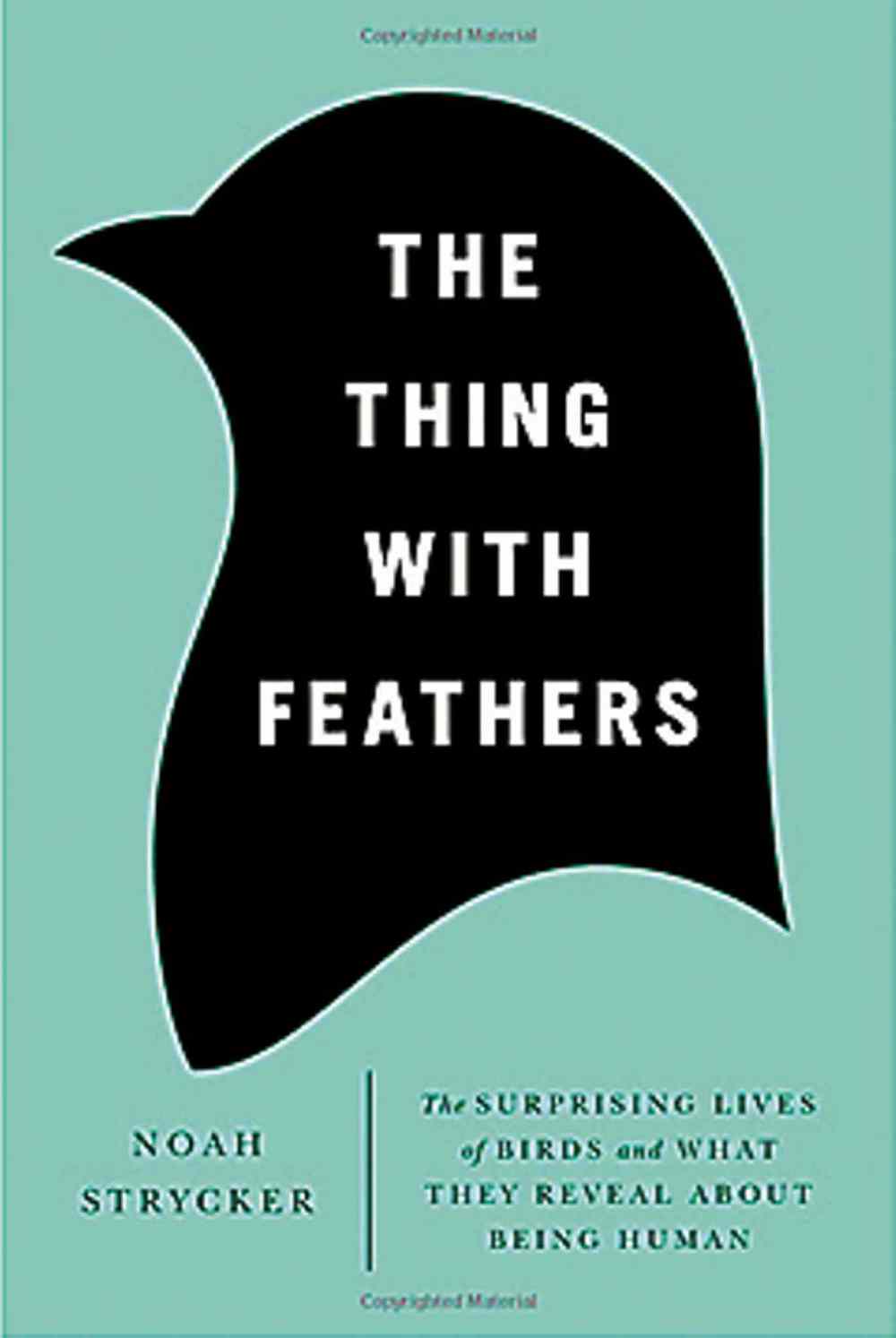
Noah Strycker never mentions that the title of his wonderful new book comes from the Emily Dickinson poem Hope Is the Thing With Feathers. If you’re unfamiliar with the full poetic phrase, the title might seem banal or plainly misleading, but it doesn’t take long for the author to correct any impression that birds are just disregardable, feathery things.
Rather, Stryker’s point is that birds are marvellous creatures with intriguing intellectual, emotional, and even artistic qualities and habits. In fact, as the subtitle notes, the book is full of surprising, even startling, information about bird behaviour.
Amazingly, birds share quite a few traits with humans, and Strycker manages to relate these qualities to many current developments.
Strycker is the author of Among Penguins, an informative, colourful and personal tale of three months spent in Antarctica studying Adélie penguins; it’s far better than the popular March of the Penguins movie.
He’s an ornithological scientist, but also an editor of Birding magazine, a gifted photographer, an in-demand bird guide and a self-confessed “bird nerd.”
Written in a personal, breezy style, The Thing with Feathers never makes you feel as if you’re being bludgeoned to death with impenetrable scientific data or smothered with bird-nerd anecdotes.
Easily understandable discussions of “stereoscopic triangulation,” cognitive limitation, neuroscience, altruism, game theory, the fight-or-flight instinct, memory palaces and the definition of art find their way into these 13 chapters.
The book is wide-ranging in its coverage. Among other things, Strycker explores the homing abilities of pigeons, the curious murmurations of starlings (in which hundreds of birds fly in stunningly abstract formations and never bang into one another), the wanderlust of snowy owls, the orneriness of hummingbirds, the musicality of parrots, social hierarchy in chickens, self-awareness in magpies, co-operation among fairy wrens and the artistry of bowerbirds.
It’s probably best to read this book alone, away from the company of others, otherwise you will make a pest of yourself, interrupting whatever they are doing to recount some fascinating bit of profound or trivial bird lore.
For instance: Did you know Mozart kept a pet starling, which he taught to memorize parts of his songs? (When it died, he buried it in his backyard and wrote a commemorative poem about it.)
Did you know a Clark’s Nutcracker (a Rocky Mountain bird named after the Clark of the Lewis and Clark expedition) can remember each one of the 5,000 caches in which it has buried the pine seeds it needs to survive the winter?
Or that only three per cent of birds are monogamous? (The tiny Saltmarsh Sparrow is the most promiscuous.)
Or that, among the most faithful, are the albatrosses that can put countless kilometres on their two-metre wings every year and still return to the same place to mate with the same partner?
If you do read the book alone, however, you will likely keep referring to the Internet or YouTube to find examples of the behaviour being described, despite the fact The Thing With Feathers is so effortlessly written it’s hard to put down.
For bird lovers this is a must-read. If you’re not interested in birds, you will be once you read this book. Even the book’s notes and sources entries are well worth reading.
Gene Walz helped put together the books The Birds of Manitoba and Finding Birds in Southern Manitoba.
History
Updated on Saturday, May 24, 2014 8:53 AM CDT: Formatting.