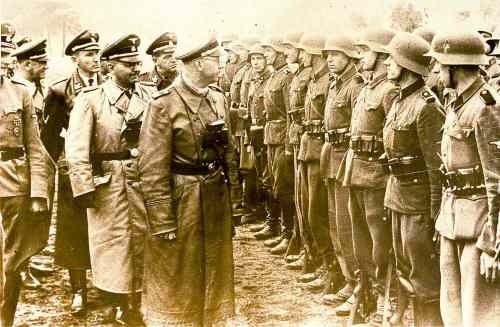
Police state: New book on Gestapo probes chilling questions about instrument of terror

Advertisement

Advertise with us

Michael Ruck's 1995 bibliography of Nazism contains over 37,000 entries, and this number has risen considerably since its publication; some 2,000 books were published on Nazi Germany in 2013 alone.

Read this article for free:

or

Already have an account? Log in here »

To continue reading, please subscribe:

Subscribe and receive a limited-edition Free Press branded hat or tote.

Digital Subscription

One year of digital access for only $205*

  • Enjoy unlimited reading on winnipegfreepress.com
  • Read the E-Edition, our digital replica newspaper
  • Access News Break, our award-winning app
  • Play interactive puzzles

*First annual payment billed as $205.00 + GST for one year. This annual subscription will automatically renew at $233.00 + GST every 52 weeks (10% off the regular annual price of $259.35). Offer available to new and qualified returning subscribers only. Cancel any time.

To continue reading, please subscribe:

Add Free Press access to your Brandon Sun subscription for only an additional

$1 for the first 4 weeks*

  • Enjoy unlimited reading on winnipegfreepress.com
  • Read the E-Edition, our digital replica newspaper
  • Access News Break, our award-winning app
  • Play interactive puzzles
Start now

*Your next Brandon Sun subscription payment will increase by $1.00 and you will be charged $17.95 plus GST for four weeks. After four weeks, your payment will increase to $24.95 plus GST every four weeks.

Hey there, time traveller!
This article was published 07/06/2014 (4428 days ago), so information in it may no longer be current.

Michael Ruck’s 1995 bibliography of Nazism contains over 37,000 entries, and this number has risen considerably since its publication; some 2,000 books were published on Nazi Germany in 2013 alone.

The University of Manitoba library catalogue contains 48,395 references to Nazi Germany, 17,870 to Nazism and 5,025 to the Gestapo. Now selling well in Germany is the satirical Er Ist Wieder Da (Look Who’s Back), in which a miraculously resurrected Hitler surveys the contemporary scene.

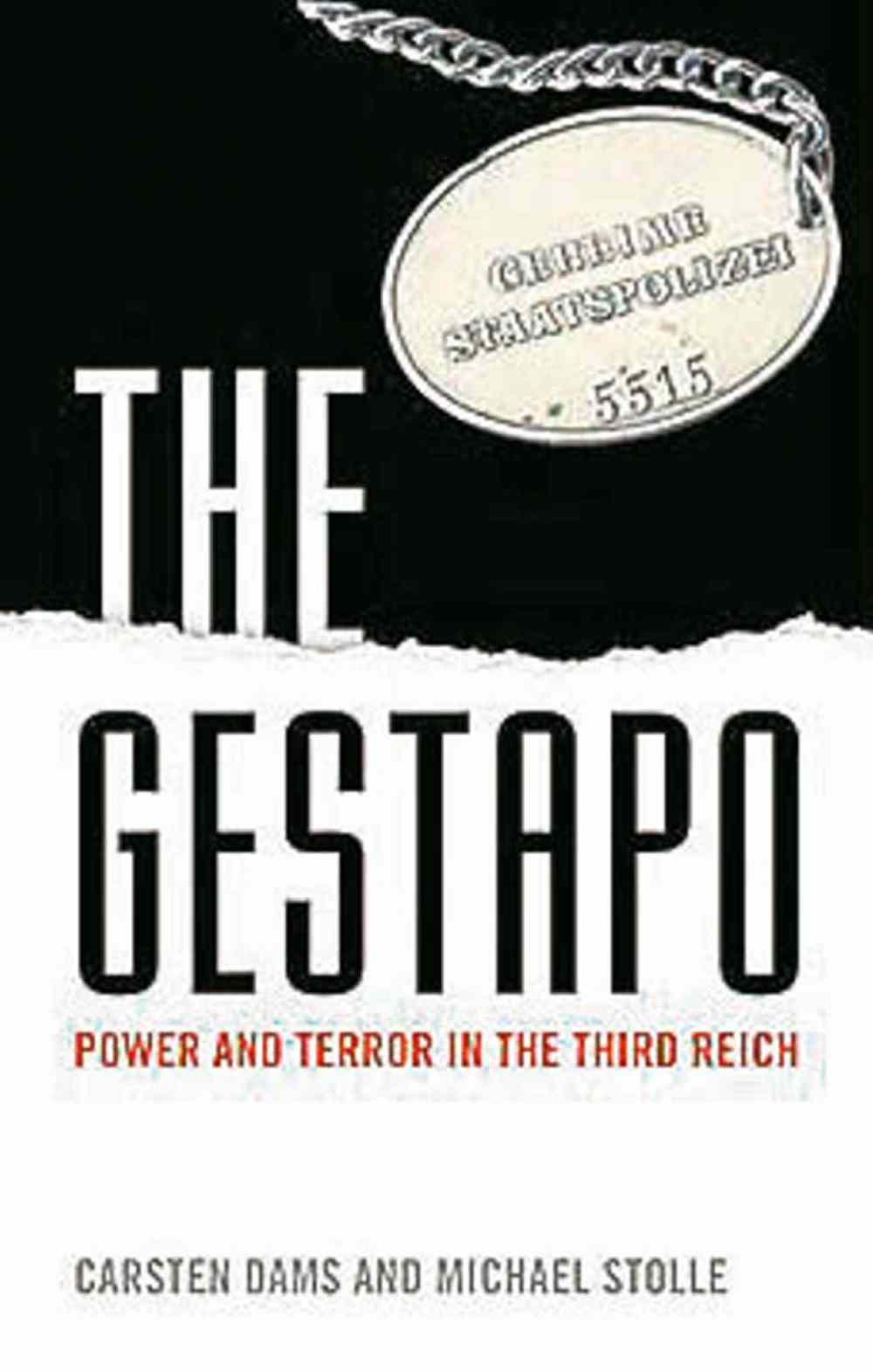
All of which raises the question: Do we need another book on the Gestapo? In the case of this new history, the answer is yes — The Gestapo draws on a large body of recent research that challenges some established ideas that are mostly accessible only in German. Its authors, Carsten Dams and Michael Stolle, are German academics who have written extensively on the Gestapo and its place in the Nazi regime.
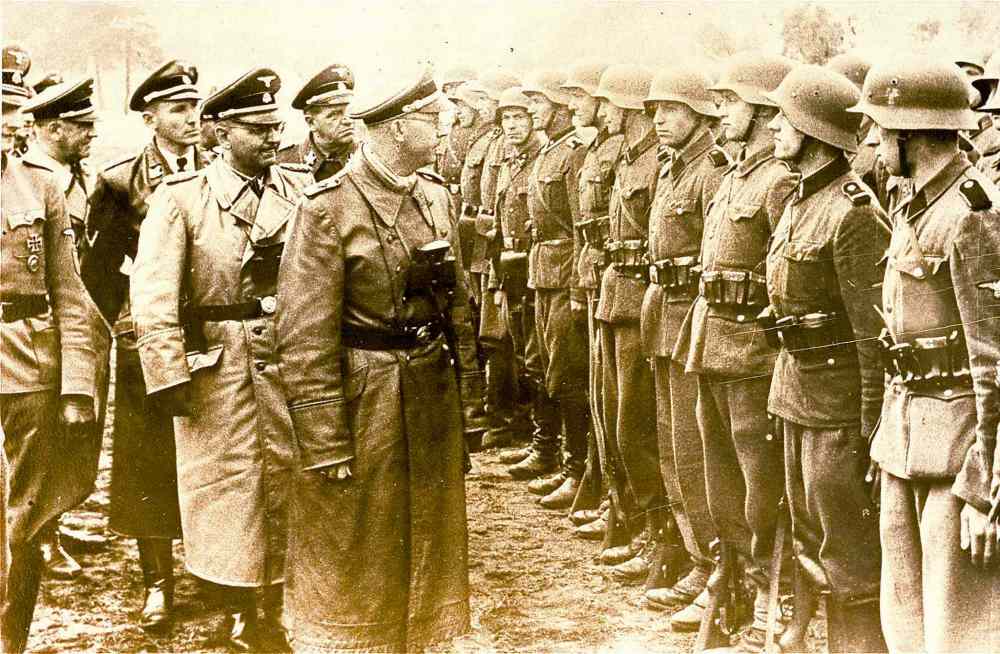
U.S. Holocaust Memorial Museum / The Associated Press files
Heinrich Himmler (centre), head of the Gestapo and the Waffen-SS and minister of the interior of Nazi Germany from 1943 to 1945, reviews troops in June 1944.
U.S. Holocaust Memorial Museum / The Associated Press files Heinrich Himmler (centre), head of the Gestapo and the Waffen-SS and minister of the interior of Nazi Germany from 1943 to 1945, reviews troops in June 1944.

They describe their book as a concise overview that closes a gap in the writing of history. This is a little unfair to Robert Gellately’s The Gestapo and German Society (1990), George Browder’s Hitler’s Enforcers (1998), and Eric Johnson’s Nazi Terror: The Gestapo, Jews and Ordinary Germans (1999), but Dams and Stolle have certainly produced a comprehensive, albeit largely institutional, overview of their subject.

They examine the Gestapo’s organization, its personnel, and its methods of investigation and interrogation. They also detail the treatment of those seen as politically suspect or, more chillingly, as unworthy of membership in the so-called national German community, as well as wartime activities and involvement in the Holocaust and the post-war fate of its agents.

Recent research has challenged the myth of an all-powerful Gestapo, describing it instead it as seriously under-staffed, more reactive than proactive, and not especially efficient. Dams and Stolle describe this revisionist portrait as exaggerated, and argue that the Gestapo was an “effective instrument of terror.”

Despite its name, the Secret State Police (Geheime Staatspolizei, a.k.a. Gestapo) actively sought publicity, well aware that its intimidating reputation facilitated its work. Moreover, the Gestapo worked closely with the regular police and the SS and so had access to whatever resources it needed as the self-described “doctor of the German national body.”

For the most part, the Gestapo targetted Jews, Roma, communists, socialists, Christians who took God too seriously, gays, and so-called “asocial” elements. Until the last years of the Second World War, most Germans had little or no contact with it, provided they were judged to pose no threat to the Nazi regime. Indeed, following much recent research, Dams and Stolle describe the Gestapo as benefiting from a general mood of consent and support.

Even if they avoided the Gestapo’s attention, Germans were caught in a web of other state-controlled organizations — from neighbourhood party officials and block wardens to the Hitler Youth, the League for German Girls, the Labour Front, the Militant League for German Culture and many others, all pursuing the Nazi vision of a radically new “national community.” The media, the schools, and the churches operated under Nazi control.

Perhaps the most depressing finding of recent research is that roughly one-third of the Gestapo’s workload consisted of following up on voluntary denunciations lodged by people against neighbours, co-workers, bosses, and sometimes even spouses, often to satisfy some personal grudge.

Dams and Stolle draw a disturbing conclusion, noting the new research on the Gestapo “makes very clear what people are capable of when state power gives them a mandate.” We’re left with the usual questions: How did Nazism take hold in such a culturally and educationally advanced country as Germany? In the right circumstances, could it happen elsewhere?
In this context, it’s no comfort to realize Manitoba students are not required to study 20th-century world history and so, except for a few paragraphs in the Grade 11 Canadian history textbook, are taught nothing about Nazism.

To be ignorant of history is to risk becoming its victim; in this light, Dams and Stolle have given us a book that makes for necessary reading.


Ken Osborne is an emeritus professor in the University of Manitoba’s faculty of education.

History

Updated on Saturday, June 7, 2014 7:18 AM CDT: Formatting.

Report Error Submit a Tip

More Stories

Jets’ Perfetti motivated to prove his worth following ‘life-changing’ contract

Mike McIntyre 8 minute read Preview

Jets’ Perfetti motivated to prove his worth following ‘life-changing’ contract

Mike McIntyre 8 minute read Yesterday at 2:40 PM CDT

Adam Lowry’s wedding was the main event, of course. But the Winnipeg Jets had even more reason to celebrate this past weekend as they returned from their off-season homes for a spirited summertime gathering.

Read
Yesterday at 2:40 PM CDT

‘Heartbreaking loss’: Sandy Bay First Nation offers condolences after apparent dog attack

Morgan Modjeski 3 minute read Preview

‘Heartbreaking loss’: Sandy Bay First Nation offers condolences after apparent dog attack

Morgan Modjeski 3 minute read Sunday, Jul. 19, 2026

Leaders with the Sandy Bay Ojibway First Nation are offering their condolences after an animal rescue worker died following an apparent dog attack in the community and say the “stray and aggressive” animals are a longstanding issue.

Amanda Nobiss, 37, was volunteering in the community on the shores of Lake Manitoba with K9 Advocacy. Her remains were discovered on Friday morning.

The Manitoba First Nations Police Service said in a news release that it had been contacted by a friend of Amanda’s who was trying to locate her, around 12:45 a.m.

Using her cellphone location, police determined she appeared to be in Sandy Bay, said the release. Resources were dispatched to the area, including a drone, but due to the large radius of the cellphone “ping,” no one was located until 6 a.m.

Read
Sunday, Jul. 19, 2026

U.S. hits Canada with steep tariffs on range of products, including hockey sticks

Kelly Geraldine Malone, The Canadian Press 6 minute read Preview

U.S. hits Canada with steep tariffs on range of products, including hockey sticks

Kelly Geraldine Malone, The Canadian Press 6 minute read Updated: Yesterday at 7:38 PM CDT

WASHINGTON - President Donald Trump signed orders Monday to hammer certain Canadian products with 50 per cent tariffs, escalating trade tensions with the United States' northern neighbour.

"President Trump took decisive action to hold Canada accountable for its retaliation and discrimination," United States Trade Representative Jamieson Greer said in a statement.

The new tariffs are set to come into force in 30 days on a wide array of goods, ranging from hockey sticks to wine to cement.

Greer said the measure is a response to provincial bans on U.S. liquor, Canada's supply managed dairy system and quotas on certain U.S. vehicles.

Read
Updated: Yesterday at 7:38 PM CDT

Police state: New book on Gestapo probes chilling questions about instrument of terror

Reviewed by Ken Osborne 4 minute read Preview

Police state: New book on Gestapo probes chilling questions about instrument of terror

Reviewed by Ken Osborne 4 minute read Saturday, Jun. 7, 2014

Michael Ruck's 1995 bibliography of Nazism contains over 37,000 entries, and this number has risen considerably since its publication; some 2,000 books were published on Nazi Germany in 2013 alone.

The University of Manitoba library catalogue contains 48,395 references to Nazi Germany, 17,870 to Nazism and 5,025 to the Gestapo. Now selling well in Germany is the satirical Er Ist Wieder Da (Look Who's Back), in which a miraculously resurrected Hitler surveys the contemporary scene.

All of which raises the question: Do we need another book on the Gestapo? In the case of this new history, the answer is yes -- The Gestapo draws on a large body of recent research that challenges some established ideas that are mostly accessible only in German. Its authors, Carsten Dams and Michael Stolle, are German academics who have written extensively on the Gestapo and its place in the Nazi regime.

They describe their book as a concise overview that closes a gap in the writing of history. This is a little unfair to Robert Gellately's The Gestapo and German Society (1990), George Browder's Hitler's Enforcers (1998), and Eric Johnson's Nazi Terror: The Gestapo, Jews and Ordinary Germans (1999), but Dams and Stolle have certainly produced a comprehensive, albeit largely institutional, overview of their subject.

Read
Saturday, Jun. 7, 2014

Search continues for brothers feared drowned at Nutimik Lake

Zoe Pierce 6 minute read Preview

Search continues for brothers feared drowned at Nutimik Lake

Zoe Pierce 6 minute read Updated: Yesterday at 6:39 PM CDT

Search-and-rescue crews continued efforts Monday to locate two boys who are presumed drowned after falling into fast-moving rapids at Nutimik Lake on the weekend, as community members and Manitoba Parks begin conversations about preventing future tragedies.

The boys, identified as brothers Aaron Au Ramirez, 13, and Maximo Au Ramirez, 10, were visiting Whiteshell Provincial Park with their father and some friends when they entered the water near the Sturgeon Falls Trail Saturday afternoon.

Lac du Bonnet RCMP received a report of a possible drowning at about 12:40 p.m. Police, along with local emergency responders, searched the shoreline and waterways but were unable to find the boys, RCMP said in a news release.

The Manitoba RCMP Underwater Recovery Team and the Hutterian Emergency Aquatic Response Team were later deployed to assist with the search.

Read
Updated: Yesterday at 6:39 PM CDT

Whale of a rescue in Churchill

Tiago Resko 3 minute read Preview

Whale of a rescue in Churchill

Tiago Resko 3 minute read 6:22 PM CDT

Manitoba conservation officers determined to rescue polar bears in distress on the Churchill shoreline were shocked when they instead came across seven beluga whales stranded in shallow water.

Churchill’s conservation office received a call at about 7:20 a.m. Monday about a white object in the water covered by seagulls half a kilometre from a public beach.

“When the public calls us and they say something white, we treat it like a bear call because we receive the call a lot,” said conservation officer Vitalii Skrynnyk.

Skrynnyk’s colleague went to investigate and discovered three adult beluga whales and four calves stranded because of low tides.

Read
6:22 PM CDT