Probable cause: Ability to find water key to homo sapiens’ survival, ecologist says

Ability to find water key to homo sapiens' survival, ecologist says

Advertisement

Advertise with us

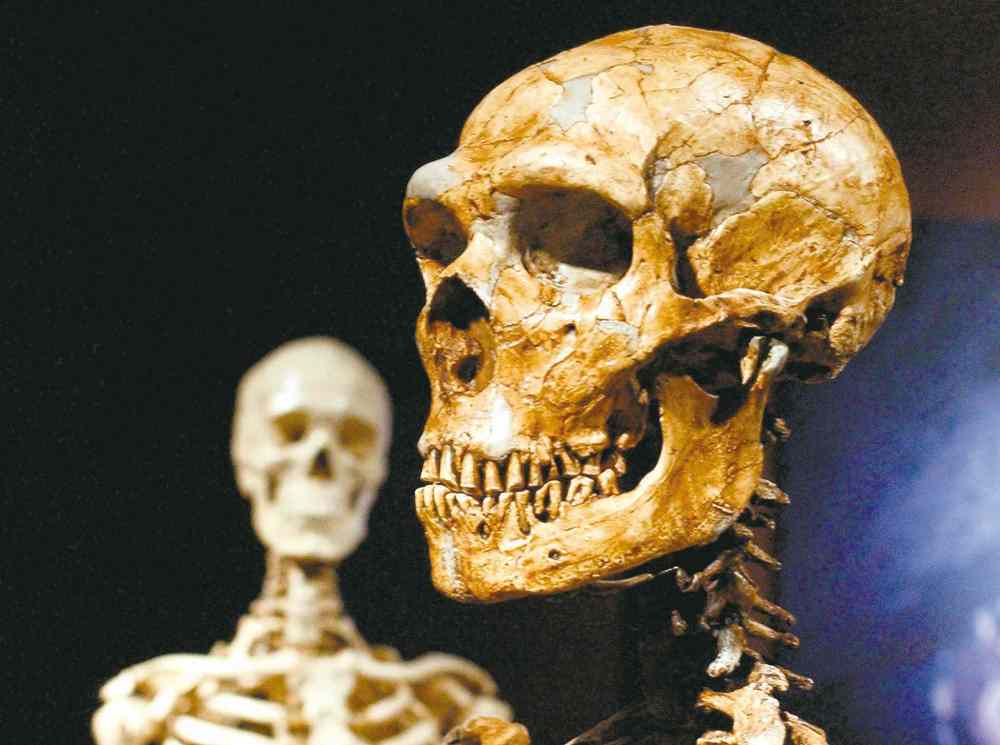
Contemporaries in the scientific world call Clive Finlayson a Neanderthal buff, acknowledging the ecologist's commitment to understanding why modern man won the evolutionary race over relatives with larger brains and larger statures.

Read this article for free:

or

Already have an account? Log in here »

To continue reading, please subscribe:

Subscribe and receive a limited-edition Free Press branded hat or tote.

Digital Subscription

One year of digital access for only $205*

  • Enjoy unlimited reading on winnipegfreepress.com
  • Read the E-Edition, our digital replica newspaper
  • Access News Break, our award-winning app
  • Play interactive puzzles

*First annual payment billed as $205.00 + GST for one year. This annual subscription will automatically renew at $233.00 + GST every 52 weeks (10% off the regular annual price of $259.35). Offer available to new and qualified returning subscribers only. Cancel any time.

To continue reading, please subscribe:

Add Free Press access to your Brandon Sun subscription for only an additional

$1 for the first 4 weeks*

  • Enjoy unlimited reading on winnipegfreepress.com
  • Read the E-Edition, our digital replica newspaper
  • Access News Break, our award-winning app
  • Play interactive puzzles
Start now

*Your next Brandon Sun subscription payment will increase by $1.00 and you will be charged $17.95 plus GST for four weeks. After four weeks, your payment will increase to $24.95 plus GST every four weeks.

Hey there, time traveller!
This article was published 07/06/2014 (4420 days ago), so information in it may no longer be current.

Contemporaries in the scientific world call Clive Finlayson a Neanderthal buff, acknowledging the ecologist’s commitment to understanding why modern man won the evolutionary race over relatives with larger brains and larger statures.

Finlayson resides in Gibraltar, home to world-renowned archeological sites holding evidence of Neanderthals who lived there as recently as 30,000 years ago.

He has written extensively about homo sapiens’ survival during the long and likely torturous process implied in Darwin’s revolutionary ideas about the natural selection of species.
Frank Franklin II / The Associated Press files

Perplexing questions of where we came from and what triggered our ascendancy over our Neanderthal cousins prompted Finlayson’s critically-acclaimed book, The Humans Who Went Extinct (2009).

His most recent offering is a provocatively simple insight into human evolution, suggesting its driving force was the ability — or luck — of some primates to locate water during the Earth’s many ecological changes.

Typical of the ongoing science-versus-religion battle, Finlayson’s writing and research provides a sharp contrast with the less-cerebral but much more comfortable faith-based notion of Adam and Eve being our seminal kin.

To understand how our species fit into nature’s selection hinges on the correct categorization of humans, and in The Improbable Primate, Finlayson shows why previous categories were likely incorrect.

He leans heavily on the findings of Ernst Mayer, one of the 20th century’s leading evolutionary biologists, who in 1942 first defined biological species as “groups of organisms capable of freely interbreeding with each other,” and suggested that “never more than one species of man existed on the earth at any one time”.

Finlayson uses Mayer’s assumptions to argue human development began with the emergence of an erect, two-legged primate, homo erectus, nearly two million years ago, and that other human-like primates such as Neanderthals represent different lineages of the one species.

He disagrees with scientists who grant special species status to differing skeletal remains of erect primates, and believes differences in physical structure point to natural selection caused by geographical environments, and not to evidence of a different species.

The arrival of this fully upright primate was a significant departure from some earlier but similar tree-traversing models and, as Finlayson states in the book’s title, it was an improbable model, fashioned by natural-selection pressures but remarkably capable of evolving in response to climatic and environmental changes.

Finlayson posits that throughout homo sapiens’ subsequent lengthy evolution, evidence from artifacts and skeletal fragments found in Africa and Eurasia prove our early ancestors were “geographically variable,” but probably “capable of reproducing with each other.”

He reminds readers DNA testing has proven that evidence of inter-breeding with Neanderthals “was retained in our genome,” and that another ancient lineage, the Denisovans from southeast Asia, are also “shown to have exchanged genes with our own.”

In the preface to The Improbable Primate, Finlayson asserts that “water was a key ingredient in our evolution,” then defends this hypothesis throughout the book’s 11 chapters, using his own research and field work along with a well-documented array of comparative analyses by other scientists.
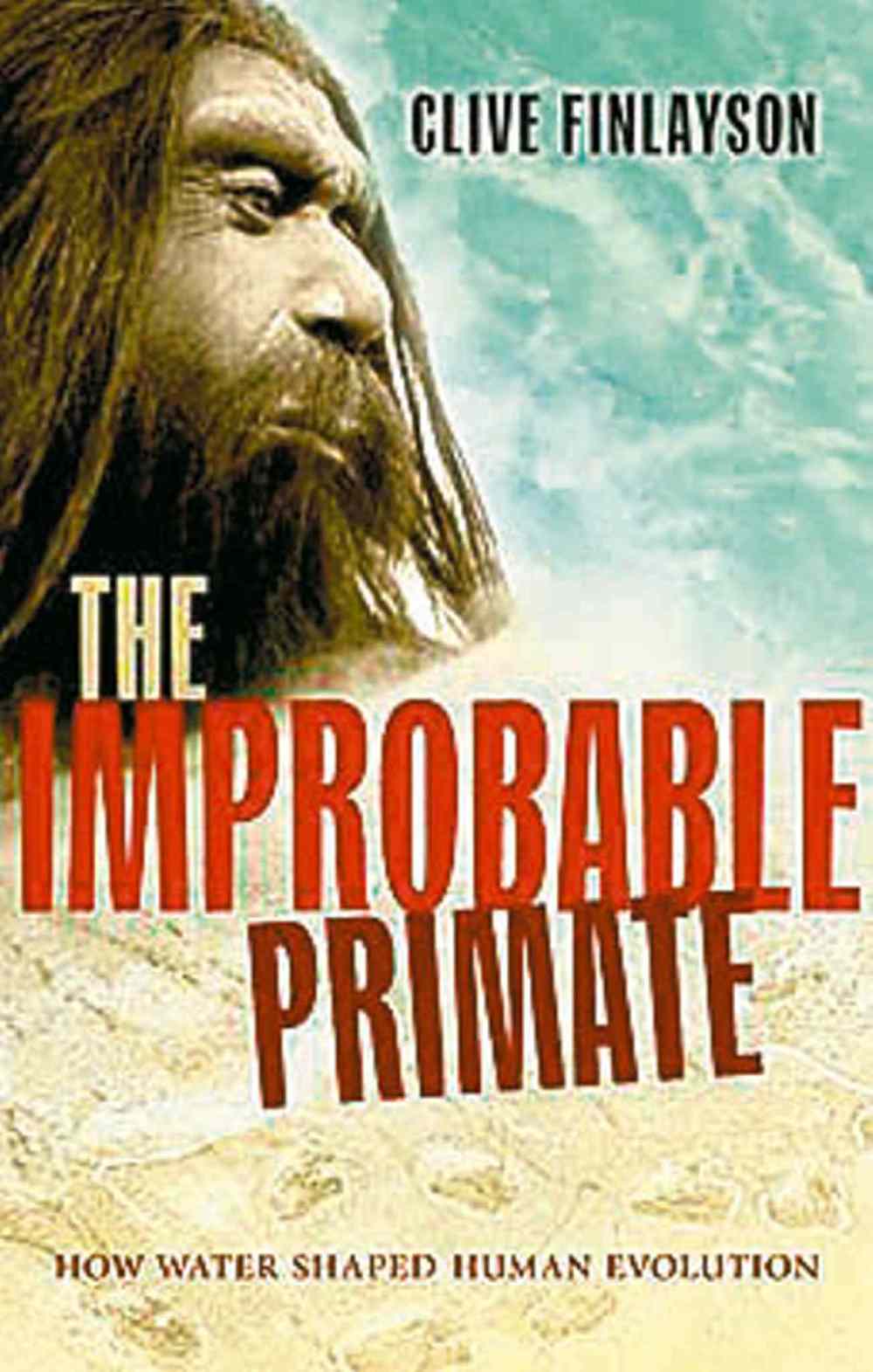
The Improbable Primate.

The result is a scholarly, revelatory, and contemplative chronology of human development that inquisitive readers should find fascinating.

One chapter is devoted to the relatively recent migration of humans into Australia approximately 50,000 years ago, what Finlayson calls “a unique opportunity to observe how humans took on the challenge of living in an arid world.”

The Australian story effectively reminds readers these early humans had “an almost 2 million year old heritage of adaptation… and were well-versed in the art of finding water.”

Finlayson’s chronology of our evolution into modern humans requires an accurate recalling of taxonomic names of various species and lineages that comprise the story of homo sapiens.

This can detract from the book’s main idea, which first appears in its subtitle, but an emphasis upon water, the undisputed precursor to life as we know it, should nevertheless attract a variety of readers.


Joseph Hnatiuk is a retired teacher, and finds some humour in now being an education Neanderthal.

History

Updated on Saturday, June 7, 2014 7:23 AM CDT: Formatting.
Report Error Submit a Tip

More Stories

Confusion part of syllabus as MITT winds down operations

Morgan Modjeski 5 minute read Preview

Confusion part of syllabus as MITT winds down operations

Morgan Modjeski 5 minute read Yesterday at 2:49 PM CDT

More than 500 students are trying to complete their courses before the Manitoba Institute of Trades and Technology permanently closes.

Manpreet Singh, who is set to graduate from the electrical applications program in the fall, said finishing his studies is a confusing and anxiety-inducing process despite the promise it would go smoothly.

“Nobody has a clear image,” he said.

Officials said in January the post-secondary institute was no longer financially viable because of the federal government’s decision to cut the number of international students allowed to study in Canada. Nineteen of its programs are being absorbed by Red River College Polytech, which is taking over the institute’s campuses in south Winnipeg.

Read
Yesterday at 2:49 PM CDT

Carney trumps Trump with Gordie Howe bridge deal

Dan Lett 5 minute read Preview

Carney trumps Trump with Gordie Howe bridge deal

Dan Lett 5 minute read Yesterday at 5:15 PM CDT

The dispute over the opening of the Gordie Howe Bridge was always and only going to end when U.S. President Donald Trump could declare he had got the better deal.

Even when he didn’t.

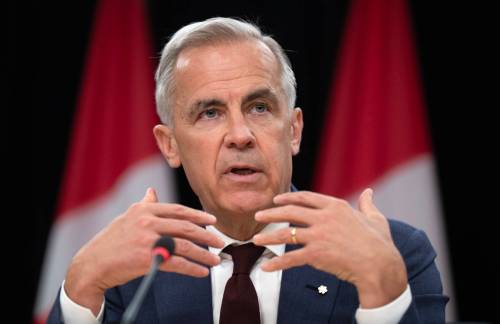
Trump gleefully posted on social media Saturday that after refusing to allow the completed bridge between Windsor and Detroit to open in late June, he got a “MUCH BETTER DEAL” from Prime Minister Mark Carney. Political opponents and a handful of opinion writers rushed to shake their heads at how Carney was used and abused by the big fella in Washington.

It’s not surprising that Conservative Leader Pierre Poilievre would do an end-zone dance as he lamented Carney’s “terrible deal; the leader of the official opposition’s default setting is “condemn.”

Read
Yesterday at 5:15 PM CDT

Structural flaws affect health-care performance

Alan H. Menkis 6 minute read Preview

Structural flaws affect health-care performance

Alan H. Menkis 6 minute read 2:00 AM CDT

The record is not background. It is the forecast. Past performance is the best available indicator of future performance. That principle belongs to every field in which the conditions producing a result are more durable than the result itself.

Read
2:00 AM CDT

Former Manitoba MP Inky Mark charged with firearms offences; more than 400 weapons seized from home

Tyler Searle 6 minute read Preview

Former Manitoba MP Inky Mark charged with firearms offences; more than 400 weapons seized from home

Tyler Searle 6 minute read Updated: Yesterday at 6:11 PM CDT

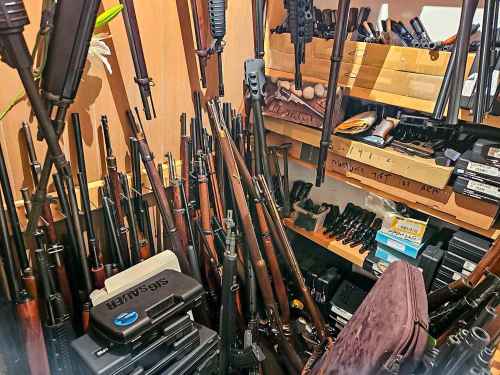
A former member of Parliament from Manitoba has been charged after a stockpile of ammunition and firearms — including an antique cannon — and $300,000 in cash were seized from a Dauphin home last week.

Manitoba RCMP charged Inky Mark, 78, with a dozen firearms-related charges, including firearms trafficking, possession of property obtained by crime, unsafe storage and careless use of a firearm.

In total, RCMP seized 439 firearms from Mark’s property, Mounties said at a news conference Monday morning.

It is expected to take investigators weeks to sort through the arsenal and determine how many of the weapons were legally possessed, but police have already identified three guns that are believed to have been illegally trafficked, and one that had a tampered serial number, RCMP Cpl. Barry Kirby said.

Read
Updated: Yesterday at 6:11 PM CDT

First-aid volunteers treat folk fest attendees suffering from heat

Eva Wasney and Jill Wilson 4 minute read Preview

First-aid volunteers treat folk fest attendees suffering from heat

Eva Wasney and Jill Wilson 4 minute read Sunday, Jul. 12, 2026

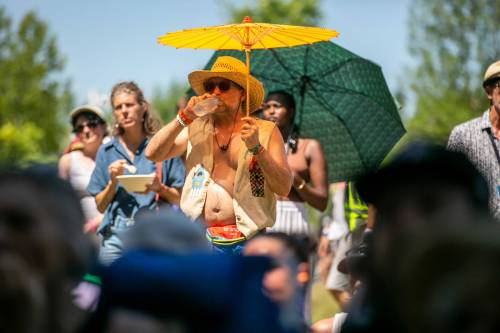
Shade was at a premium at Birds Hill Provincial Park over the weekend as Winnipeg Folk Festival goers tried to keep cool during an extreme heat wave.

Heat warnings were issued across southern Manitoba and temperatures peaked at 35 C Sunday afternoon.

First-aid volunteers were seen administering cold compresses to several overheated attendees. STARS air ambulance responded to a medical call at the park on Saturday night, but did not transport the patient to hospital. By Sunday at noon, EMS had been called to the festival nine times.

“This is not an unusual number of calls for us or other events of our size,” festival executive director Valerie Shantz said.

Read
Sunday, Jul. 12, 2026

If it works in Ontario, why not in Manitoba?

James Wilt 5 minute read Preview

If it works in Ontario, why not in Manitoba?

James Wilt 5 minute read Yesterday at 2:00 AM CDT

Grid-scale battery storage has fundamentally changed the global energy landscape — and Manitoba needs to get on board.

Battery systems store large amounts of excess electricity for when it’s most needed. While they can be charged from any generation source, they are especially beneficial for integrating wind and solar power, which vary with weather and time of day. Batteries allow electrical grids to meet the need for firm, dispatchable and affordable capacity using renewable energy, rather than relying on coal, nuclear and fossil gas. They also provide numerous other benefits, including reducing overloading of transmission infrastructure and helping to regulate the grid’s frequency and voltage.

Average costs for grid-scale batteries plummeted by more than half between 2023 and 2025 and installations have skyrocketed in China, the U.S., Australia and Europe. Texas now has 16,500 megawatts (MW) of battery storage, while California has 15,200 MW. Closer to home, Ontario recently awarded 640 MW of contracts to three battery storage projects in a competitive auction, with batteries beating out fossil gas-fired power plants on cost every time. One of these projects will be built near Dryden, only four hours east of Winnipeg.

Each battery system will provide eight hours of capacity but will cost considerably less than Ontario’s previous battery procurements, which provide only four hours of capacity. With this latest auction, Ontario has now secured 3,600 MW of battery storage capacity, including the operational Oneida (250 MW), Hagersville (300 MW) and Napanee (250 MW) projects. Almost all have significant Indigenous participation, with the latest procurements boasting 50 per cent First Nations ownership.

Read
Yesterday at 2:00 AM CDT