Curiosity essential to progress

Advertisement

Advertise with us

If you're curious to know more about a book about curiosity, you're already exhibiting "epistemic curiosity." Would you rather watch cat videos on YouTube? You're demonstrating "diversive curiosity."

Read this article for free:


or

Already have an account? Log in here »

To continue reading, please subscribe:

Subscribe and receive a limited-edition Free Press branded hat or tote.

Digital Subscription

One year of digital access for only $205*

  • Enjoy unlimited reading on winnipegfreepress.com
  • Read the E-Edition, our digital replica newspaper
  • Access News Break, our award-winning app
  • Play interactive puzzles

*First annual payment billed as $205.00 + GST for one year. This annual subscription will automatically renew at $233.00 + GST every 52 weeks (10% off the regular annual price of $259.35). Offer available to new and qualified returning subscribers only. Cancel any time.

To continue reading, please subscribe:

Add Free Press access to your Brandon Sun subscription for only an additional

$1 for the first 4 weeks*

  • Enjoy unlimited reading on winnipegfreepress.com
  • Read the E-Edition, our digital replica newspaper
  • Access News Break, our award-winning app
  • Play interactive puzzles
Start now

*Your next Brandon Sun subscription payment will increase by $1.00 and you will be charged $17.95 plus GST for four weeks. After four weeks, your payment will increase to $24.95 plus GST every four weeks.

Hey there, time traveller!
This article was published 09/08/2014 (4418 days ago), so information in it may no longer be current.

If you’re curious to know more about a book about curiosity, you’re already exhibiting “epistemic curiosity.” Would you rather watch cat videos on YouTube? You’re demonstrating “diversive curiosity.”

It’s the combination of both types that results in human progress, the eureka moment in which several ideas synthesize into something new.

But the Internet may kill off all curiosity, dooming us to becoming “intelligent apes,” Ian Leslie warns.
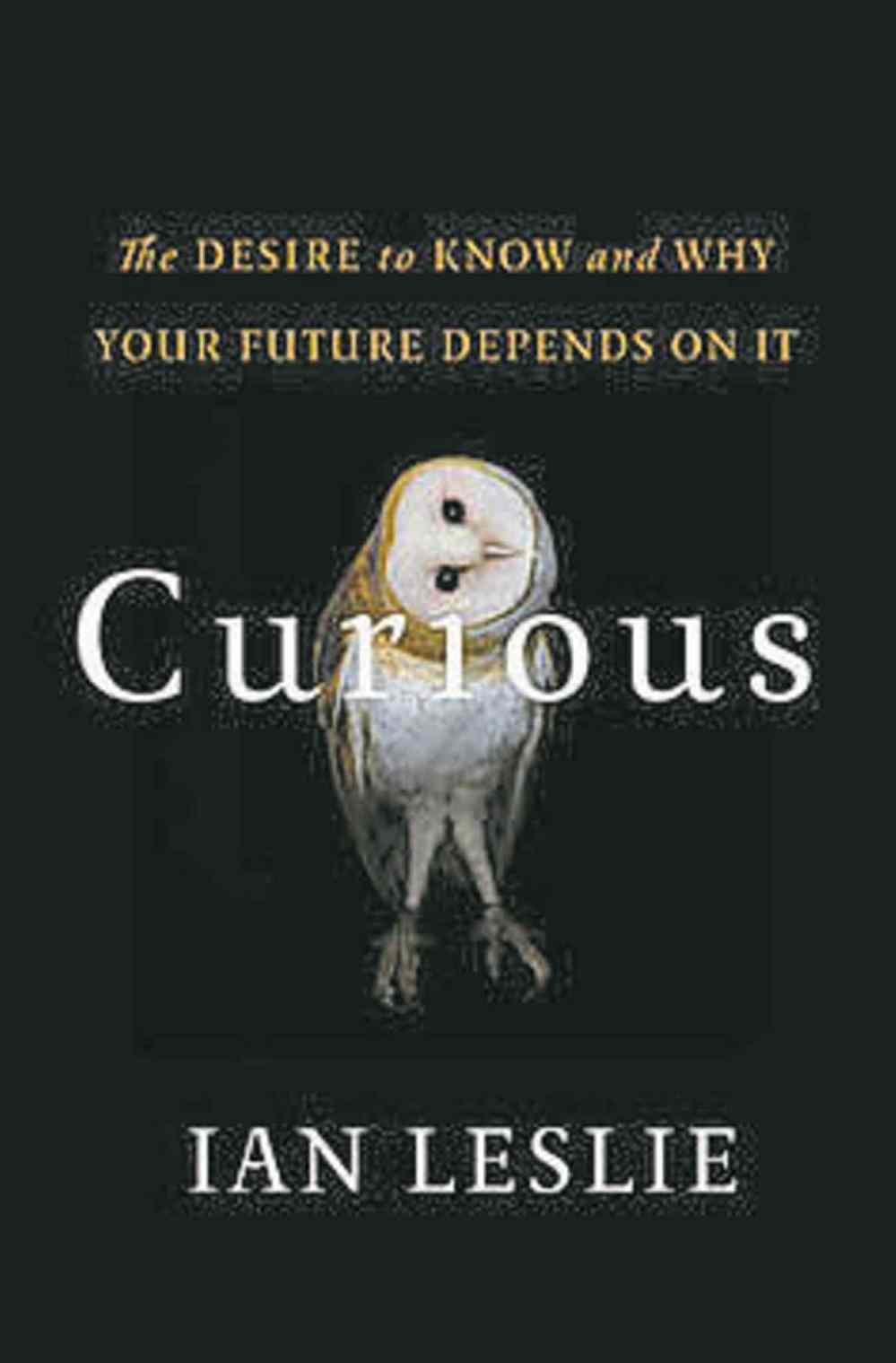
Leslie is a London-based journalist who has written about politics, culture and psychology for the Guardian, the Times and the BBC.

In this highly engaging book, Leslie traces the vital role of curiosity in moving forward human thought.

The truly great thinkers bring together the need for in-depth knowledge in their fields (epistemic curiosity) with a wide-ranging knowledge of their own society (diversive curiosity).

A to-do list in one of Leonardo da Vinci’s notebooks, for instance, includes drawing Milan, calculating the measurement of Milan and its suburbs, examining a crossbow, and learning how to both repair a canal lock and measure the sun.

Steve Jobs’ knowledge of popular culture revolutionized how we purchase and listen to music. Just as important was a college course he took in calligraphy, which resulted in computers producing fonts and spacing previously reserved for printing presses.

But the computers Jobs created, and the Internet they connect to, threaten to create a generation that lacks curiosity, because everyone believes they know everything they need to know.

New York Times journalist Ben Greenman wrote about his son Jack’s school project on snakes. Thanks to the Internet, Jack got a good mark on his project on the anaconda, the world’s biggest snake.

When Ben was Jack’s age, he would have gone to the library to find books about snakes; his curiosity would have been engaged.

Even the head of Google’s search department, Amit Singhal, says: “The more accurate the machine gets, the lazier the questions become.”

That’s a red flag to Leslie, who intones: “The more we outsource our memories to Google, the less we are nourishing the wonderfully accidental creativity of our unconscious.”

He caps off the book with tips for keeping one’s curiosity intact. From Jobs comes “Stay foolish” — never be afraid to ask questions others don’t.

Build your personal store of information by becoming a “foxhog.” Combine the fox’s frantic search for a variety of survival techniques with the hedgehog’s ability to survive by brandishing its spikes — the “one big thing” it needs to know.

Always ask the big “why.” Leslie quotes negotiators from the seemingly intractable Irish Troubles, who made headway when they looked past specific demands made by both sides and dealt with underlying causes.

Bjarni Herjolfsson was likely the first European to see North America, but he was too busy going to Greenland to land. That honour went to Leif Eriksson, a Viking whose epistemic curiosity was likely inspired by Bjarni’s failure.

Leslie’s final plea to Google-ized man: Don’t miss discovering a new continent or a new field of interest because you’re thinking about your next appointment.

Be a Leif. Don’t be a Bjarni.


Donald Benham is director of hunger and poverty awareness at Winnipeg Harvest.

History

Updated on Saturday, August 9, 2014 8:09 AM CDT: Formatting.

Report Error Submit a Tip

More Stories

Retired sportscaster Scott Oake determined as fundraising for women's addictions treatment facility enters home stretch

Melissa Martin 4 minute read Preview

Retired sportscaster Scott Oake determined as fundraising for women's addictions treatment facility enters home stretch

Melissa Martin 4 minute read Thursday, Sep. 10, 2026

For now, the patch of land just east of the Victoria Hospital doesn’t look like much: just a field of rocks, mounded dirt, and concrete piles driven into the earth. Yet when Scott Oake looks over the site, he can already imagine how it will look in just over a year’s time, when the new Anne Oake Family Recovery Centre is expected to open.

It’s easier to picture this time around. In 2020, when the recently-retired CBC sportscaster and his late wife, Anne, were building their first labour of intermingled grief and love, the Bruce Oake Recovery Centre for men, it was hard for him to wrap his mind around how a raw construction site could transform into a welcoming addictions treatment facility.

When that centre opened in 2021, Oake found it looked “almost identical” to the architect’s renderings. So it’s easy to hope the Anne Oake Centre will be the same. It will be the first facility of its kind, its founders believe, not only in Canada but in North America: a place where 50 to 70 women can pursue sobriety while staying with their children.

“At Bruce Oake there’s a culture of love, and most of all a culture of hope,” Oake said, speaking at the site Thursday after a media conference to announce the final push of the centre’s fundraising campaign. “I can feel it every time I walk into that building. And I know it will be the same here.”

Read
Thursday, Sep. 10, 2026

Downtown no place to be after dark, huge majority of Winnipeggers say in survey

Joyanne Pursaga 8 minute read Preview

Downtown no place to be after dark, huge majority of Winnipeggers say in survey

Joyanne Pursaga 8 minute read Friday, Sep. 11, 2026

Most Winnipeggers are afraid to walk alone downtown and believe the city needs more police officers, a new survey finds.

Winnipeg Police Service released its 2026 citizen survey Friday.

Downtown safety appears to remain a major concern, with just 44 per cent saying they feel very or reasonably safe walking alone in the area during the day. The number plummets to eight per cent overall at night, down from nine per cent in 2024, the last time the survey was conducted.

This year, 14 per cent of men felt very or reasonably safe walking alone downtown at night, compared to just three per cent of women.

Read
Friday, Sep. 11, 2026

Contact Us

6 minute read Monday, Jul. 27, 2026

Contact UsJUMP: Editorial

Delivery

Promotions

Advertising |Photo Reprints

Privacy Inquiries

Newsmedia Council

By TelephoneIf the number you need is not listed below, call the Winnipeg Free Press main switchboard, at 204-697-7000, it's open Monday to Friday 8 a.m. to 4 p.m. All numbers are area code204 unless otherwise noted.

E-Mailfpcirc@freepress.mb.ca |

Citizen reports help highlight connectivity issues across southwest Manitoba

Nicole Buffie 5 minute read Preview

Citizen reports help highlight connectivity issues across southwest Manitoba

Nicole Buffie 5 minute read Updated: Yesterday at 10:43 AM CDT

A southwestern Manitoba man has created a map to document cell service blackout spots in an effort to push for better access in rural areas.

Mark Custance compiled more than 300 citizen reports over the last few months to document where service in southwest Manitoba is strong, spotty or doesn’t exist at all.

“I’ve heard people complain and say, ‘cell service sucks’ or ‘this is not working.’ But what does the data actually say?” Custance said from his office in Melita, where he has installed a cell-service booster to maintain connectivity with the rest of the world.

Analyzing where service is good and poor, he cross-references it with the location of cellphone towers across the region.

Read
Updated: Yesterday at 10:43 AM CDT

City to hire consultant to analyze 911 staffing levels amid skyrocketing calls

Joyanne Pursaga 4 minute read Preview

City to hire consultant to analyze 911 staffing levels amid skyrocketing calls

Joyanne Pursaga 4 minute read Friday, Sep. 11, 2026

The Winnipeg Fire Paramedic Service is ordering a detailed analysis of its 911 communications staffing level to cope with a surge in emergency calls and the demands of new technology.

WFPS emergency communications staff handled calls for 136,198 separate incidents in 2025. That number has risen every year since at least 2020, when 104,250 incidents were reported, the service’s annual report notes.

The total number of calls to the centre reached almost 275,000 last year. That broader figure also includes multiple calls per event and administrative calls.

“Things have changed in the last decade and call volumes have increased dramatically. That puts pressure on our systems,” said Coun. Vivian Santos (Point Douglas).

Read
Friday, Sep. 11, 2026

Puzzles Palace

1 minute read Monday, Jul. 27, 2026

To solve our puzzles, please subscribe with this special offer: |