Princeton University professor is first Canadian to win math’s highest honour
Advertisement
Read this article for free:
or
Already have an account? Log in here »
To continue reading, please subscribe:

Digital Subscription
One year of digital access for only $205*
- Enjoy unlimited reading on winnipegfreepress.com
- Read the E-Edition, our digital replica newspaper
- Access News Break, our award-winning app
- Play interactive puzzles
*First annual payment billed as $205.00 + GST for one year. This annual subscription will automatically renew at $233.00 + GST every 52 weeks (10% off the regular annual price of $259.35). Offer available to new and qualified returning subscribers only. Cancel any time.
To continue reading, please subscribe:
Add Free Press access to your Brandon Sun subscription for only an additional
$1 for the first 4 weeks*
- Enjoy unlimited reading on winnipegfreepress.com
- Read the E-Edition, our digital replica newspaper
- Access News Break, our award-winning app
- Play interactive puzzles
*Your next Brandon Sun subscription payment will increase by $1.00 and you will be charged $17.95 plus GST for four weeks. After four weeks, your payment will increase to $24.95 plus GST every four weeks.
Read unlimited articles for free today:
or
Already have an account? Log in here »
Hey there, time traveller!
This article was published 14/08/2014 (4381 days ago), so information in it may no longer be current.
A 39-year-old Canadian-born mathematician has won a prestigious award often described as the Nobel Prize in math.
Princeton University math professor Manjul Bhargava, who was born in Hamilton, received the Fields Medal on Wednesday in Seoul.
The medal, which is math’s highest honour, was first awarded in 1936 and was named after another Canadian mathematician — John Charles Fields, who was also born in Hamilton.
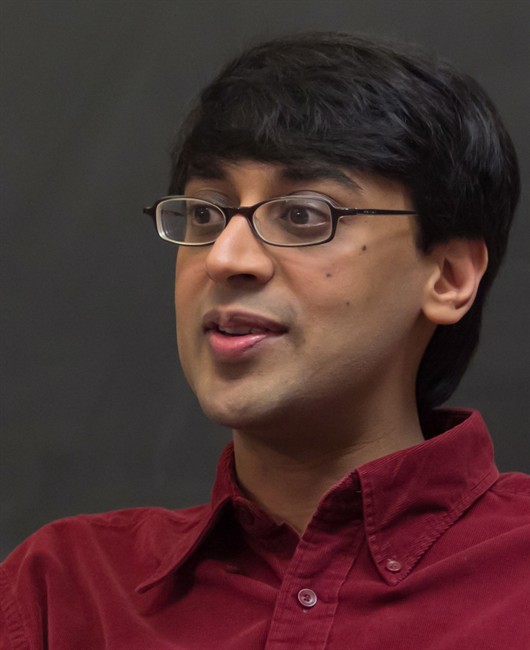
It is managed by the International Mathematical Union (IMU), who says Bhargava is being recognized “for developing powerful new methods in the geometry of numbers.”
The Fields Medal and a cash prize of US$13,700 are awarded every four years to mathematicians 40 years old or younger.
According to the IMU, Bhargava, whose parents came to Canada from India before moving to the U.S., joined Princeton in 2003 after receiving his doctorate in mathematics from the university in 2001.
The school says Bhargava is known for his popular seminar for incoming students, which explores the mathematical principles behind games and magic tricks.
He has also received numerous other awards and was elected to the U.S. National Academy of Sciences in 2013. He was named one of Popular Science magazine’s “Brilliant 10” in 2002.
Bhargava was in Seoul for a week-long conference and could not be reached for comment Thursday.
In a Princeton news release, he acknowledged those who worked alongside him, saying, “this is their prize too.”
“I am, of course, very honoured,” Bhargava said. “Beyond that, it is a great source of encouragement and inspiration, not just for me, but I hope also for my students, collaborators and colleagues who work with me.”
University of Montreal math professor Andrew Granville, who designed a summer course for his students on Bhargava’s work, said Bhargava has made breakthroughs in number theory — the study of whole numbers.
Granville, who has met Bhargava dozens of times at conferences, added that Bhargava has a unique thought process, with an ability to “get to the crux of the matter.”
“His approach tends to be somewhat less technical than the others,” he said.
“Some of these people are working on stuff you need years and years to really understand what they’re trying to do.

“Bhargava’s program — I wouldn’t say easy — but you have some opportunity to get to grips with it in a relatively short amount of time.”
Three other mathematicians received the prize this year, including Maryam Mirzakhani, a Stanford University professor, Artur Avila, a Brazilian-born professor at the Institute of Mathematics of Jussieu in Paris and Martin Hairer of the University of Warwick in England.
Mirzakhani, 37, who was born and raised in Tehran, Iran, where she earned her bachelor’s degree, is the first woman to win the award.
“This is a great honour. I will be happy if it encourages young female scientists and mathematicians,” she said in a statement released by Stanford. “I am sure there will be many more women winning this kind of award in coming years.”
_ With files from The Associated Press.