

Their passion is plane to see
Flyers like aircraft built by hand
Advertisement
Read this article for free:
or
Already have an account? Log in here »
To continue reading, please subscribe:
Monthly Digital Subscription
$1 per week for 24 weeks*
- Enjoy unlimited reading on winnipegfreepress.com
- Read the E-Edition, our digital replica newspaper
- Access News Break, our award-winning app
- Play interactive puzzles
*Billed as $4.00 plus GST every four weeks. After 24 weeks, price increases to the regular rate of $19.95 plus GST every four weeks. Offer available to new and qualified returning subscribers only. Cancel any time.
Monthly Digital Subscription
$4.99/week*
- Enjoy unlimited reading on winnipegfreepress.com
- Read the E-Edition, our digital replica newspaper
- Access News Break, our award-winning app
- Play interactive puzzles
*Billed as $19.95 plus GST every four weeks. Cancel any time.
To continue reading, please subscribe:
Add Free Press access to your Brandon Sun subscription for only an additional
$1 for the first 4 weeks*
*Your next subscription payment will increase by $1.00 and you will be charged $16.99 plus GST for four weeks. After four weeks, your payment will increase to $23.99 plus GST every four weeks.
Read unlimited articles for free today:
or
Already have an account? Log in here »
Hey there, time traveller!
This article was published 26/09/2014 (4213 days ago), so information in it may no longer be current.
STEINBACH — It wasn’t just that John Linde landed his home-built Super Cub aircraft on an Alaskan glacier, bouncing along its surface with low-pressure tundra tires.
He also broke a brake while flying in Alaska’s Wrangell-St. Elias National Park. Bill Funk, who built most of the airplane and accompanied him on the flight, fixed it using a coat hanger for a welding rod.
Those magnificent men in their flying machines — their homemade flying machines.
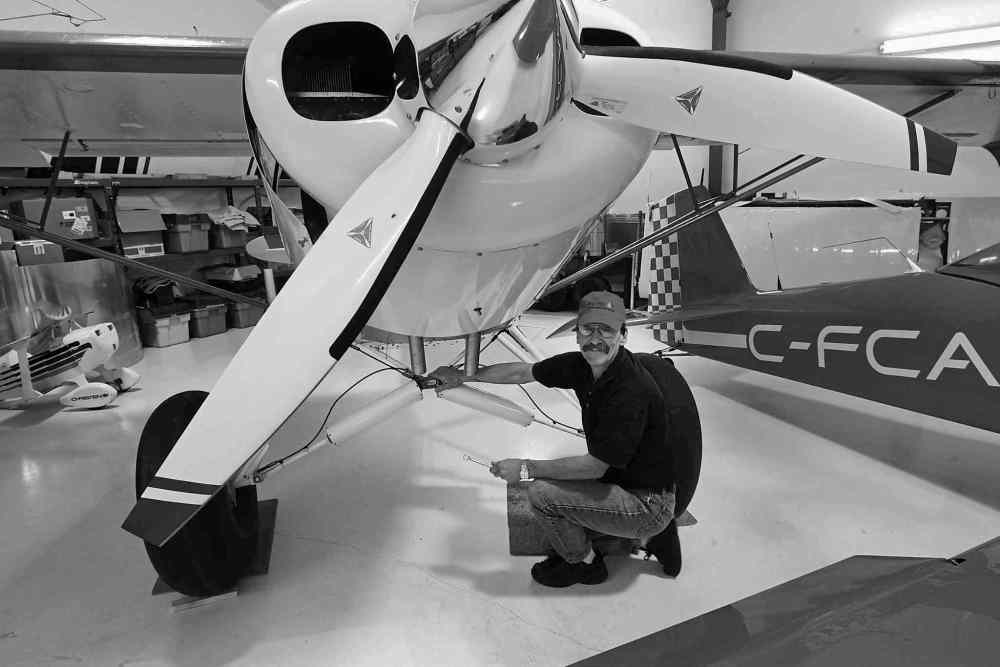
The Steinbach Airport is Manitoba’s hotbed for do-it-yourself plane builders. There are about 20 home-built planes in the area. Nine fly out of the small Steinbach Airport. That’s believed to be more than the number of regular manufactured planes housed there.
The hobbyists make all kinds of sporty small aircraft, with various personal touches. In the case of Linde’s Super Cub, he added extra fuel tanks into the wings, and in a belly pod under the cockpit, so he could make longer northern flights without refuelling.
Then there’s flyer Alex Loewen, who wanted to transport his plane down the highway, so he built wings that can fold back. “I can put it on a trailer,” he said.
Many choose to build planes with less speed, which allows for shorter takeoffs and landings. That way they can perform makeshift landings in various rural locales, like farm fields — and glaciers. Linde said glaciers are not pristine-white, nor smooth like a skating rink, as you might presume. They’re actually quite dirty from scouring the earth’s surface, much like the mountains of plowed snow that lingered around Winnipeg earlier this year.
The two gurus of home-built airplanes in southern Manitoba are Funk of Steinbach and Peter Kuzak, who lives just north of Winnipeg.
Kuzak had just the back legs and a couple of wheels from a plane and built an entire aircraft around them without any plans. Most hobbyists work from kits that cost in the $20,000 range. One of his modifications was to locate the radiator on the plane’s roof. In the first airplane he ever built, he installed an engine from a 1966 Chevy station wagon.
Funk is the same way, not needing to build from plans. An aircraft maintenance engineer by trade, he now works full time making home-built aircraft for clients under company name Funk Aviation.
Funk has made or helped with 15 home-built planes, his first made out of spruce wood. “It was just like building furniture,” he said.
Then he popped in a 12-horsepower, two-cycle go-kart engine. The entire plane weighed 145 pounds. It was a replica of a Birdman, whose slogan was, as recalled by Funk, “It could fly as slow as a man could run.”
The slower the better. “It’s flying like a bird. It doesn’t go fast. It’s like sitting in a lawn chair. You feel the connection with the air,” Funk said. “You could land in trees and probably not be hurt.”
Others have installed motors out of cars, snowmobiles and even lawn mowers, into their home-built planes. Linde assembled the motor himself at a school in Texas. Planes are also made out of all kinds of materials, including aluminum, fibreglass, synthetic cotton and even mahogany.

Fabric planes are good for aerobatics. A synthetic cotton is stretched very tightly around the frame like a sock. Builders then heat-shrink it with an iron-like device. A wax stitching is used to fasten the fabric to the aluminum ribs. Linde, a dentist in Steinbach who is originally from Hilbre in the Interlake, employed his dental support staff one day to help with the sewing and ironing of his plane.
It takes about 2,000 hours to build a small aircraft, using a kit. That’s about a full year of 40-hour work weeks. Most people don’t have that kind of time and will take two years or more to build.
Burt Loewen and Art Poetker, both semi-retired, took three years to build their slick-as-a-Corvette Van’s RV7B aircraft. While the kit cost $20,000, the engine cost another $25,000 and total cost was over $100,000. But they only needed about $500 worth of tools, including an electric drill, pliers, deburring tools and a punch for fastening rivets. They put in 14,000 rivets.
There is a “pre-cover” inspection (before the guts of the plane are covered up) by an inspector designated by Transport Canada, followed by a final inspection when the plane is completed. Pilots are required to fly it 25 hours within a 40-kilometres radius of their home airport, in case of any glitches, before the plane is fully licensed.
bill.redekop@freepress.mb.ca