WEATHER ALERT

Animal instincts

Two exhibitions by emerging local artists examine our complicated relationships with other living creatures

Advertisement

Advertise with us

Most of us can relate to other, non-human animals on some level, to the extent that we like to think they have human traits and motivations. We can't know for sure what (or even if) they actually think and feel like we do, but animals populate our myths and movies, serve as emblems for countries and sports franchises, and become cherished members of human families. The way we regard and relate to animals is shaped by cultural norms and practical concerns (namely the need to feed and clothe ourselves), but it also shows us the limits of our ability to empathize, something at the heart of solo exhibitions by two very different emerging artists.

Read this article for free:

or

Already have an account? Log in here »

To continue reading, please subscribe:

Subscribe and receive a limited-edition Free Press branded hat or tote.

Digital Subscription

One year of digital access for only $205*

  • Enjoy unlimited reading on winnipegfreepress.com
  • Read the E-Edition, our digital replica newspaper
  • Access News Break, our award-winning app
  • Play interactive puzzles

*First annual payment billed as $205.00 + GST for one year. This annual subscription will automatically renew at $233.00 + GST every 52 weeks (10% off the regular annual price of $259.35). Offer available to new and qualified returning subscribers only. Cancel any time.

To continue reading, please subscribe:

Add Free Press access to your Brandon Sun subscription for only an additional

$1 for the first 4 weeks*

  • Enjoy unlimited reading on winnipegfreepress.com
  • Read the E-Edition, our digital replica newspaper
  • Access News Break, our award-winning app
  • Play interactive puzzles
Start now

*Your next Brandon Sun subscription payment will increase by $1.00 and you will be charged $17.95 plus GST for four weeks. After four weeks, your payment will increase to $24.95 plus GST every four weeks.

Opinion

Hey there, time traveller!
This article was published 09/10/2014 (4310 days ago), so information in it may no longer be current.

Most of us can relate to other, non-human animals on some level, to the extent that we like to think they have human traits and motivations. We can’t know for sure what (or even if) they actually think and feel like we do, but animals populate our myths and movies, serve as emblems for countries and sports franchises, and become cherished members of human families. The way we regard and relate to animals is shaped by cultural norms and practical concerns (namely the need to feed and clothe ourselves), but it also shows us the limits of our ability to empathize, something at the heart of solo exhibitions by two very different emerging artists.

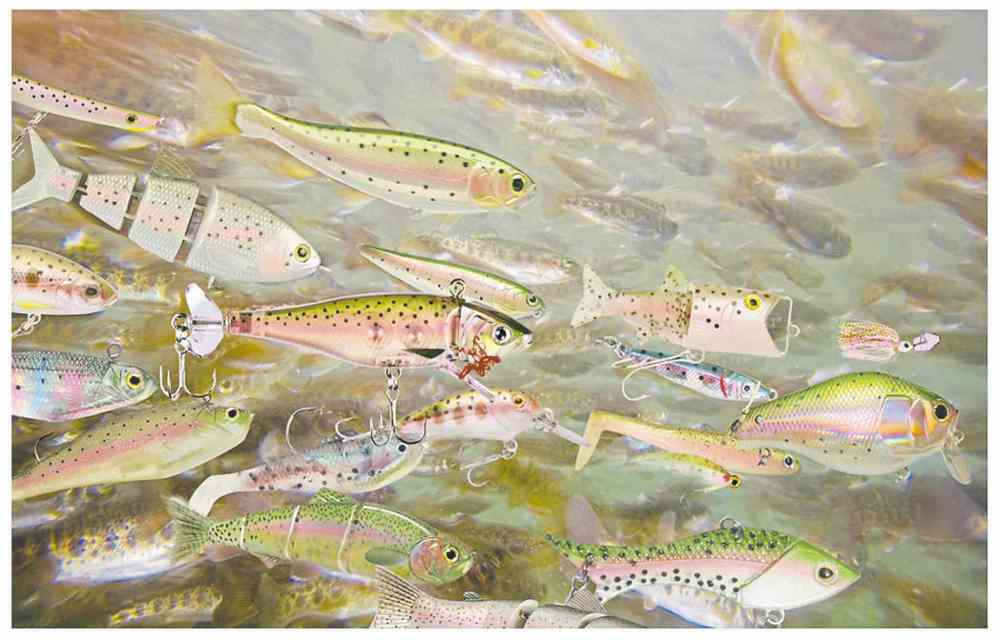
In Émouvoir (“to move”), which closes this week at the Maison des Artistes, Yvette Cenerini’s slick digital collages illustrate animal behaviours that seem to suggest familiar, human-like emotions. Each composite image depicts a specific research finding or field observation, case study in “joy,” “fear,” “hope,” or “pain.” A grieving mother gorilla cradles her infant’s corpse for days after it dies. Brain-damaged rats lose their fear of cats and laboratory mice lose their will to live. Cockatoos find May-December romance and military dogs develop post-traumatic stress disorders.

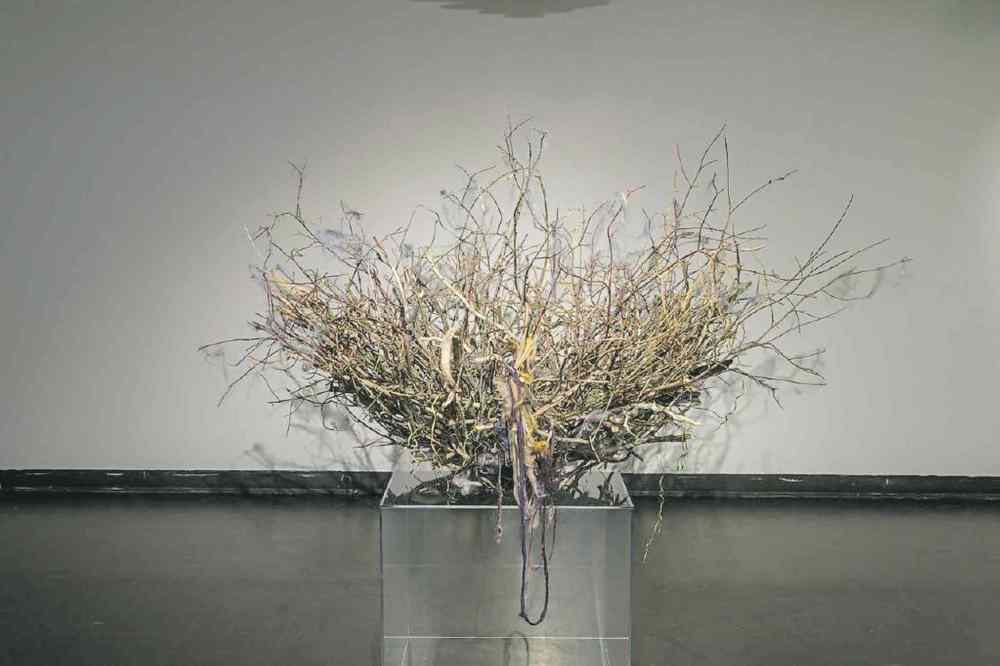
Cenerini looks to provoke an emotional response, and the imagery isn’t exactly subtle, but her inventive digital printing techniques give the work an uncanny illusion of depth. Stacked layers of printed Mylar lend a school of silvery fishing lures a scaly verisimilitude, but they also separate out the collaged layers, revealing the work’s constructed nature. The admission of artifice is a reminder that, however things might look from our perspective, the inner lives of other animals remain frustratingly off limits.
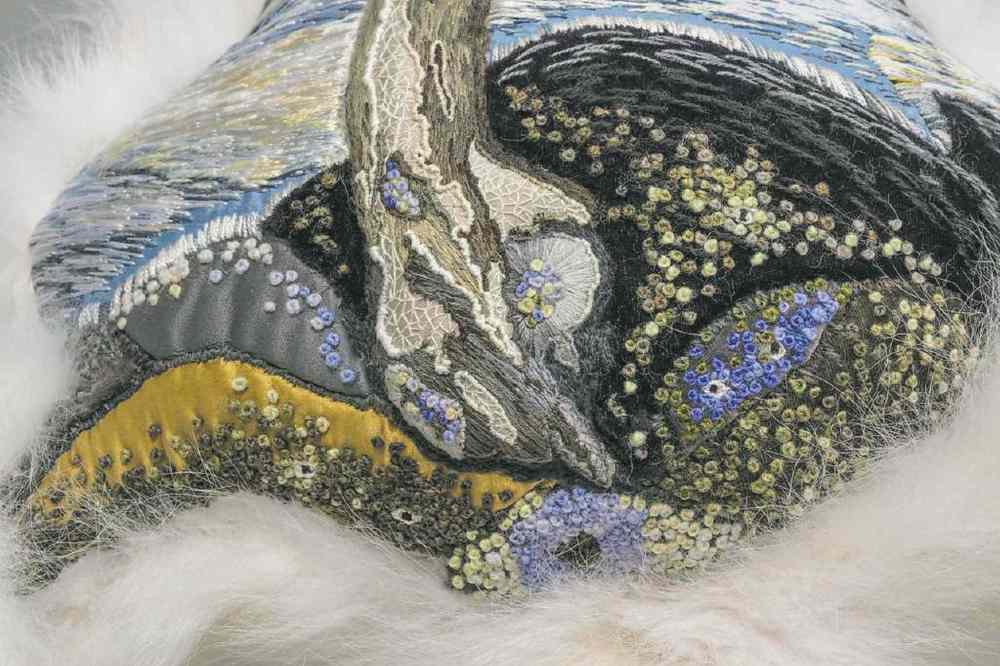
Detail from Rector's The Singing Bone

In Trapped, an exhibition at Gallery 1C03, Willow Rector offers a view of our relationship with animals and the landscape they inhabit that’s both panoramic in scope and shockingly intimate. Her richly embroidered animal pelts — skunk, ermine, otter, lynx — combine references to the fur trade, to Canadian modernist landscape painting (specifically the Group of Seven), and to historically overlooked, gendered forms of expression (namely needlework). She loosely translates the Group’s iconic vistas into dense fields of compacted satin stitches, affixing the embroidered panels to the underside of each skin. In the darkened gallery, the spotlit sculptures hang suspended from monofilament as if caught in free fall, casting human-like shadows on the wall.

Made on-location in a style that broke with the staid conventions of colonial painting, the Group of Seven landscapes that Rector quotes were firsthand impressions of the Canadian wilderness. With time and exposure, they would evolve into kind of neutral, decorative shorthand for “Canadianness.” By stitching them onto a canvas of hide and fur, she seeks to reunite the images with their “wild,” embodied and tactile origins while acknowledging that, one some level, they remain “trapped” and dead.

We can imagine that Rector’s landscapes offer glimpses of what each animal might have experienced in life, but this is a confabulation, a projection and, in any case, they’re dead now. She memorializes the animals, repairing wounds and punctures with crystal beads, even as she reduces them to convenient metaphors and, quite literally, raw material. The works are pointedly ambivalent, both tender and cruel, luxurious and morbid, beautiful objects that nevertheless speak to violence and exploitation — in the name of national identity, in the service of art. They test our willingness to identify with other animals, showing us the limits of our empathy.


Steven Leyden Cochrane is a Winnipeg-based artist, writer and educator.
Cenerini's Pain
Cenerini's Pain
Sculpture by Willow Rector
Report Error Submit a Tip

More Stories

Bombers search for an offensive identity after Week 8 tailspin

Ken Wiebe 7 minute read Preview

Bombers search for an offensive identity after Week 8 tailspin

Ken Wiebe 7 minute read 6:30 PM CDT

Tommy Condell has been around long enough to know that criticism is part of the job, so you can understand why there were moments when the Winnipeg Blue Bombers offensive co-ordinator sounded a tad defensive when speaking to the media on Monday afternoon.

The Bombers were coming off a disappointing 52-30 loss to the Calgary Stampeders that dropped them to 4-3 on the season.

In many instances, a 30-point outburst would have been cause for celebration. But when you look under the hood of Friday’s outing — which included four interceptions for Bombers pivot Dru Brown — the picture wasn’t quite as rosy.

Compounding matters, star tailback Brady Oliveira went from making the longest touchdown run of his CFL career — a 45-yard scamper late in the third quarter — to being a mostly forgotten player in the fourth as the club mostly abandoned the run in an effort to rally from nine and eventually 12-point deficits.

Read
6:30 PM CDT

Ref ‘dominates’ game in Sea Bears loss to Honey Badgers, says coach

Joshua Frey-Sam 7 minute read Preview

Ref ‘dominates’ game in Sea Bears loss to Honey Badgers, says coach

Joshua Frey-Sam 7 minute read Saturday, Jul. 25, 2026

Following a festive Christmas-in-July-themed Saturday afternoon inside Canada Life Centre, Winnipeg Sea Bears head coach Mike Raimbault didn’t mince words about who he thought was the Grinch in a hard-fought 88-86 loss to the visiting Brampton Honey Badgers that ended in controversy.

As the Sea Bears owned a one-point lead in Target Score Time, Brampton guard Sean East II was awarded three free throws — all of which he converted — after a questionable foul called on Teddy Allen by official Perry Stothart.

Raimbault, who has been known to bite his tongue on such topics, left nothing to the imagination about where he stood on the game-deciding judgment made in a game that had major post-season implications.

“I just felt like it was a fitting ending to the game where Perry Stothart had dominated the flow of the game from the start,” he said. “For him to call a bit of a guess foul and end the game on the foul, I felt like it’s disappointing that he can come in and dictate how the game’s going to be played and flow, and (that) continues to be a bit of an M.O. for him. So I think we’re disappointed with the fact that the league continues to let that happen.”

Read
Saturday, Jul. 25, 2026

An eroding Winnipeg neighbourhood looks to new foundations

Ian Bickis, The Canadian Press 5 minute read Preview

An eroding Winnipeg neighbourhood looks to new foundations

Ian Bickis, The Canadian Press 5 minute read Updated: Yesterday at 1:34 PM CDT

WINNIPEG - The lot Jesse Bettcher lives on in Winnipeg's north end used to be a pile of burnt rubble. Same with the one next door. And the one across the street.

But he's now the proud owner of a two-storey house with blue-grey siding and white trim, so new the orange construction fencing is still out front.

It's a dream home for Bettcher, and the latest hope for a city seeking to knock down, clean up and revitalize neighbourhoods that have seen hundreds of homes left vacant, leading to safety hazards and worries about the future.

He bought the house as part of a pilot project aimed at creating affordable home ownership. It let him and his family move out of a rental that he said was falling apart.

Read
Updated: Yesterday at 1:34 PM CDT

Puzzles Palace

1 minute read Updated: 1:37 PM CDT

To solve our puzzles, please subscribe with this special offer: |

Police are asking for help locating a 36-year-old woman missing for approximately 10 days.

Last seen on July 18, Dixie Richard was reported missing Saturday evening to Cross Lake RCMP, said a news release from Mounties Monday, with both police and her family concerned for her well-being. 

She was in Winnipeg for an appointment, but it’s unclear if she made it and nobody has seen her since, said RCMP. It’s believed she’s still in the city.

Richard is described as five-foot-one with a thin build and black hair. RCMP said she was last seen wearing a black tank top and leggings, black Nike shoes and had a black cross-body bag. She may also be wearing a black baseball hat.

Qualico celebrating 75 years of growth, success since its first development of 13 bungalows in River Heights

Aaron Epp 6 minute read Preview

Qualico celebrating 75 years of growth, success since its first development of 13 bungalows in River Heights

Aaron Epp 6 minute read 6:00 AM CDT

The first things staff and visitors see after ascending to the third floor of Qualico’s head office in Winnipeg are two statues — one each for company founders David and Katherine Friesen.

Flanking the doors to the integrated real estate company’s C-suite offices, the bronze sculptures are monuments to the couple and the vision, strength and integrity (as the plaques attached to the wooden pedestals attest) it took to start Qualico in 1951.

But imagine for a moment what it would be like if the sculptures were less reverent and more whimsical. Picture them outfitted with the kind of pull-string voice boxes one finds in a child’s toy. What might they say?

It’s possible one of David Friesen’s phrases would be: “No margin, no mission.”

Read
6:00 AM CDT