

New Flyer developing latest in hybrid buses
Will run on battery-electric/fuel cell
Advertisement
Read this article for free:
or
Already have an account? Log in here »
To continue reading, please subscribe:
Monthly Digital Subscription
$1 per week for 24 weeks*
- Enjoy unlimited reading on winnipegfreepress.com
- Read the E-Edition, our digital replica newspaper
- Access News Break, our award-winning app
- Play interactive puzzles
*Billed as $4.00 plus GST every four weeks. After 24 weeks, price increases to the regular rate of $19.95 plus GST every four weeks. Offer available to new and qualified returning subscribers only. Cancel any time.
Monthly Digital Subscription
$4.99/week*
- Enjoy unlimited reading on winnipegfreepress.com
- Read the E-Edition, our digital replica newspaper
- Access News Break, our award-winning app
- Play interactive puzzles
*Billed as $19.95 plus GST every four weeks. Cancel any time.
To continue reading, please subscribe:
Add Free Press access to your Brandon Sun subscription for only an additional
$1 for the first 4 weeks*
- Enjoy unlimited reading on winnipegfreepress.com
- Read the E-Edition, our digital replica newspaper
- Access News Break, our award-winning app
- Play interactive puzzles
*Your next Brandon Sun subscription payment will increase by $1.00 and you will be charged $17.95 plus GST for four weeks. After four weeks, your payment will increase to $24.95 plus GST every four weeks.
Read unlimited articles for free today:
or
Already have an account? Log in here »
Hey there, time traveller!
This article was published 15/10/2014 (4223 days ago), so information in it may no longer be current.
IT’S a new twist on hybrid buses, and it’s being developed right here in Winnipeg.
Monday, New Flyer Industries Inc. announced it is developing the first North American-designed and built zero-emission, 60-foot transit bus that combines a battery-powered electric drive unit with an electricity-generating hydrogen fuel cell.
The new battery-electric/fuel cell propulsion system, which will be developed in partnership with Ballard Power Systems Inc. and Siemens, will be integrated into New Flyer’s Buy-American-compliant Xcelsior X60 heavy-duty transit bus platform. That platform includes a combination of batteries, a fuel cell and hydrogen storage.
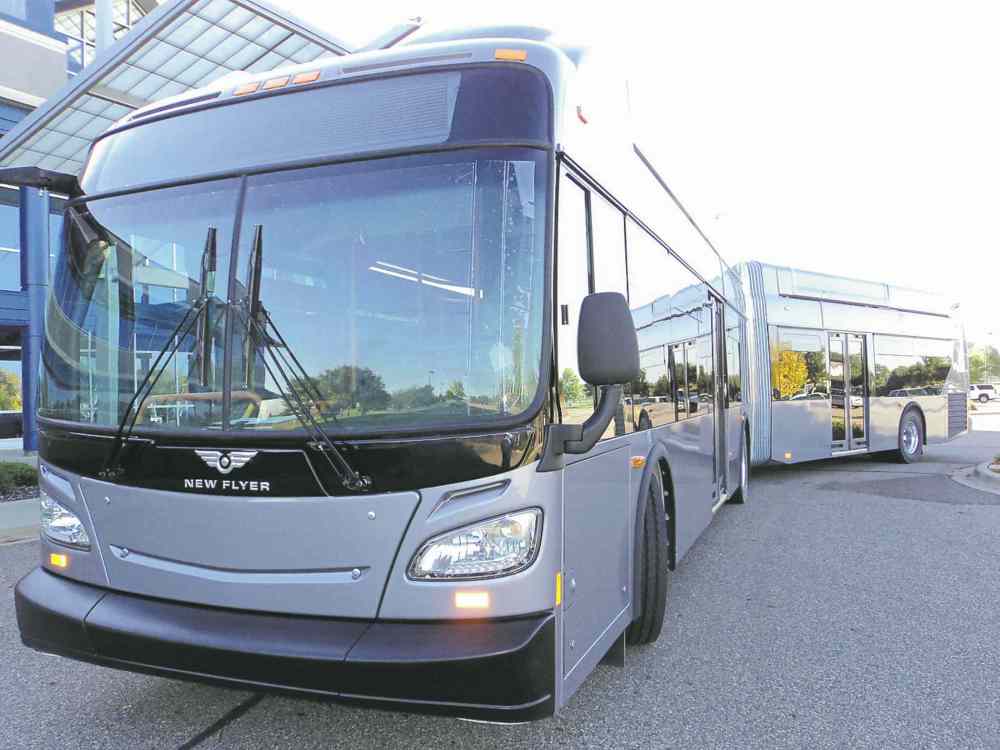
Last Friday, New Flyer also announced it is adding a new battery-electric propulsion system for its line of Xcelsior buses.
President and CEO Paul Soubry said in a written statement the development of the new 60-foot battery-electric/fuel cell bus represents another important step in the company’s pursuit of durable, reliable and affordable zero-emission transit buses.
“Over the next decade, we expect to see a continued transition from conventional propulsion towards zero-emission technologies in the heavy-duty transit market, and this builds on our natural evolution from diesel, to hybrid, to natural gas, to electric — all based on the same proven Xcelsior bus platform.”
The company said the new model will feature a Ballard-built, next-generation, fuel-cell power plant that is smaller, lighter and less costly than existing models. The new electric-drive model will allow the fuel cell to operate at a relative steady state, while the batteries will capture braking energy and also provide power for acceleration.
New Flyer said Connecticut Transit will be trying out the new battery-electric/fuel cell bus for 22 months. The bus will also have to pass a full durability and performance test as part of the U.S. Federal Transit Administration’s bus-testing program.

If everything goes well, the company will begin offering the new bus to customers throughout North America. It didn’t say how soon that might happen, and Soubry was unavailable Tuesday for further comment.
New Flyer, which has production plants in both Winnipeg and the United States, is North America’s largest manufacturer of heavy-duty transit buses. It also offers the industry’s broadest product line, with models that run on clean diesel or natural gas, as well as a diesel-electric hybrid, electric trolley buses, fuel-cell hybrid buses and now, a battery-electric hybrid bus.
The company has been producing zero-emission buses since 1995, when it delivered North America’s first 40-foot hydrogen-cell bus.
New Flyer shares (TSX:NFI) trade on the Toronto Stock Exchange and closed Tuesday down two cents to $12.74 on a trading volume of 43,859 shares.
murray.mcneill@freepress.mb.ca