

Falling for fall
Quality nature time in scenic West Virginia
Advertisement
Read this article for free:
or
Already have an account? Log in here »
To continue reading, please subscribe:
Digital Subscription
One year of digital access for only $1.44 a week*
- Enjoy unlimited reading on winnipegfreepress.com
- Read the E-Edition, our digital replica newspaper
- Access News Break, our award-winning app
- Play interactive puzzles
*Billed as $5.77 plus GST every four weeks. After 52 weeks, price increases to the regular rate of $19.95 plus GST every four weeks. Offer available to new and qualified returning subscribers only. Cancel any time.
To continue reading, please subscribe:
Add Free Press access to your Brandon Sun subscription for only an additional
$1 for the first 4 weeks*
- Enjoy unlimited reading on winnipegfreepress.com
- Read the E-Edition, our digital replica newspaper
- Access News Break, our award-winning app
- Play interactive puzzles
*Your next Brandon Sun subscription payment will increase by $1.00 and you will be charged $17.95 plus GST for four weeks. After four weeks, your payment will increase to $24.95 plus GST every four weeks.
Read unlimited articles for free today:
or
Already have an account? Log in here »
Hey there, time traveller!
This article was published 18/10/2014 (4249 days ago), so information in it may no longer be current.
I’ve chased Technicolor leaves from coast to coast, timed trips to scenic locales to coincide with the annual change. I’ve trekked to Cape Cod, Massachetts; Seattle; Harpers Ferry, West Virginia; Charlottesville, Virginia. A honeymoon, a birthday trip, a football game, a heck-let’s-jump-in-the-car-and-go-somewhere day: I can find any excuse for an October excursion.
I never get tired of leaf-peeping, and sometimes just a quick drive out to the country to do it is all I need to refresh myself after a hectic summer and before the cold, short days of winter. And I can think of few places more refreshing than West Virginia.
Which is why on a threateningly gray October morning last year, I set out for the Mountain State. Plus, I had arranged to meet someone who’s as crazy about foliage as I am. If that’s even possible.
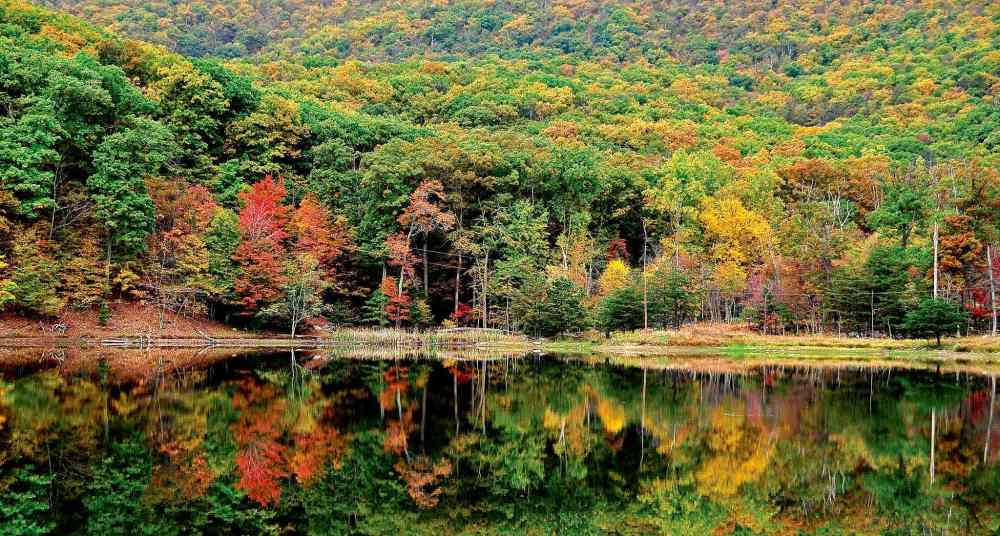
En route to West Virginia, I hit the expected white-knuckle stop-and-go traffic I’ve become so accustomed to on Interstate 66. As I continue west, the roads narrow and the vistas expand. I can catch only blurred glimpses of colour — eyes on the road, please! — so by the time I pull into the parking lot at Cacapon Resort State Park, I’m ready to slow down and soak it all in.
You’d be hard-pressed to find a better hotbed for foliage than this finger-shaped, 6,000-acre retreat south of Berkeley Springs. The focal point is Cacapon Mountain, elevation 700 metres. From the top, you can see four states: Maryland, Virginia, Pennsylvania and, of course, West Virginia.
The park’s main lodge is just the kind of rustic but charming place that you’d want to make your headquarters for some quality nature time. When I walk into what you might call the lodge’s great room, I come across a group of women happily chatting, all positioned to take advantage of the views from the panel of glass windows that overlook the tree-bordered golf course.
It’s not hard to pick out the man I’ve come to meet: Steve Shaluta, a staff photographer for the West Virginia Department of Commerce. The cameras and laptop are a dead giveaway.
Every year for almost the past 30, Shaluta has travelled the state to photograph its patchwork quilt of foliage. “Fall colours is what all of us nature photographers look forward to every year,” he says.
No pressure, but so do the tourists his employer hopes to lure to the state using his photographs.
The notion of someone paid to leaf-peep fascinates me. Or, to be more accurate, makes me rather envious. I want to know what it’s like to be at the centre of the autumnal frenzy, to be on the front lines of helping the state’s tourism officials announce peak season — and maybe get some insider tips on where to find the best foliage.
Before we head up Cacapon Mountain, we’re joined by Herb Peddicord, another cog in the wheel of the annual Operation Foliage. The Chesapeake Bay Watershed forester with the West Virginia Division of Forestry (also part of the Commerce Department) turns in a report on the colours’ progress every Tuesday for the following weekend.
“We always try to anticipate what it’s going to look like,” Peddicord says. He doesn’t have to go too far out of his way to make his observations, since his job pretty much requires that he be out in nature. “We drive around enough to notice what’s changing and when.”
As we bounce along the rutted road in Shaluta’s state car to the top of the mountain, Peddicord rattles off names of foliage-boasting flora common to the region — oak, hickory, red maple, tulip poplar, black birch. My ears pop as we climb higher past flashes of crimson and gold.
I ask him what brings on the annual display of color. Peddicord explains that as daylight hours decrease, the trees slow down their chlorophyll production. As the green goes away, the leaves’ other tones come to the fore. In dry times, leaves can start dropping early. Cloudy days can fool the trees into a premature change. For a banner year, ideal conditions are lots of moisture followed by lots of sunshine and cool days, Peddicord says. (Shaluta, for his part, says that despite what all the science indicates, his experience is that the driest summers produce the best fall colors.)
The year has been pretty normal as far as moisture goes, but when we get to the top of the mountain, the view is anything but ordinary.
The sun, as if on cue, breaks through the persistent clouds. On three sides of the observation platform we’re standing on, we’re surrounded by trees with leaves in various shades of yellow and orange. Below us, the mountain drops off in a steep incline. Farther out, the landscape spreads into gentle ripples of hills, still mostly green but with intermittent bursts of color.
So, yes, there’s still magic waiting to happen, even though Shaluta has been driving around the state shooting foliage since the end of September.
The varied nature of the state’s terrain means that not all trees turn at the same time. “In West Virginia, you could really leaf-peep three or four weeks and hit different areas of the state,” Peddicord says.
It’s too bad that I only have one day – a few hours, really – to see it.
I strain against the platform’s wooden railing, where previous visitors have carved their initials, and pull out my little Canon point-and-shoot camera, knowing that it will never sufficiently capture the topography, the almost imperceptible intricacies of color gradation.
Even though he works with top-of-the-line equipment provided by the state, Shaluta understands my frustration. He says that the eye will pick up more color than a camera ever could, so in the process of editing his images in Photoshop, he tries to bring back some of that vibrancy.
I’ll probably never put that much work into my photos. And yet, away I click.
We go from above the trees to into the thick of them. The three of us start down one of the hiking trails so that I can see the photographer and the forester in their elements.
We’re immersed in green and yellow. The trees lean toward one another on either side of the trail like the vaulted ceiling of a Gothic cathedral. Fallen leaves rustle underfoot as we follow the ruts left by unknown vehicles at unknown times. I’ve put away my camera for now, but Shaluta has his at the ready. “I’m looking for color and a turn in the trail,” he says. A path curving off into the distance makes for a nice image, he thinks.
He likes being in the woods because the lighting is less harsh, which is also why he favors overcast days. “Sometimes (the color) seems a lot more brilliant in the darkness,” Peddicord says. Shaluta also seeks out waterfalls, which he captures on a longer exposure. His favorite times to shoot are early morning and late evening. He’d already been out for several hours before I arrived, including at the park’s lake.
On our walk, I notice that the foliage looks a bit thin, at least at eye level. “Deer really affect fall color,” Peddicord says, because they eat the understory, or underbrush. When they don’t eat it all up, though, “road edges are really good for fall colors because they have a lot of understory.” So deer and I are drawn to the same thing, albeit for different reasons. That may be the first and last time I can say that.
This short trip to West Virginia has only made me want to see more foliage — if not today, if not this season, then at least another year. I figure that Peddicord and Shaluta must know the state backward and forward, so I ask them for the best places for leaf-peeping.
Peddicord recommends Panorama at the Peak in Berkeley Springs and Corridor H (U.S. Route 48), an as-yet-unfinished highway in the northeastern portion of the state.
Shaluta likes Dolly Sods Wilderness in the Monongahela National Forest and Canaan Valley, which he says is one of the first spots to see changing colors because of the “frost bowl” that traps cold air. Regardless of where you are, though, “the color is always here,” he says.
After Peddicord and Shaluta leave, I decide to kill some time at the lodge, so I retire to the covered back patio and stretch out on a wooden lounge chair with a snack.
Will I remember this view 30 years from now? Will it blend in with all the other foliage I’ve seen?
Earlier in the day, Shaluta had shown me all the park brochures in the lobby that feature his photos on the cover. Keep in mind that he can take upwards of 1,000 photographs each day. (Sometimes he’ll stay up until midnight or later finding just the right picture to pass on to his bosses for Facebook-posting purposes.)
When it comes to his own work, you might say he has a photographic memory. “I can’t remember what I had for breakfast, but I remember these things,” Shaluta laughed. “My problem is, I’ve seen it at the best of the best,” he’d said. Nonetheless, his professional instinct means that even when he’s off-duty, he’s always thinking about the scenery from the perspective of a photographer looking for the perfect shot.
“Mentally, it’s just exhausting to see all this color and not be able to do something with it,” he added. A pause. “I still love it.”
As I linger on the patio, a gentle rain begins to fall. No matter. The golf course is a glistening emerald green, the foliage behind it a pointillistic tapestry. Soothed by the sounds of falling water, I could sit here for hours, transfixed by the colors of fall. I still love it, too.
If you go:
Getting there
Cacapon Resort State Park is about 105 miles northwest of Washington, D.C. Take Interstate 66 west to I-81 north. Take Exit 317 to U.S. 11 south and then continue on Va. 37 south. Take the U.S. 522 north exit. Shortly after crossing the state line into West Virginia, turn left on Cacapon Lodge Drive.
Where to see foliage
Cacapon Resort State Park
818 Cacapon Lodge Dr.
304-258-1022
–The Washington Post