

Telcos battle over NHL web content
Rogers defends Internet turf against rivals
Advertisement
Read this article for free:
or
Already have an account? Log in here »
To continue reading, please subscribe:
Monthly Digital Subscription
$1 per week for 24 weeks*
- Enjoy unlimited reading on winnipegfreepress.com
- Read the E-Edition, our digital replica newspaper
- Access News Break, our award-winning app
- Play interactive puzzles
*Billed as $4.00 plus GST every four weeks. After 24 weeks, price increases to the regular rate of $19.95 plus GST every four weeks. Offer available to new and qualified returning subscribers only. Cancel any time.
Monthly Digital Subscription
$4.99/week*
- Enjoy unlimited reading on winnipegfreepress.com
- Read the E-Edition, our digital replica newspaper
- Access News Break, our award-winning app
- Play interactive puzzles
*Billed as $19.95 plus GST every four weeks. Cancel any time.
To continue reading, please subscribe:
Add Free Press access to your Brandon Sun subscription for only an additional
$1 for the first 4 weeks*
*Your next subscription payment will increase by $1.00 and you will be charged $16.99 plus GST for four weeks. After four weeks, your payment will increase to $23.99 plus GST every four weeks.
Read unlimited articles for free today:
or
Already have an account? Log in here »
Hey there, time traveller!
This article was published 08/12/2014 (4140 days ago), so information in it may no longer be current.
TORONTO — Hockey is so crucial to television revenue streams that Canada’s largest media companies are battling publicly over access to camera angles during games.
The fight revolves around an online feature Rogers Communications offers customers called GamePlus, which enables users to watch and replay game footage from multiple angles, including a camera mounted on a referee’s helmet. BCE Inc., known as Bell, was first to complain to regulators that its subscribers should have access to those same online options.
It’s not just camera angles that are at stake. In question is whether Rogers’ $5.2-billion deal to distribute National Hockey League games in Canada will pay off, as well as what regulators deem to be TV content in the Internet age. The 12-year hockey contract, signed last year, was a bet Rogers could win new subscribers by offering video on tablets and smartphones. While companies are required to provide universal access to content produced for TV, the same rules don’t currently apply to Internet-only media.
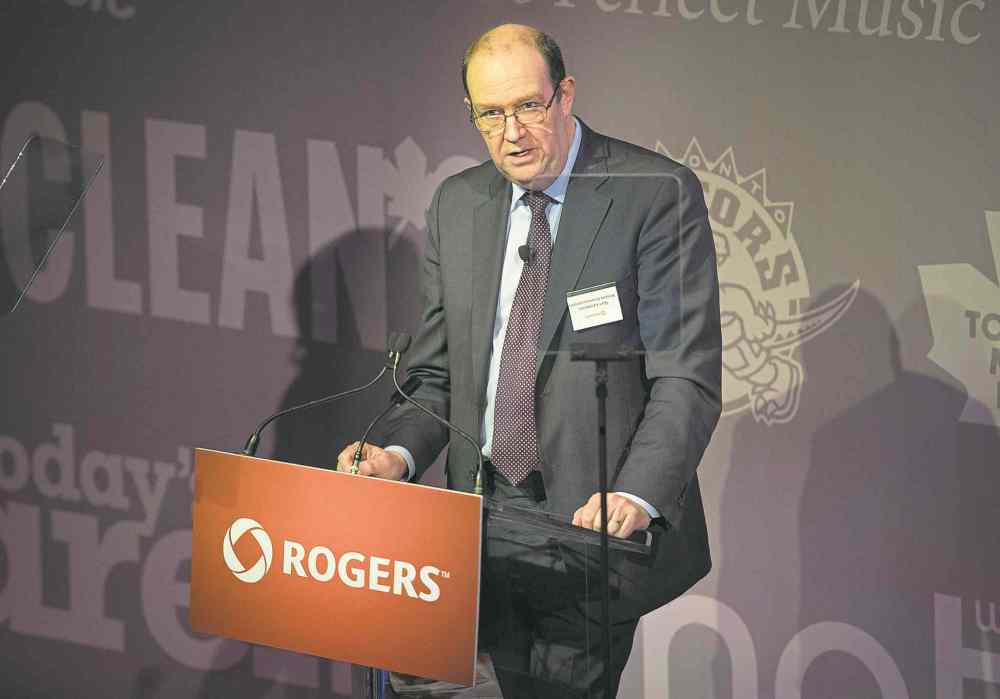
“I think the Bells and the Teluses will win,” Dvai Ghose, an analyst with Canaccord Genuity Group Inc., said in a phone interview. “Obviously that leads to the question, which is, why did Rogers spend $5.2 billion on the NHL rights and can they monetize them effectively?”
Rogers chief executive officer Guy Laurence called Bell a “crybaby” with a “puerile attitude” during his company’s third-quarter earnings call, saying his rival was trying to stifle innovation. Telus Corp. and Eastlink, the brand name of Bragg Communications Inc., have since joined BCE’s complaint.
The complaints are forcing the Canadian Radio-television and Telecommunications Commission (CRTC) to decide whether Rogers will be allowed to offer some access to hockey exclusively. GameCentre, the streaming service that GamePlus is part of, costs $199 for a season pass. Rogers customers get free access, including the unique camera angles, until the end of December.
Users streamed 1.9 million minutes of hockey through Rogers’ Internet and mobile services on Oct. 8, the NHL’s opening night, the company said in a statement. At one point, there were more fans watching on mobile in Toronto than in the entire U.S., Rogers said. More than 700,000 Canadians are registered to play hockey, compared with 500,000 in the U.S., a nation with about nine times the population, report the countries’ hockey associations.
Online streaming is becoming increasingly important for media companies. Rogers has lost cable customers for five consecutive quarters as users ditch traditional TV subscriptions for Internet-delivered services. Products such as GameCentre Live are part of Laurence’s strategy to retain high-value customers with free or exclusive offerings, he said during the Oct. 23 conference call.
Rogers, based in Toronto, has lagged behind Bell and Telus in adding new wireless subscribers. Revenue at the company’s media unit, which includes subscriptions to the hockey app, was unchanged last quarter at $440 million. Rogers’s total revenue for the third quarter was C$3.25 billion.
Rogers shares have fallen 6.5 per cent this year, while BCE has gained 15 per cent and Telus has risen 16 per cent.
When Rogers announced its arrangement with the NHL a year ago, it trumpeted the deal as the first time the NHL was granting all Canadian rights to a single broadcaster. Now, an adverse ruling from the regulator may call into question whether the contract to broadcast Canada’s favourite sport is as valuable as originally thought.
The CRTC’s rules say features developed exclusively for Internet customers don’t have to be shared. Bell and Telus argued in submissions to the regulator that the unique camera angles are derived from TV content and, therefore, shouldn’t be treated as Internet-only.
“Canadians should be able to access the content they want from the provider of their choice, and not be forced to pay for multiple wireless or Internet services,” Shawn Hall, a spokesman for Telus said in an e-mail.
Rogers’s GamePlus denies content to rivals’ subscribers and gives Rogers an anticompetitive advantage, Bell said in its submission to the CRTC. A representative for Bell didn’t respond to requests for comment.
Rogers says it designed the app specifically to comply with the regulations.
“If this isn’t Internet content, what is?” Ken Engelhart, Rogers’s head of regulatory affairs, said in a phone interview. “We’re pretty confident that what we’ve done here does comply with the CRTC rules.”
Rogers also said it isn’t concerned about recouping its investment in the NHL.
“We fully expect that revenues generated by advertising, sponsorships and subscriptions to our Sportsnet properties will more than offset the costs over the duration of the contract,” Patricia Trott, a spokeswoman for Rogers, said in an email.
Hockey will be a high-profile issue for the CRTC, which could further define its policy on how broadcasters can market their content in a world where viewers are moving from TVs to tablets and smartphones.
“The question that’s being asked of the CRTC in this particular case is, ‘What does designed primarily for TV mean?’ ” said Benjamin Klass, a communications policy researcher at Carleton University in Ottawa. “Because at this point, from the consumer’s perspective, what’s the difference?”
Denis Carmel, a spokesman for the CRTC, said he couldn’t comment on the proceeding. He said the commission could make a decision based on the submissions or call for a public hearing.

The CRTC is concerned about the power that companies such as Rogers and Bell have because they own both the content and the delivery tools, said Ghose of Canaccord Genuity. That may persuade regulators to rule against Rogers and force the company to share all NHL content, he said.
While Rogers wants people to watch content over its own networks, the company could at least charge extra if the regulator makes it share all the camera angles, said David Heger, an analyst with Edward Jones & Co. in St. Louis.
“People watching on other devices and racking up more wireless usage, that’s ultimately the name of the game,” Heger said. “If they’re going to have to offer it to everyone, I think they should be able to get some premium for it over the regular service.”
— Bloomberg News