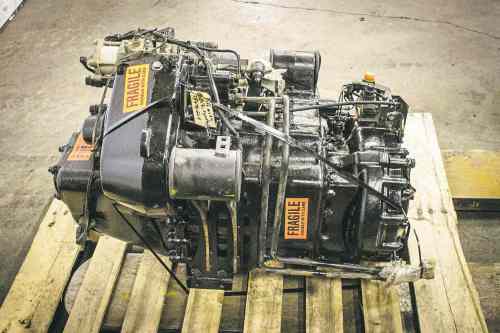
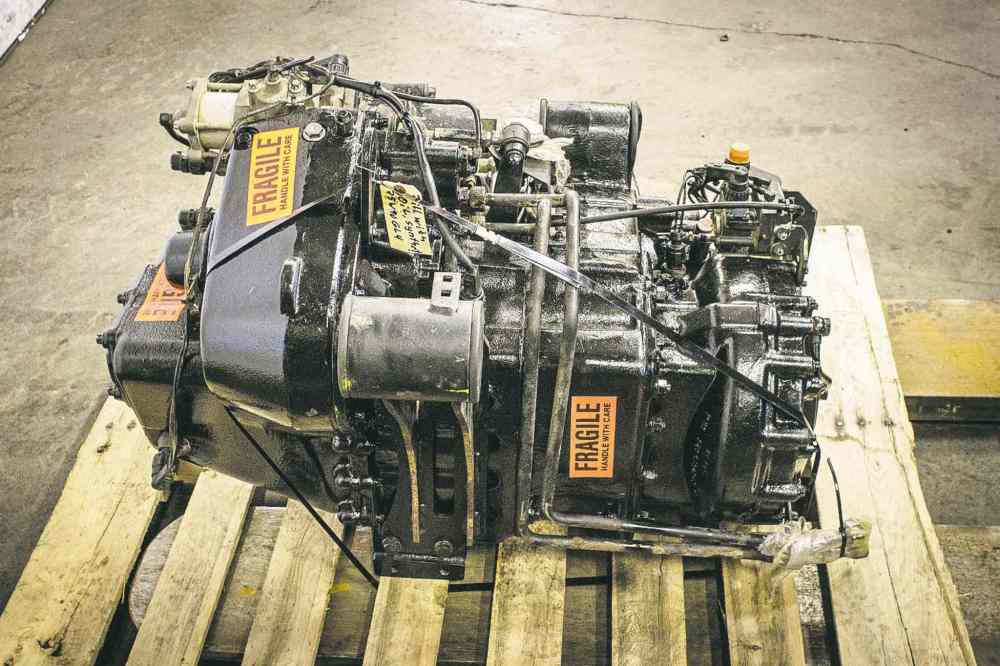
Unimog is a no-nonsense, do-anything beast
A brief encounter with possibly the most capable wheeled vehicle on the planet
Advertisement
Read this article for free:
or
Already have an account? Log in here »
To continue reading, please subscribe:

Digital Subscription
One year of digital access for only $205*
- Enjoy unlimited reading on winnipegfreepress.com
- Read the E-Edition, our digital replica newspaper
- Access News Break, our award-winning app
- Play interactive puzzles
*First annual payment billed as $205.00 + GST for one year. This annual subscription will automatically renew at $233.00 + GST every 52 weeks (10% off the regular annual price of $259.35). Offer available to new and qualified returning subscribers only. Cancel any time.
To continue reading, please subscribe:
Add Free Press access to your Brandon Sun subscription for only an additional
$1 for the first 4 weeks*
- Enjoy unlimited reading on winnipegfreepress.com
- Read the E-Edition, our digital replica newspaper
- Access News Break, our award-winning app
- Play interactive puzzles
*Your next Brandon Sun subscription payment will increase by $1.00 and you will be charged $17.95 plus GST for four weeks. After four weeks, your payment will increase to $24.95 plus GST every four weeks.
Read unlimited articles for free today:
or
Already have an account? Log in here »
Hey there, time traveller!
This article was published 16/01/2015 (4253 days ago), so information in it may no longer be current.
LANGLEY, B.C. — Out among the fields and farmlands, there is a workshop where mighty beasts stand guard. They are huge-wheeled, blunt-nosed, squared-off and ready for anything. This is the home of perhaps the most capable wheeled vehicles ever to crawl across the Earth. Here, there be Unimogs.
Hans Mross, owner of Mross Import Service, looks exactly as you’d expect a Mercedes-trained master heavy mechanic to appear. His heavy blue coveralls are spotless, his moustache neatly clipped, his handshake callused and dry.
His demeanour is initially brusque — this isn’t a man who suffers fools gladly and he has no time for flights of fancy and even less for bad engineering.
It’s a perfect fit for one of the most no-nonsense machines ever to come out of Germany. While you can’t currently buy a Unimog new, if you’re trying to source a used one, or looking to keep yours on (or off) the road, then Hans is the guy you come and talk to. He knows the ‘Mog inside and out; he grew up with them.
The early story of the Universal-Motor-Ger§t is that of swords beaten into ploughshares. Even before the defeat of Germany, engineers employed in the great factories supplying the war effort were already thinking about what they might build next. Albert Fredrich, an engineer with Daimler-Benz’s aircraft division, would have plans ready in 1945 for an agricultural vehicle, ideal for the farmers who would form the basis of a new Germany.
The Morgenthau plan, named for the U.S. Secretary of the Treasury who championed it, called for postwar Germany to be turned into a pastoral, agricultural society. Heavy industry and any kind of military capability would be eliminated, along with the possibility of further conflict.
The plan didn’t last long, but there were some lasting effects, and the Unimog was one of them.
Fredrich’s design was essentially a vehicle that could be used as both a tractor and a farmer’s everyday transportation. Right from the beginning, the Unimog was designed to fit various farming implements, and it eventually included a closed cab for working in inclement weather and a rear deck for haulage duties. It was a sort of hybridization between truck and tractor, and fittingly wore a set of ox horns as its badge; the Unimog was a do-anything beast of burden, not fast, but burly.
By 1951, Daimler-Benz took over the Unimog name and moved production to Gaggenau, West of Stuttgart in Southern Germany. In 1953, Hans Mross’s father bought a Unimog for work on the family farm. Mross was three at the time, and grew up working alongside this universally capable machine.
There are a number of things that make a Unimog special, and the first of these is an incredible toughness. Over-engineered from the first, many of the early 1950s originals are still in service. Because it was intended to cope with the rough-and-tumble world of the farmyard, and later moved into military and firefighting service, the ‘Mog is incredibly durable, with a sturdy backbone and stout Mercedes-sourced engines.
If the 300SL Gullwing is the glittering jewel of Mercedes engineering from the 1950s, then the Unimog is the steel shovel that dug it out of the ground. Both vehicles are part of the company’s history, and both are still supported by the factory to an amazing degree.
Mross returns to Germany several times a year to catch up on any developments in the ‘Mog world, and he has the ability to find and replace even the fiddliest parts, thanks to factory connections.
As an example, he recently received an email from a customer looking for the pawl for an emergency brake for a 1956 Unimog 411. It’s a tiny piece, an inexpensive part, but anyone who has worked on and tried to restore a 1950s-era passenger car knows how difficult these trim bits are to find. Mercedes had one sitting on the shelf, ready to go.
Unimogs first came to Canada directly, through the dealerships. Needless to say, this was not a great success, as someone looking for high-capability farm equipment might feel a bit ridiculous waltzing in, wearing gumboots, past gleaming 190SL cabriolets in a downtown showroom.
Later, a service and distribution agreement with the agricultural equipment manufacturer CASE was hammered out, lasting into the mid-1970s. When CASE’s business plan to focus on selling backhoes and the like came into conflict with Mercedes-Benz, a new distributor was needed.

In the meantime, Mross had moved to Canada and established himself as a specialist mechanic, and later a Unimog service dealer for Western Canada. He began importing ‘Mogs in the mid 1980s, which lasted through until 2002 and Daimler’s restructuring.
Mercedes next began selling the Unimog through the Freightliner network, but this was something of a doomed operation, and the last new Unimogs came into the country before the turn of the decade. This vehicle was simply too specialized to be sold alongside heavy-duty highway rigs.
Yet the vehicles that had been brought in, either by Mross or earlier, found a dedicated fan base. When it comes to sheer capability, the Unimog is like no other vehicle in the world, and they put up with all kinds of abuse.
Part of what makes the ‘Mog so useful for off-road and back-country operation is its Tonka-like dimensions and excellent ground clearance. It’s fitted with portal axles, meaning the axle sits above the hub of the wheel, connected by gearing. This, in combination with the short overhangs front and rear, means the Unimog can clamber over just about anything. It can climb slopes of up to 45 degrees, has a very high ramp angle for cresting over the peak of a climb. When fitted with a fording snorkel, it can wade through 1.2 metres of water without difficulty.
Those huge tires can be connected to an optional on-board air-compressor running off the engine, and softened up to crawl over sandy surfaces. They’re equally sized, front and rear, and not staggered, so the rear tires follow in the path packed down by the fronts. Rear-wheel steering is an option, and the Unimog’s relatively compact dimensions make it highly manoeuverable in tight areas.
All of these attributes make it one hell of an off-road vehicle, although Mross has a slight chuckle at the suggestion of recreational use.
“Of course you can,” he says, “but it’s like using an excavator to dig out your back garden.”
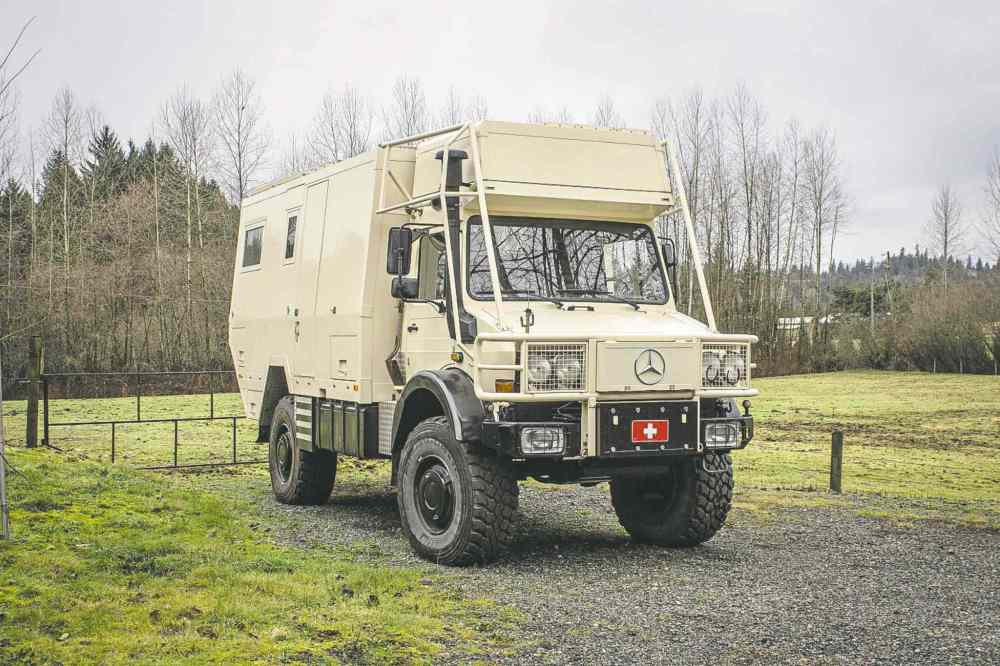
The camperized Unimog out front of the shop is one of the more awesome vehicles I’ve ever seen, fitted out like it was meant to take on the zombie apocalypse. Custom ordered by a Swiss couple to roam around the world, it initially cost 800,000 Swiss Francs (about CDN $1.2-million at the time), and has now found a new home with an unnamed buyer in B.C.
Inside Mross’s shop are various other ‘Mogs, either undergoing restoration or being fitted with highly customized attachments. There’s a remotely-controlled hydraulic tailgate on one, while an ex-firefighting ‘Mog is being brought up to spec so it can also be used as a camping vehicle.
Then there are the commercial uses for the ‘Mog, which range from ranch vehicle to heavy-duty service machine. Mross pulls up pictures of ‘Mogs he has worked on — “here’s one in Colombia … here’s one in Alberta” — including one he built for the Toronto Transit Commission, a bright yellow machine with multiple power takeoffs and steel wheels to ride the rails. When all was said and done, the total cost was just under $700,000, and the truck had to be airfreighted from Germany at an eye-watering $37,000 in transportation fees.
But not all ‘Mogs need be so expensive. Mross shows me a picture of another machine, an older one that sold recently for around $40,000.
“That was absolutely mint,” he says. Not bad for around the same price as a mid-level full-sized pickup truck.
When asked to put a number on how many Unimogs might be roaming around Canada, Mross considers carefully. He knows there are several hundred in B.C. alone, although even putting a number on that can be tricky, as many are unregistered because they never venture onto the beaten track.
There are, he estimates, somewhere between 6,000 to 8,000 ‘Mogs in North America, and the number is climbing. You can’t bring them in new, but the grey market provides some supply. After all, the Mog has been around for more than half a century.
But it’s the modern version that’s the most interesting, and while it’s hard to find a second-hand version of one of the trucks imported in the 2000s, they’re unique machines. Equipped with powerful and efficient BlueTec Mercedes-Benz diesel engines, they produce emissions like that of an average passenger car — except there’s almost nowhere you couldn’t drive it.
The Unimog is a rare beast, certainly not a common sight, but even those who aren’t in the know stop and stare any time one is seen on the road. It’s a dream truck for many, a symbol of ultimate off-roading prowess.

It was built for farmers, built to work, but the Unimog is also special for another reason. If the automobile is an expression of freedom in many ways, then the camperized version sitting outside Mross’s shop on this damp and dreary West Coast morning represents ultimate escape. You could drive it to Mexico. You could drive it to Alaska. You could drive clear across the Gobi Desert and make friends in Beijing.
Just as its name indicates, the Unimog is the universal motoring machine. I hope it comes back to Canada soon.
–Postmedia Network Inc. 2015