

Medical device company makes use of marketing support
Advertisement
Read this article for free:
or
Already have an account? Log in here »
To continue reading, please subscribe:

Digital Subscription
One year of digital access for only $205*
- Enjoy unlimited reading on winnipegfreepress.com
- Read the E-Edition, our digital replica newspaper
- Access News Break, our award-winning app
- Play interactive puzzles
*First annual payment billed as $205.00 + GST for one year. This annual subscription will automatically renew at $233.00 + GST every 52 weeks (10% off the regular annual price of $259.35). Offer available to new and qualified returning subscribers only. Cancel any time.
To continue reading, please subscribe:
Add Free Press access to your Brandon Sun subscription for only an additional
$1 for the first 4 weeks*
- Enjoy unlimited reading on winnipegfreepress.com
- Read the E-Edition, our digital replica newspaper
- Access News Break, our award-winning app
- Play interactive puzzles
*Your next Brandon Sun subscription payment will increase by $1.00 and you will be charged $17.95 plus GST for four weeks. After four weeks, your payment will increase to $24.95 plus GST every four weeks.
Read unlimited articles for free today:
or
Already have an account? Log in here »
Hey there, time traveller!
This article was published 18/03/2015 (4161 days ago), so information in it may no longer be current.
When IMRIS Inc. went public and raised $40 million in 2007, it was the largest medical device IPO in Canada for some time.
When the company pulled up stakes and moved from Winnipeg to Minneapolis a couple of years ago, not all of its staff followed.
Some of the key personnel are now part of a Winnipeg company called Cubresa Inc. It represents the next generation of medical device companies in the important life-sciences sector in Winnipeg.
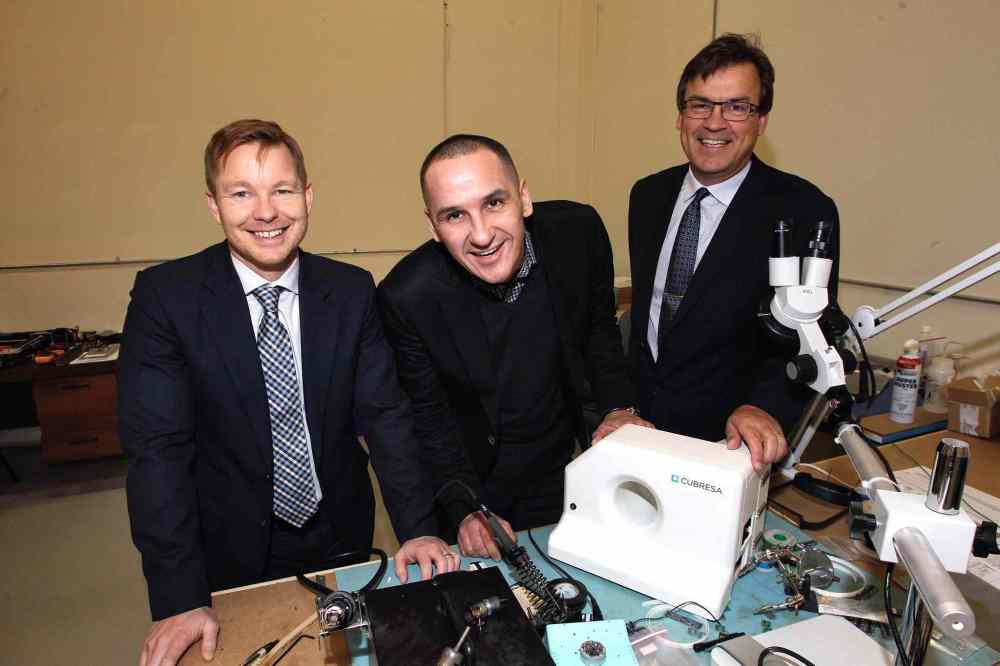
Cubresa makes one of the most compact gamma cameras on the market. With its first sale to a research institution in Halifax last year, it now has a number of sales lined up for its $500,000 mini-imaging devices targeted at the medical research market, including a large, Nasdaq-listed pharmaceutical company in the Boston area.
Led by founder and CEO James Schellenberg, the company also employs his brother Bob, who was the production manager at IMRIS. Ron Sabourin, the former CFO of IMRIS, is on Cubresa’s board of directors and IMRIS founder, John Saunders, is also on staff at Cubresa.
Not only has Cubresa availed itself of some pretty specialized talent that happened to be extant in Winnipeg, it’s also had the good fortune to be able to grow thanks to the effective infrastructure in place in the city to help technology startups.
Cubresa was incorporated in 2011, but even before that, James Schellenberg was already meeting with Marshall Ring, CEO of the Manitoba Technology Accelerator (MTA).
“Marshall and I started talking in about 2010,” Schellenberg said. “We started to structure the idea even before I incorporated. The MTA has been involved since the start. Strategy and context is important.”
As part of its revived commitment to supporting the technology sector in the province, Jobs and the Economy Minister Kevin Chief announced Monday the province will commit to funding the MTA for $300,000 for two additional years.
It’s an additional $100,000 per year for MTA, which last year was also successful in landing federal funding.
“The science and technology world is a small place,” Chief said in reference to the fact a company such as Cubresa started selling its product globally as soon as it was ready for the market.
“MTA supports startups in a way that has global impact,” he said. “And the beneficiary is the investment made in our own hometown.”
Securing long-term funding from the province — as has the Eureka Project, another business incubator in the city — means a lot to the manner in which they can operate.
“What this means is that I can build relationships to help these companies grow rather than worrying about meeting with Minister Chief to talk about surviving,” Ring said.
Cubresa’s development is a good case study on how the local infrastructure should work.
By hooking up with MTA, Schellenberg received the kind of strategic marketing support that convinced him to focus on a product for the pre-clinical research market first. The human diagnostic market would have cost tens of millions of dollars more in investment and taken Schellenberg much longer to get to market.
As well, Cubresa has been successful in raising more than $1 million in three rounds of financing from the Manitoba Knights, an angel investor group Ring organized that targets companies being supported by MTA.
Last year, Cubresa became the first company to be approved for an investment from the Manitoba Innovation Growth Sidecar Fund.

That deal will see the province match last year’s $330,000 investment Cubresa secured from Manitoba Knights.
Cubresa is in the process of getting approval for an additional $170,000, accessing the maximum for a single-company investment from the $4.5-million Side Car Fund. The fund was launched last year as a three-year pilot project for the province to co-invest with private investors from Manitoba in high-growth ventures based in the province.
ãIn the past year, the MTA has provided support to nine companies specializing in medical devices, functional foods and nutraceuticals, and information and communications technologies.
The MTA charges clients using a convertible debt note, which means clients pay for services after their company achieves financial success.
martin.cash@freepress.mb.ca
History
Updated on Wednesday, March 18, 2015 7:13 AM CDT: Replaces photo, changes headline