What’s with Roger’s moustache?
Mad Men's '70s facial hair driving viewers to distraction

Advertisement
Read this article for free:
or
Already have an account? Log in here »
To continue reading, please subscribe:

Digital Subscription
One year of digital access for only $205*
- Enjoy unlimited reading on winnipegfreepress.com
- Read the E-Edition, our digital replica newspaper
- Access News Break, our award-winning app
- Play interactive puzzles
*First annual payment billed as $205.00 + GST for one year. This annual subscription will automatically renew at $233.00 + GST every 52 weeks (10% off the regular annual price of $259.35). Offer available to new and qualified returning subscribers only. Cancel any time.
To continue reading, please subscribe:
Add Free Press access to your Brandon Sun subscription for only an additional
$1 for the first 4 weeks*
- Enjoy unlimited reading on winnipegfreepress.com
- Read the E-Edition, our digital replica newspaper
- Access News Break, our award-winning app
- Play interactive puzzles
*Your next Brandon Sun subscription payment will increase by $1.00 and you will be charged $17.95 plus GST for four weeks. After four weeks, your payment will increase to $24.95 plus GST every four weeks.
Read unlimited articles for free today:
or
Already have an account? Log in here »
Hey there, time traveller!
This article was published 18/04/2015 (4141 days ago), so information in it may no longer be current.
With only five Mad Men episodes left, this should be a time for profound reflection, for the weighty summing up of the series’ serious themes.
Will this influential show end in hope or despair, in sudden death or new beginnings? What has Mad Men revealed about men and women, family and work, the promises of materialism and the disappointments of the postwar American Dream? And finally, what will become of our iconic antihero, Don Draper? Will he rise to his better nature, or fall from a tall building?
Clearly, it’s Big Question time. But as we head to that inexorable finale, I keep getting sidetracked by Little Details. And I’m not the only one, as suggested by this recent Mashable headline: “Something happened on Mad Men but Twitter doesn’t care because Roger Sterling grew a moustache.”
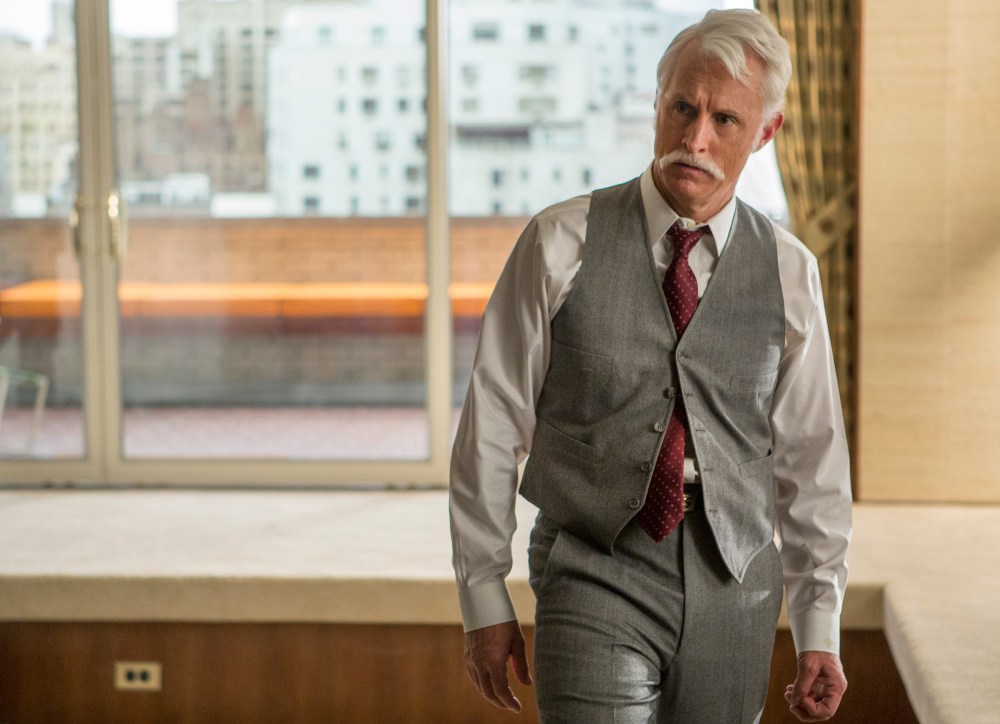
Oh, that ‘stache. Luxuriant and grotesque, comic and just a bit sad. It’s a scene-stealer, all right, a seemingly minor element that somehow demands major attention. In a lesser series, Roger’s facial hair would be trivial, but here it’s transfixing — a sleek, silvery transmitter of mood and meaning.
Right from the beginning, the series has proclaimed its persnickety attention to period-perfect detail. With its obsessive interest in clothes, hair, makeup, furniture and props, Mad Men is exquisitely art-directed, right down to the smallest elements. Showrunner Matthew Weiner has been known to micromanage onscreen fruit.
Detractors have suggested that all this meticulous replication has turned Mad Men into an airless museum diorama. They believe Mad Men fetishizes an imagined past, covering it with a dangerous nostalgic sheen. Even worse, they charge, the show ends up caressing the shiny surfaces of advertising and consumerism that it claims to critique.
It may be true that there’s a paradox at the centre of the show. Even as Mad Men reminds us — relentlessly! — that all this minty mid-century style isn’t making anyone happy, it’s hard not to covet those Saarinen chairs and sharp Brooks Brothers suits. But taking pleasure in the show’s details isn’t necessarily shallow.
As with the strange saga of Roger’s moustache, all those small things aren’t just set decoration. They’re packed with significance. Maybe the niggling details — the John Dos Passos paperback, the can of Tab, the L’eggs nylons, Joan’s magenta dress, Pete’s mesmerizing hairline — aren’t distracting us from the big questions. Maybe they’re offering us cautious, coded answers to the big questions.
Consider Tom Fitzgerald and Lorenzo Marquez, two guys who blog about “Mad Style” on tomandlorenzo.com, combining bitchy asides with acute visual analysis. For them, the second half of the final season is all about the onset of the Me Decade 1970s. The era is signalled by “the creeping horror of earth tones,” by Don’s revolutionary decision to wear a blue shirt at the office. (At the office? He’s a white-shirt man!)
But mostly by the spreading ’70s man-hair: beards, moustaches, sideburns and shag surging toward the shirt collar. According to Tom and Lorenzo, the men of Mad Men are catching up with early adopter Stan, trying out what the bloggers call their 1970s “starter hair.”
Tom and Lorenzo may begin with surfaces, but they end with substance. Their analysis of fashion covers power and money, sex and love, alliances and betrayals. All these things are expressed, on Mad Men, through the semiotics of fashion.
That brings us back to the prickly issue of Roger’s ‘stache. It’s easy to joke about this startling soup-strainer. Social media have already decided that the moustache should have its own spinoff show, its own Twitter account, maybe a gig opening for Wilco at the Fillmore. It’s been given several nicknames. (I favour “The Platinum Caterpillar.”)
Why all the attention? Sometimes a moustache is just a moustache, but with Roger Sterling in the spring of 1970, it feels like much more. That moustache could be the hairy pivot on which Roger’s character turns from a silver-haired charmer to a desperate old saddo. (Or, as Megan might bitterly suggest, “an aging, sloppy, selfish liar.”)
Back in the early seasons, when we talked about clean-shaven Roger, we tended to use quaint, slightly dated terminology. We called him a roué, a rogue, a rake, a Lothario, a ladies’ man, a philanderer.
Now sporting a ruffled tuxedo shirt and that crazy pornstache, he suddenly looks more like a standard-issue serial modelizer, a chequebook-flashing bore. His charm feels like a tired act. In his first Season 7 appearance, he has two women going at the same time, like some kind of liquor-ad cliché.

And the moustache means his smarminess can no longer be safely slotted into the stylized historical past of the 1960s. For Mad Men fans of a certain age (and that would include me), Roger is starting to slip toward the actual remembered past of the 1970s. For many of us, he’s probably starting to look like that creepy, self-deluded, drunken friend of our parents. You know, the one prone to ruining their parties, hitting on babysitters, driving cars into fences, messing up at work.
It could be that the first six seasons of Mad Men have been leading to the final cruel conclusion that people don’t really change. In a horrible parody of Don’s Kodak Carousel presentation, they might be condemned to circle around their old patterns, to repeat their old mistakes.
And as Mad Men’s characters head into the 1970s, older but many of them not much wiser, failings that were once tragic are now just pathetic, sins that had a certain seductive chic now just look tacky.
It’s all there in that damn moustache.
alison.gillmor@freepress.mb.ca
Studying at the University of Winnipeg and later Toronto’s York University, Alison Gillmor planned to become an art historian. She ended up catching the journalism bug when she started as visual arts reviewer at the Winnipeg Free Press in 1992.
Our newsroom depends on a growing audience of readers to power our journalism. If you are not a paid reader, please consider becoming a subscriber.
Our newsroom depends on its audience of readers to power our journalism. Thank you for your support.
Studying at the University of Winnipeg and later Toronto’s York University, Alison Gillmor planned to become an art historian. She ended up catching the journalism bug when she started as visual arts reviewer at the Winnipeg Free Press in 1992.
Our newsroom depends on a growing audience of readers to power our journalism. If you are not a paid reader, please consider becoming a subscriber.
Our newsroom depends on its audience of readers to power our journalism. Thank you for your support.
Advertisement Advertise With Us
Advertisement Advertise With Us