

Building a piece of history
Red River cart replica squeaks with authenticity
Advertisement
Read this article for free:
or
Already have an account? Log in here »
To continue reading, please subscribe:
Monthly Digital Subscription
$1 per week for 24 weeks*
- Enjoy unlimited reading on winnipegfreepress.com
- Read the E-Edition, our digital replica newspaper
- Access News Break, our award-winning app
- Play interactive puzzles
*Billed as $4.00 plus GST every four weeks. After 24 weeks, price increases to the regular rate of $19.95 plus GST every four weeks. Offer available to new and qualified returning subscribers only. Cancel any time.
Monthly Digital Subscription
$4.99/week*
- Enjoy unlimited reading on winnipegfreepress.com
- Read the E-Edition, our digital replica newspaper
- Access News Break, our award-winning app
- Play interactive puzzles
*Billed as $19.95 plus GST every four weeks. Cancel any time.
To continue reading, please subscribe:
Add Free Press access to your Brandon Sun subscription for only an additional
$1 for the first 4 weeks*
*Your next subscription payment will increase by $1.00 and you will be charged $16.99 plus GST for four weeks. After four weeks, your payment will increase to $23.99 plus GST every four weeks.
Read unlimited articles for free today:
or
Already have an account? Log in here »
Hey there, time traveller!
This article was published 23/05/2015 (3980 days ago), so information in it may no longer be current.
EMERSON — The Red River ox cart of the early 1800s had no peer for generating high, squealing noise from the wood-on-wood grinding of axle inside wheel hub.
It was like Jack Benny practising violin all day. It was nicknamed “the North West fiddle,” and the squealing could spoil the peaceful prairie for miles around.
So to give some relief from the head-splitting noise, drivers invented some home remedies.
“There was no grease. So they would put pig rinds (skin) in the holes, or catch gophers or mice,” said local farmer Leonard Pappel.
Great gobs of greasy grimy gopher guts! Talk about a lube job.
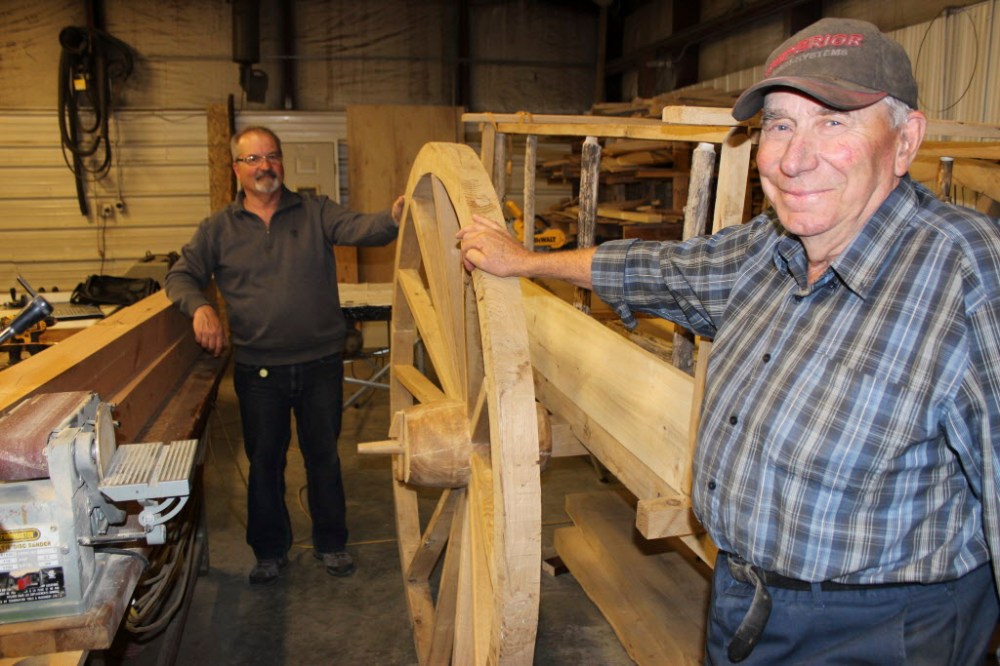
Pappel, 80, and Paul Barnabe, 66, of Emerson, are the latest to try their hand at building a replica Red River cart. Emerson is a bit of an ox cart manufacturing hub, with one built by resident Dick Remus two years ago now on display at the Fort Dufferin national historic site just outside Emerson.
It stands to reason. In the mid-1800s, one Métis buffalo hunting party passed through here with a reported 1,200 carts. The North-West Mounted Police employed 114 carts in their march of 1874 from Fort Dufferin to Fort Whoop-Up in Alberta to close an American whisky-trading post.
One of the outstanding features of the deluxe, early 1800s Red River ox cart is it was amphibian. Say you come to a river? Just pop off the wheels and it converts into a raft.
What the ox cart dealerships of the 1800s failed to say was what happened if one of those wooden wheels should break.
There was no CAA. Cart trails routinely followed rivers, which were lined with trees, serving many purposes, including wood to build a replacement wheel.
So how long would it take to change a tire? It took Pappel and Barnabe 140 man-hours just to build the wheels for their Red River cart. That’s with power tools. The ox cart drivers of 200 years ago may have been more skilled, but it still would have taken days.
To make their ox cart as authentic as possible, Pappel and Barnabe used wood from five different kinds of trees, all common along the Red River.
The wheel hub was made from Siberian elm because elms grow in a spiral and don’t split. The rims, spokes and wheel axles were made of oak because of its strength. The long shafts that extended to the ox and that didn’t need to be as strong as oak were made of birch, which is lighter. The wagon box, which may have been piled high with buffalo hides, was made of cottonwood because it was common and easy to process. The box spindles were willow.
“The woods were all chosen for their natural qualities. That’s they way ox carts were built,” said Barnabe, who studied ox cart construction from existing literature.
They harvested the trees, had them milled at a local sawmill, and turned them into an ox cart in six weeks this spring. Nails weren’t readily available back then. So the cart is held together with dowels, wedges and straps made from animal hides.
“We can now appreciate what (the pioneers) went through (to build ox carts). That’s the only way to appreciate it is to go through what they did,” said Barnabe.
It’s not the first heritage project for Pappel, either. He and Remus restored the former officers’ latrine at Fort Dufferin. Hey, a heritage building is a heritage building. But they didn’t rebuild the “holes.”

The wheels of the ox cart are extraordinary at 1.67 metres tall. That’s eye level for many people today, but would have been over many people’s heads in 1801. For example, the ceiling of the aforementioned latrine was just 1.95 metres high, versus the standard 2.44 metres in homes today.
It wasn’t so much the case that there was no grease then as the carts had open hubs that collected grit, which quickly damaged the wooden wheels.
The other engineering feat of the carts is their tapered holes for holding the axle. The two builders used 13 drill bits to get it right.
Barnabe and Pappel are with local heritage group Post Road Heritage Group Inc. They are donating their ox cart to the St. Joseph Museum in St. Joseph, 80 kilometres south of Winnipeg.
bill.redekop@freepress.mb.ca
History
Updated on Saturday, May 23, 2015 7:56 AM CDT: Changes photo.