Director’s vision of the future isn’t 20/20
Advertisement
Read this article for free:
or
Already have an account? Log in here »
To continue reading, please subscribe:

Digital Subscription
One year of digital access for only $205*
- Enjoy unlimited reading on winnipegfreepress.com
- Read the E-Edition, our digital replica newspaper
- Access News Break, our award-winning app
- Play interactive puzzles
*First annual payment billed as $205.00 + GST for one year. This annual subscription will automatically renew at $233.00 + GST every 52 weeks (10% off the regular annual price of $259.35). Offer available to new and qualified returning subscribers only. Cancel any time.
To continue reading, please subscribe:
Add Free Press access to your Brandon Sun subscription for only an additional
$1 for the first 4 weeks*
- Enjoy unlimited reading on winnipegfreepress.com
- Read the E-Edition, our digital replica newspaper
- Access News Break, our award-winning app
- Play interactive puzzles
*Your next Brandon Sun subscription payment will increase by $1.00 and you will be charged $17.95 plus GST for four weeks. After four weeks, your payment will increase to $24.95 plus GST every four weeks.
Read unlimited articles for free today:
or
Already have an account? Log in here »
Hey there, time traveller!
This article was published 30/05/2015 (4139 days ago), so information in it may no longer be current.
Tomorrowland, the new live-action family adventure from filmmaker Brad Bird, centres on an optimistic vision of a shiny, happy future. A deeply sincere Disney counter-argument to our culture’s craze for post-apocalyptic disaster, the film suggests that belief in a better tomorrow isn’t just a nice idea. It’s actually necessary to the survival of humankind.
Bird’s message-heavy movie has been dividing audiences and critics, who consider it either wondrous and inventive or naØve and preachy. Basically, it comes down to this: Where you stand on Tomorrowland might depend on how you feel about jetpacks.
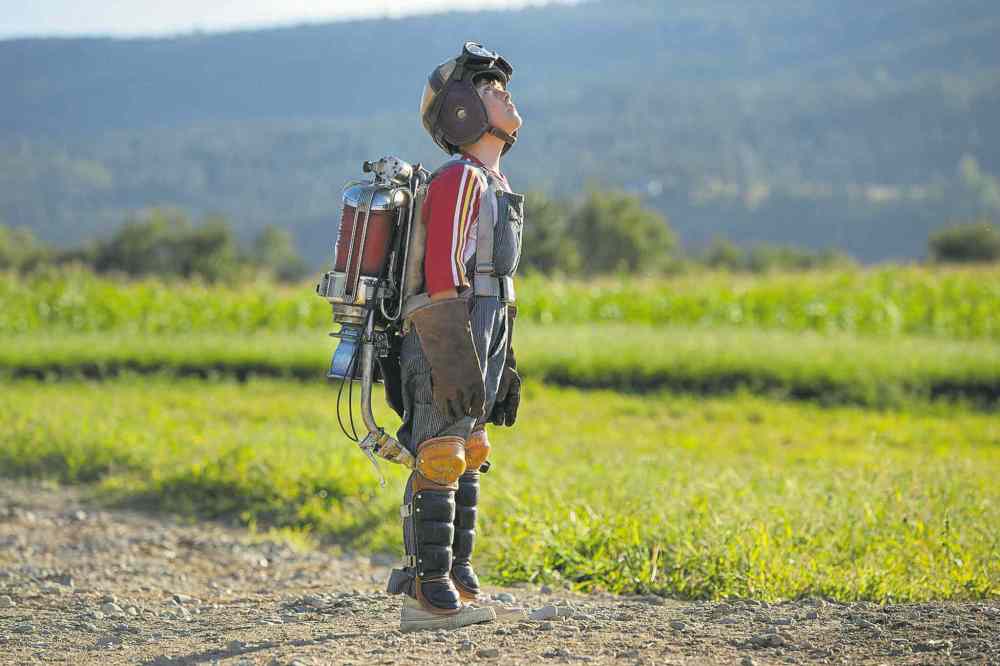
The film starts with a trip to the 1964 New York World’s Fair, where a gee-whiz 11-year-old boy is determined to show off his homemade jetpack. There are still a few bugs to work out, but, gosh, the kid is keen. Flash-forward 50 years to our own grubby, defeatist age, and that boy, now grown up into George Clooney, has soured into a misanthropic recluse. Fortunately, he meets a peppy, science-positive girl who has glimpsed what could be humankind’s future, all silver towers and technological marvels. Maybe those jetpack dreams will fly again.
This speculative sci-fi story is pure Bird. The 57-year-old filmmaker (The Incredibles, Ratatouille, Mission: Impossible 4) grew up in an era that practically guaranteed a future crammed with jetpacks, flying cars and friendly, apron-wearing robots. It was a time of Amazing Stories and The Jetsons and Googie-style atomic architecture. Tomorrowland supposedly pictures the possibilities of the later 21st century, but it’s really a yearning, retro-futurist return to Bird’s mid-20th-century childhood.
Like Christopher Nolan’s Interstellar, Tomorrowland mourns the slow death of NASA and our culture’s been-there-done-that attitude to the space program. Like Nolan, Bird divides the world into the complacent mediocre masses and the exceptional can-do individuals who reach for the stars (literally).
When it comes to the future, forget the sadistic spectacles of The Hunger Games or the chaotic social breakdown of The Walking Dead or the environmental devastation of Mad Max. When Bird takes us to Tomorrowland’s transdimensional world, it’s all smooth, silent machines and soaring white buildings. The productive and peaceful inhabitants are swimming in anti-gravity pools and riding in floating monorails and wearing Nehru jackets. (Why is it always Nehru jackets?)
And, of course, there are jetpacks. If you had to pick one symbol for the Space Age’s once-anticipated, now-lost hopes, it would be the jetpack. Combining ancient fantasies of flight with techno-cool gadgetry, the jetpack embodies the limitless freedom of an imagined future.
This irresistible gizmo has inspired books: Mac Montandon’s Jetpack Dreams: One Man’s Up and Down (But Mostly Down) Search for the Greatest Invention That Never Was and Daniel Wilson’s Where’s My Jetpack?: A Guide to the Amazing Science Fiction Future that Never Arrived. It’s a common TV and movie trope (“I want my jetpack! Gimme my jetpack!”), as well as a perennial nuisance for Popular Mechanics magazine, which has been fielding questions about the jetpack’s viability for decades.
Part of me can see the lure of the jetpack and the anything-is-possible attitude it represents. Bird wants to go back to a time when rocket launches were events and kids got to stay up late to watch them. When there were geodesic domes and streamlined kitchen appliances. When the future was going to be about fixing problems and overcoming obstacles and exploring new worlds.

I totally understand Bird’s idea that, geez, somebody should have designed a jetpack by now. I’m less comfy with Bird’s suggestion that someone would have designed a jetpack by now, if not for the small-minded bean-counters and dream-crushing bureaucrats and naysaying politicians who keep thwarting the dreamers and doers. A subplot that suggests that history’s best scientists and engineers are part of an elite secret society is just creepy.
Laden with odd thematic freight, Bird’s cinematic jetpack never quite lifts off, and Tomorrowland ends up being a polarizing movie. Full of curious contradictions, the film looks forward to the future and backward to a nostalgic past. It starts with enthusiastic freshness and dwindles into uncertain incoherence. It’s part cheery pep talk and part chiding lecture, an odd, unstable mixture of youthful confidence and get-off-my-porch crankiness.
And for all its moral urgency about our present predicament, for all its hand-wringing over our doom-hastening pop-culture pessimism, the film never faces our own future head-on.
Tomorrowland is too busy mooning over a future that once was.
alison.gillmor@freepress.mb.ca