Pixar’s latest delivers sophisticated take on psychological turmoil inside 11-year-old’s head

Advertisement
Read this article for free:
or
Already have an account? Log in here »
To continue reading, please subscribe:

Digital Subscription
One year of digital access for only $205*
- Enjoy unlimited reading on winnipegfreepress.com
- Read the E-Edition, our digital replica newspaper
- Access News Break, our award-winning app
- Play interactive puzzles
*First annual payment billed as $205.00 + GST for one year. This annual subscription will automatically renew at $233.00 + GST every 52 weeks (10% off the regular annual price of $259.35). Offer available to new and qualified returning subscribers only. Cancel any time.
To continue reading, please subscribe:
Add Free Press access to your Brandon Sun subscription for only an additional
$1 for the first 4 weeks*
- Enjoy unlimited reading on winnipegfreepress.com
- Read the E-Edition, our digital replica newspaper
- Access News Break, our award-winning app
- Play interactive puzzles
*Your next Brandon Sun subscription payment will increase by $1.00 and you will be charged $17.95 plus GST for four weeks. After four weeks, your payment will increase to $24.95 plus GST every four weeks.
Read unlimited articles for free today:
or
Already have an account? Log in here »
Hey there, time traveller!
This article was published 18/06/2015 (4097 days ago), so information in it may no longer be current.
Inside Out is not the first movie to anthropomorphize the inner workings of a human being. That distinction may actually belong to the climactic segment (pun intended) of Woody Allen’s 1972 comedy Everything You Always Wanted to Know About Sex, But Were Afraid to Ask, a prolonged sketch depicting what goes on when people, you know… do it.
Coming from Pixar, Inside Out has, by necessity, a more child-friendly premise. But that doesn’t mean the film doesn’t boast riches of complexity and nuance, well beyond Allen’s burlesque.
For something destined to be consumed as another G-rated summer diversion, this is a film of dazzling ambition.
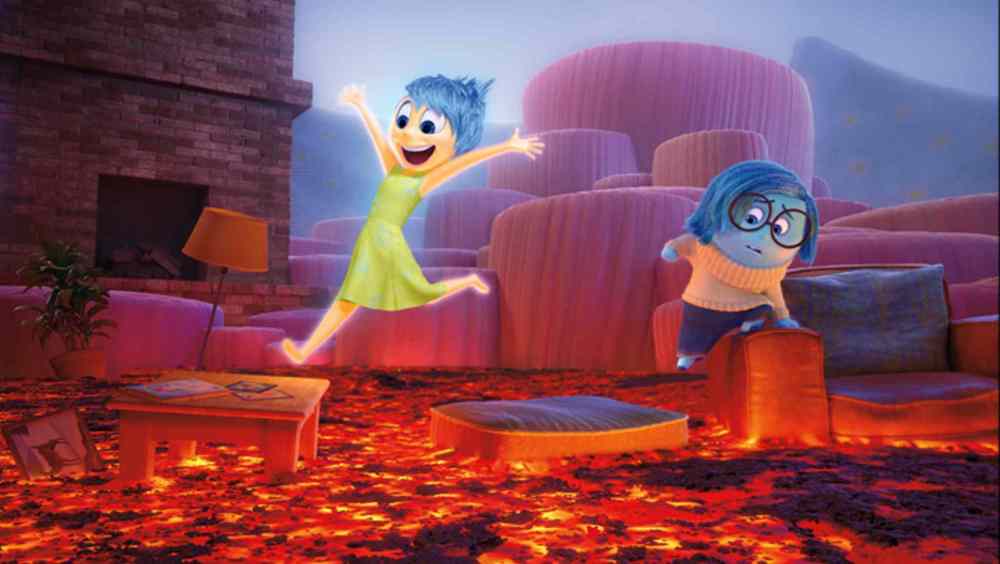
It largely takes place inside the brain of 11-year-old Riley (voiced by Kaitlyn Dias). She’s a happy kid, mostly. As we can see from the film’s fanciful depiction of her inner mind, she has a healthy mix of emotions, including frazzled flibbertigibbet Fear (Bill Hader), the fussy-haughty Disgust (Mindy Kaling) and the literal hot-head Anger (Lewis Black, naturally).
It’s clear that for much of Riley’s life, the elfin Joy (an exuberant Amy Poehler) has been in the emotional driver’s seat. But when Riley’s parents move from Minnesota to San Francisco for dad’s work, Joy finds herself struggling to contain the escalating power of Sadness (Phyllis Smith), a gal whose glasses, turtleneck and overall demeanour suggest Scooby-Doo’s Velma Dinkley’s enduring mittelschmerz.
The coin of the realm for this bunch are memories, here represented by glassy spheres, each coloured according to the dominant emotion attending the memory. When Joy tries to stop Sadness from changing the colours of Riley’s happy core memories, both are sucked from Riley’s control centre, leaving Fear, Disgust and Anger left to try to steer Riley through her crisis. In the hinterlands of Riley’s brain, Joy and Sadness have to work together to find their way back into Riley’s emotional palette, as succinct a metaphor for battling depression as you could ask.
In his previous Pixar film Up, director Pete Docter demonstrated a gift for creating comic images with weirdly profound metaphoric significance. (Remember the elderly Carl Frederickson doggedly dragging his semi-aloft house behind him — a sublime illustration of a character who literally can’t let go of his past.)
Docter, co-directing with Ronaldo Del Carmen, actually ups the ante here within this film’s candy-coloured mindscapes. On a kids’ level, the film delivers a simple enough problem, as Joy and Sadness have to get home before Riley does something desperate. The terrain includes dreams, fantasy (which looks like a movie studio) and a pit where old, irrelevant memories — including phone numbers — are dumped.
On a deeper level, the story delivers a sophisticated view of emotions. One must particularly respect the portrayal of Sadness, not as a negative or bad character but as a necessary member of the emotional team, with an important function to fulfil.
Voiced with a tender comedic touch by Smith (best known as the matronly drone Phyllis on TV’s The Office), Sadness isn’t just a sympathetic character, she’s an effective repudiation of a dominant feel-good culture that would love to see her medicated out of existence.
randall.king@freepress.mb.ca
Inside Out
Starring the voices of Amy Poehler, Phyllis Smith and Lewis Black
Grant Park, Kildonan Place, McGillivray, Polo Park, St. Vital, Towne.
G
95 minutes
4 stars out of five
INSIDE Out is not the first movie to anthropomorphize the inner workings of a human being. That distinction may actually belong to the climactic segment (pun intended) of Woody Allen’s 1972 comedy Everything You Always Wanted to Know About Sex, But Were Afraid to Ask, a prolonged sketch depicting what goes on when people, you know… do it.
Coming from Pixar, Inside Out has, by necessity, a more child-friendly premise. But that doesn’t mean the film doesn’t boast riches of complexity and nuance, well beyond Allen’s burlesque.
For something destined to be consumed as another G-rated summer diversion, this is a film of dazzling ambition.
It largely takes place inside the brain of 11-year-old Riley (voiced by Kaitlyn Dias). She’s a happy kid, mostly. As we can see from the film’s fanciful depiction of her inner mind, she has a healthy mix of emotions, including frazzled flibbertigibbet Fear (Bill Hader), the fussy-haughty Disgust (Mindy Kaling) and the literal hot-head Anger (Lewis Black, naturally).
It’s clear that for much of Riley’s life, the elfin Joy (an exuberant Amy Poehler) has been in the emotional driver’s seat. But when Riley’s parents move from Minnesota to San Francisco for dad’s work, Joy finds herself struggling to contain the escalating power of Sadness (Phyllis Smith), a gal whose glasses, turtleneck and overall demeanour suggest Scooby-Doo’s Velma Dinkley enduring mittelschmerz.
The coin of the realm for this bunch are memories, here represented by glassy spheres, each coloured according to the dominant emotion attending the memory. When Joy tries to stop Sadness from changing the colours of Riley’s happy core memories, both are sucked from Riley’s control centre, leaving Fear, Disgust and Anger left to try to steer Riley through her crisis. In the hinterlands of Riley’s brain, Joy and Sadness have to work together to find their way back into Riley’s emotional palette, as succinct a metaphor for battling depression as you could ask.
In his previous Pixar film Up, director Pete Docter demonstrated a gift for creating comic images with weirdly profound metaphoric significance. (Remember the elderly Carl Frederickson doggedly dragging his semi-aloft house behind him — a sublime illustration of a character who literally can’t let go of his past.)
Docter, co-directing with Ronaldo Del Carmen, actually ups the ante here within this film’s candy-coloured mindscapes. On a kids’ level, the film delivers a simple enough problem, as Joy and Sadness have to get home before Riley does something desperate. The terrain includes dreams, fantasy (which looks like a movie studio) and a pit where old, irrelevant memories — including phone numbers — are dumped.
On a deeper level, the story delivers a sophisticated view of emotions. One must particularly respect the portrayal of Sadness, not as a negative or bad character but as a necessary member of the emotional team, with an important function to fulfil.
Voiced with a tender comedic touch by Smith (best known as the matronly drone Phyllis on TV’s The Office), Sadness isn’t just a sympathetic character, she’s an effective repudiation of a dominant feel-good culture that would love to see her medicated out of existence.
Other voices
Inside Out is an absolute delight — funny and charming, fast-moving and full of surprises. It is also a defense of sorrow, an argument for the necessity of melancholy dressed in the bright colors of entertainment.
— A.O. Scott, New York Times
Inside Out movingly but casually plays with our emotions, like a baby walking her fingers across a parent’s face; it leaves you changed, entertained, nostalgic, dazzled.
— Moira Macdonald, Seattle Times
It works for adults and children and, in fact, its most receptive audience could well be parents who are trying to figure out their kids.
— Chris Hewitt, St. Paul Pioneer Press
Only Pixar could turn a metaphor into a heart-tugging story about preteen growing pains. Absolutely brilliant.
— Rafer Guzman, Newsday
Pixar’s 15th feature proves to be the greatest idea the toon studio has ever had… promises to forever change the way people think about the way people think, delivering creative fireworks grounded by a wonderfully relatable family story.
— Peter Debruge, Variety
Inside Out
Starring the voices of Amy Poehler, Phyllis Smith and Lewis Black
Grant Park, Kildonan Place, McGillivray, Polo Park, St. Vital, Towne.
G
95 minutes
4 stars out of five
INSIDE Out is not the first movie to anthropomorphize the inner workings of a human being. That distinction may actually belong to the climactic segment (pun intended) of Woody Allen’s 1972 comedy Everything You Always Wanted to Know About Sex, But Were Afraid to Ask, a prolonged sketch depicting what goes on when people, you know… do it.
Coming from Pixar, Inside Out has, by necessity, a more child-friendly premise. But that doesn’t mean the film doesn’t boast riches of complexity and nuance, well beyond Allen’s burlesque.
For something destined to be consumed as another G-rated summer diversion, this is a film of dazzling ambition.
It largely takes place inside the brain of 11-year-old Riley (voiced by Kaitlyn Dias). She’s a happy kid, mostly. As we can see from the film’s fanciful depiction of her inner mind, she has a healthy mix of emotions, including frazzled flibbertigibbet Fear (Bill Hader), the fussy-haughty Disgust (Mindy Kaling) and the literal hot-head Anger (Lewis Black, naturally).
It’s clear that for much of Riley’s life, the elfin Joy (an exuberant Amy Poehler) has been in the emotional driver’s seat. But when Riley’s parents move from Minnesota to San Francisco for dad’s work, Joy finds herself struggling to contain the escalating power of Sadness (Phyllis Smith), a gal whose glasses, turtleneck and overall demeanour suggest Scooby-Doo’s Velma Dinkley enduring mittelschmerz.
The coin of the realm for this bunch are memories, here represented by glassy spheres, each coloured according to the dominant emotion attending the memory. When Joy tries to stop Sadness from changing the colours of Riley’s happy core memories, both are sucked from Riley’s control centre, leaving Fear, Disgust and Anger left to try to steer Riley through her crisis. In the hinterlands of Riley’s brain, Joy and Sadness have to work together to find their way back into Riley’s emotional palette, as succinct a metaphor for battling depression as you could ask.
In his previous Pixar film Up, director Pete Docter demonstrated a gift for creating comic images with weirdly profound metaphoric significance. (Remember the elderly Carl Frederickson doggedly dragging his semi-aloft house behind him — a sublime illustration of a character who literally can’t let go of his past.)
Docter, co-directing with Ronaldo Del Carmen, actually ups the ante here within this film’s candy-coloured mindscapes. On a kids’ level, the film delivers a simple enough problem, as Joy and Sadness have to get home before Riley does something desperate. The terrain includes dreams, fantasy (which looks like a movie studio) and a pit where old, irrelevant memories — including phone numbers — are dumped.
On a deeper level, the story delivers a sophisticated view of emotions. One must particularly respect the portrayal of Sadness, not as a negative or bad character but as a necessary member of the emotional team, with an important function to fulfil.
Voiced with a tender comedic touch by Smith (best known as the matronly drone Phyllis on TV’s The Office), Sadness isn’t just a sympathetic character, she’s an effective repudiation of a dominant feel-good culture that would love to see her medicated out of existence.
randall.king@freepress.mb.ca
Other voices
Inside Out is an absolute delight — funny and charming, fast-moving and full of surprises. It is also a defense of sorrow, an argument for the necessity of melancholy dressed in the bright colors of entertainment.
— A.O. Scott, New York Times
Inside Out movingly but casually plays with our emotions, like a baby walking her fingers across a parent’s face; it leaves you changed, entertained, nostalgic, dazzled.
— Moira Macdonald, Seattle Times
It works for adults and children and, in fact, its most receptive audience could well be parents who are trying to figure out their kids.
— Chris Hewitt, St. Paul Pioneer Press
Only Pixar could turn a metaphor into a heart-tugging story about preteen growing pains. Absolutely brilliant.
— Rafer Guzman, Newsday
Pixar’s 15th feature proves to be the greatest idea the toon studio has ever had… promises to forever change the way people think about the way people think, delivering creative fireworks grounded by a wonderfully relatable family story.
— Peter Debruge, Variety
Inside Out
Starring the voices of Amy Poehler, Phyllis Smith and Lewis Black
Grant Park, Kildonan Place, McGillivray, Polo Park, St. Vital, Towne.
G
95 minutes
4 stars out of five
INSIDE Out is not the first movie to anthropomorphize the inner workings of a human being. That distinction may actually belong to the climactic segment (pun intended) of Woody Allen’s 1972 comedy Everything You Always Wanted to Know About Sex, But Were Afraid to Ask, a prolonged sketch depicting what goes on when people, you know… do it.
Coming from Pixar, Inside Out has, by necessity, a more child-friendly premise. But that doesn’t mean the film doesn’t boast riches of complexity and nuance, well beyond Allen’s burlesque.
For something destined to be consumed as another G-rated summer diversion, this is a film of dazzling ambition.
It largely takes place inside the brain of 11-year-old Riley (voiced by Kaitlyn Dias). She’s a happy kid, mostly. As we can see from the film’s fanciful depiction of her inner mind, she has a healthy mix of emotions, including frazzled flibbertigibbet Fear (Bill Hader), the fussy-haughty Disgust (Mindy Kaling) and the literal hot-head Anger (Lewis Black, naturally).
It’s clear that for much of Riley’s life, the elfin Joy (an exuberant Amy Poehler) has been in the emotional driver’s seat. But when Riley’s parents move from Minnesota to San Francisco for dad’s work, Joy finds herself struggling to contain the escalating power of Sadness (Phyllis Smith), a gal whose glasses, turtleneck and overall demeanour suggest Scooby-Doo’s Velma Dinkley enduring mittelschmerz.
The coin of the realm for this bunch are memories, here represented by glassy spheres, each coloured according to the dominant emotion attending the memory. When Joy tries to stop Sadness from changing the colours of Riley’s happy core memories, both are sucked from Riley’s control centre, leaving Fear, Disgust and Anger left to try to steer Riley through her crisis. In the hinterlands of Riley’s brain, Joy and Sadness have to work together to find their way back into Riley’s emotional palette, as succinct a metaphor for battling depression as you could ask.
In his previous Pixar film Up, director Pete Docter demonstrated a gift for creating comic images with weirdly profound metaphoric significance. (Remember the elderly Carl Frederickson doggedly dragging his semi-aloft house behind him — a sublime illustration of a character who literally can’t let go of his past.)
Docter, co-directing with Ronaldo Del Carmen, actually ups the ante here within this film’s candy-coloured mindscapes. On a kids’ level, the film delivers a simple enough problem, as Joy and Sadness have to get home before Riley does something desperate. The terrain includes dreams, fantasy (which looks like a movie studio) and a pit where old, irrelevant memories — including phone numbers — are dumped.
On a deeper level, the story delivers a sophisticated view of emotions. One must particularly respect the portrayal of Sadness, not as a negative or bad character but as a necessary member of the emotional team, with an important function to fulfil.
Voiced with a tender comedic touch by Smith (best known as the matronly drone Phyllis on TV’s The Office), Sadness isn’t just a sympathetic character, she’s an effective repudiation of a dominant feel-good culture that would love to see her medicated out of existence.
randall.king@freepress.mb.ca
Other voices
Inside Out is an absolute delight — funny and charming, fast-moving and full of surprises. It is also a defense of sorrow, an argument for the necessity of melancholy dressed in the bright colors of entertainment.
— A.O. Scott, New York Times
Inside Out movingly but casually plays with our emotions, like a baby walking her fingers across a parent’s face; it leaves you changed, entertained, nostalgic, dazzled.
— Moira Macdonald, Seattle Times
It works for adults and children and, in fact, its most receptive audience could well be parents who are trying to figure out their kids.
— Chris Hewitt, St. Paul Pioneer Press
Only Pixar could turn a metaphor into a heart-tugging story about preteen growing pains. Absolutely brilliant.
— Rafer Guzman, Newsday

Pixar’s 15th feature proves to be the greatest idea the toon studio has ever had… promises to forever change the way people think about the way people think, delivering creative fireworks grounded by a wonderfully relatable family story.
— Peter Debruge, Variety
Our newsroom depends on a growing audience of readers to power our journalism. If you are not a paid reader, please consider becoming a subscriber.
Our newsroom depends on its audience of readers to power our journalism. Thank you for your support.
Movie Review
Inside Out
- Starring the voices of Amy Poehler, Phyllis Smith and Lewis Black
- Grant Park, Kildonan Place, McGillivray, Polo Park, St. Vital, Towne.
- G
- 95 minutes
- 4 stars out of five
Other voices
Inside Out is an absolute delight — funny and charming, fast-moving and full of surprises. It is also a defence of sorrow, an argument for the necessity of melancholy dressed in the bright colours of entertainment.
— A.O. Scott, New York Times
Inside Out movingly but casually plays with our emotions, like a baby walking her fingers across a parent’s face; it leaves you changed, entertained, nostalgic, dazzled.
— Moira Macdonald, Seattle Times
It works for adults and children and, in fact, its most receptive audience could well be parents who are trying to figure out their kids.
— Chris Hewitt, St. Paul Pioneer Press
Only Pixar could turn a metaphor into a heart-tugging story about preteen growing pains. Absolutely brilliant.
— Rafer Guzman, Newsday
Pixar’s 15th feature proves to be the greatest idea the toon studio has ever had… promises to forever change the way people think about the way people think, delivering creative fireworks grounded by a wonderfully relatable family story.
— Peter Debruge, Variety
Our newsroom depends on a growing audience of readers to power our journalism. If you are not a paid reader, please consider becoming a subscriber.
Our newsroom depends on its audience of readers to power our journalism. Thank you for your support.
Related Articles
Phyllis Smith's doleful delivery gives Sadness life in 11-year-old's head

Advertisement Advertise With Us
Advertisement Advertise With Us
History
Updated on Thursday, June 18, 2015 1:05 PM CDT: Adds trailer
More Stories

Canada’s first drive-thru-only McDonald’s opens in Winnipeg
4 minute read Preview Wednesday, Sep. 2, 2026
Export supports, loans part of Manitoba efforts to back businesses amid U.S. trade war
5 minute read Preview Yesterday at 6:23 PM CDTDon’t settle for being ‘reasonable facsimile’
4 minute read Yesterday at 2:00 AM CDTDEAR MISS LONELYHEARTS: I always fall in love when the leaves start turning to fall colours. But, this year I have a big problem that could get me in terrible trouble. My heart is burning for a guy I can’t have — because he used to be married to my older sister. My sister is “possessive for life” and would divorce me as a family member if I took up with him.
Still, he’s been calling me at night to talk about her and I have been giving him advice during the long calls. You know what that means — a lot of things are being said in conversation after midnight, especially when both of us have been drinking wine!
The trouble is I know deep down I’m only a substitute for my older sister. I even look like her! He was crazy about her, but he wasn’t true to her, and she can’t forgive him for that!
I understand him. It isn’t in him to be “true blue” to anyone, just like it isn’t for me, either. He can be talking about missing her and then start talking about how much I am like her — “in all the good ways, minus her bad habits.” Nothing would hurt my sister more than me messing with her ex-husband seriously. How do I get myself out of this mess? He calls me almost every night.

QDoc patients in tight spot over billing dispute
6 minute read Preview Thursday, Sep. 3, 2026
NDP minister needs lesson in political civility
5 minute read Preview Yesterday at 2:40 PM CDT