

Lisa Smirl left behind a legacy in words and actions

Advertisement
Read this article for free:
or
Already have an account? Log in here »
To continue reading, please subscribe:
Digital Subscription
One year of digital access for only $1.44 a week*
- Enjoy unlimited reading on winnipegfreepress.com
- Read the E-Edition, our digital replica newspaper
- Access News Break, our award-winning app
- Play interactive puzzles
*Billed as $5.77 plus GST every four weeks. After 52 weeks, price increases to the regular rate of $19.95 plus GST every four weeks. Offer available to new and qualified returning subscribers only. Cancel any time.
To continue reading, please subscribe:
Add Free Press access to your Brandon Sun subscription for only an additional
$1 for the first 4 weeks*
- Enjoy unlimited reading on winnipegfreepress.com
- Read the E-Edition, our digital replica newspaper
- Access News Break, our award-winning app
- Play interactive puzzles
*Your next Brandon Sun subscription payment will increase by $1.00 and you will be charged $17.95 plus GST for four weeks. After four weeks, your payment will increase to $24.95 plus GST every four weeks.
Read unlimited articles for free today:
or
Already have an account? Log in here »
Hey there, time traveller!
This article was published 20/06/2015 (4006 days ago), so information in it may no longer be current.
Lisa Smirl was many things. She was smart and scrappy, a punk-rock bassist with a PhD. She was an aid worker, a brilliant academic and Rhodes Scholar whose work in international relations challenged and inspired. To hear her friends and family from Winnipeg remember her, she was a woman who burned bright, her glow illuminating those around her.
Smirl died in February 2013 in the U.K., where she had built her life with her husband, Dr. Arran Gaunt. She was 37.
Smirl knew something was wrong with her, and after months of having her physical symptoms misdiagnosed as depression and anxiety, Smirl heard the words no one ever wants to hear: she had lung cancer, and it was terminal.
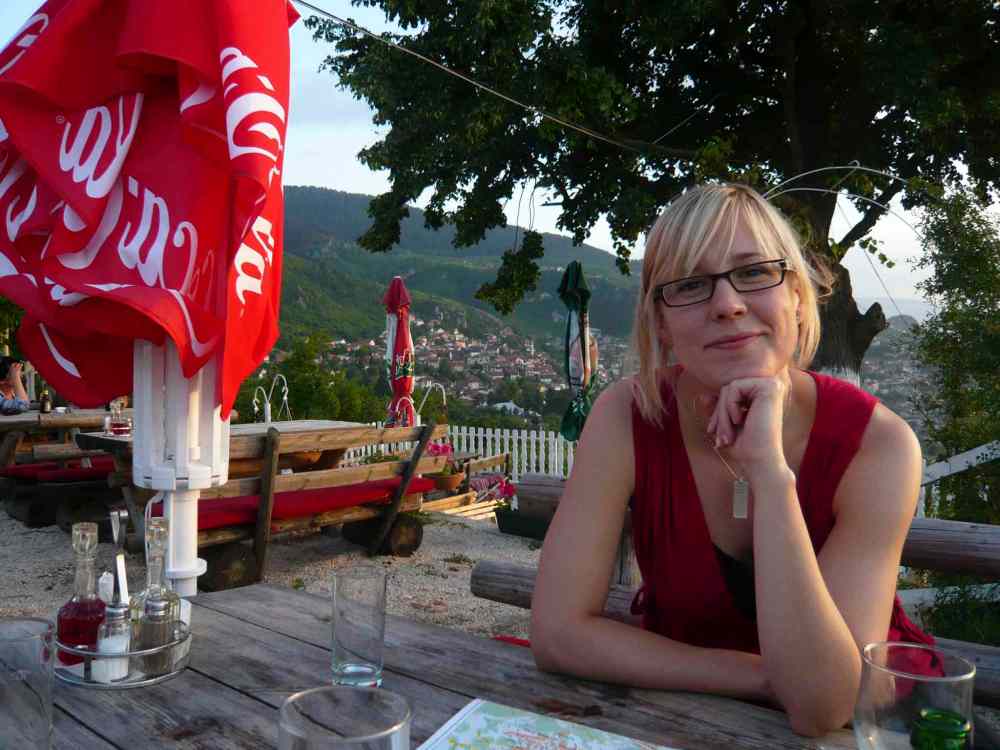
It was a diagnosis that made little sense. She was young and healthy. She wasn’t a smoker. She had access to western health care.
But to dwell on the circumstances around her death would be to misunderstand Smirl entirely. After all, Smirl didn’t dwell. She lived her life until the end. And thanks to her friends and colleagues, she will continue to shape minds.
On Sunday evening, the Good Will Social Club will host the posthumous launch of Smirl’s book, Spaces of Aid: How Cars, Compounds and Hotels Shape Humanitarianism. It’s a groundbreaking work, one that examines the intersections between privilege, power and humanitarian aid.
Julietta Singh had been friends with Smirl since she was 15. Both women went on to become academics; Singh, who is a post-colonial studies professor at the University of Richmond, studied in the U.S. while Smirl, who was a lecturer in international relations at the University of Sussex until she got sick, studied in the U.K. The pair remained close and their work often overlapped.
Since Smirl’s death, Singh has been working hard to make sure her friend’s voice is still being heard. Singh incorporated Smirl’s work in a chapter in her own book manuscript; the chapter will be published in a respected theory journal as well as in Singh’s book. Singh also participated in a conference in Toronto last year to discuss Smirl’s work.
“It’s been a really incredible experience to keep this intellectual dialogue going with Lisa after her death,” Singh says. “Her work is so important.”
Many of her peers agree. Severine Autesserre of Columbia University called Smirl’s book “essential reading for anyone interested in understanding or improving humanitarian interventions.” Tim Dunne at the University of Queensland said Smirl “was one of the most original and brilliant academics working on the global humanitarian order.”
The book is already being sold as a course text in the U.K. A PhD prize at the University of Cambridge, where Smirl earned her own PhD, has also been named for her.
Before she was an academic star, Smirl was a small-town Prairie girl. She grew up in Notre-Dame-de-Lourdes in southern Manitoba, the eldest of three sisters. Her youngest sister, Ellen, 34, helped organize the Winnipeg book launch. She remembers her big sister as a leader. “She always wanted to go big,” Ellen says. “She always wanted to rent the town hall to do our Christmas productions when we were, like, 5. She never had a sense of not being able to do something.”
Smirl went away to boarding school at the Mennonite Collegiate Institute in Gretna when Ellen was still in grade school. “But she was writing punk-rock zines, though, which wasn’t quite in line with MCI policy,” Ellen recalls with a laugh.
When Smirl moved to Winnipeg on her own to attend the University of Winnipeg Collegiate, she met Singh as well as a Kelvin student by the name of Julie Penner. Smirl and Penner met at a house party and immediately struck up a bond over music, pledging to start a band. It didn’t quite work out that way: Smirl played bass in a Winnipeg punk rock outfit Banned from Atlantis and Penner played violin in a band called Buick Six. (Penner went on to become a prolific touring violinist who has played with a host of Canadian bands including Broken Social Scene and Do Make Say Think.)
“Lisa was always known as this amazing mixture of super-smart and super-fun. She was ambitious but down to earth — which was her farm roots showing,” Penner recalls. She’s emotional when she talks about her friend. While there was often an ocean between them, they remained close. Both Singh and Smirl were in Penner’s wedding party.
Having a physical book — and a local event at which to celebrate Smirl’s many accomplishments — means a lot to Penner. “The book is such a great thing for all of us. This would have made Lisa so happy. She spent her life working toward this.”
Ellen echoes that sentiment. “Right before she got sick, she had gotten word from a publisher that they wanted to publish her thesis as a book. But then she got sick, and it couldn’t happen. For Lisa, that was really devastating. Her entire identity was really around her intellect and academic career.”

For Ellen, the book keeps her sister close. “It’s somebody’s words,” she says. “They don’t disappear.”
You could say Smirl was a lucky woman, to have such a support network of friends and family. But if you ask Singh, those who knew her were the lucky ones. “She was this amazing person who shepherded us through her illness and her death. She was so caring and so thoughtful in terms of how she handled us and our grief.”
“She did so much in her life that it feels like she lived a whole life. I think everyone was always in awe of her — and everyone still is.”
The Winnipeg book launch is set for 6 p.m.
jen.zoratti@freepress.mb.ca
Jen Zoratti is a columnist and feature writer working in the Arts & Life department, as well as the author of the weekly newsletter NEXT. A National Newspaper Award finalist for arts and entertainment writing, Jen is a graduate of the Creative Communications program at RRC Polytech and was a music writer before joining the Free Press in 2013. Read more about Jen.
Every piece of reporting Jen produces is reviewed by an editing team before it is posted online or published in print – part of the Free Press‘s tradition, since 1872, of producing reliable independent journalism. Read more about Free Press’s history and mandate, and learn how our newsroom operates.
Our newsroom depends on a growing audience of readers to power our journalism. If you are not a paid reader, please consider becoming a subscriber.
Our newsroom depends on its audience of readers to power our journalism. Thank you for your support.
Jen Zoratti is a columnist and feature writer working in the Arts & Life department, as well as the author of the weekly newsletter NEXT. A National Newspaper Award finalist for arts and entertainment writing, Jen is a graduate of the Creative Communications program at RRC Polytech and was a music writer before joining the Free Press in 2013. Read more about Jen.
Every piece of reporting Jen produces is reviewed by an editing team before it is posted online or published in print – part of the Free Press‘s tradition, since 1872, of producing reliable independent journalism. Read more about Free Press’s history and mandate, and learn how our newsroom operates.
Our newsroom depends on a growing audience of readers to power our journalism. If you are not a paid reader, please consider becoming a subscriber.
Our newsroom depends on its audience of readers to power our journalism. Thank you for your support.
Advertisement Advertise With Us
Advertisement Advertise With Us
History
Updated on Saturday, June 20, 2015 1:21 PM CDT: Clarifies that Singh participated in a conference, not organized it.