WEATHER ALERT

Dafoe, Free Press editorial board took stand against Nazis

Advertisement

Advertise with us

Consider for a moment three stories covered in the Winnipeg Free Press on April 21, 2015: the officers of a ship that capsized in the Mediterranean Sea carrying 850 refugees were arrested; the paper's editorial writers opined on the finance minister's latest budget; Prime Minister Stephen Harper didn't wear a white Jets sweater to the April 20, 2015 playoff game.

Read this article for free:

or

Already have an account? Log in here »

To continue reading, please subscribe:

Subscribe and receive a limited-edition Free Press branded hat or tote.

Digital Subscription

One year of digital access for only $205*

  • Enjoy unlimited reading on winnipegfreepress.com
  • Read the E-Edition, our digital replica newspaper
  • Access News Break, our award-winning app
  • Play interactive puzzles

*First annual payment billed as $205.00 + GST for one year. This annual subscription will automatically renew at $233.00 + GST every 52 weeks (10% off the regular annual price of $259.35). Offer available to new and qualified returning subscribers only. Cancel any time.

To continue reading, please subscribe:

Add Free Press access to your Brandon Sun subscription for only an additional

$1 for the first 4 weeks*

  • Enjoy unlimited reading on winnipegfreepress.com
  • Read the E-Edition, our digital replica newspaper
  • Access News Break, our award-winning app
  • Play interactive puzzles
Start now

*Your next Brandon Sun subscription payment will increase by $1.00 and you will be charged $17.95 plus GST for four weeks. After four weeks, your payment will increase to $24.95 plus GST every four weeks.

Hey there, time traveller!
This article was published 25/07/2015 (4022 days ago), so information in it may no longer be current.

Consider for a moment three stories covered in the Winnipeg Free Press on April 21, 2015: the officers of a ship that capsized in the Mediterranean Sea carrying 850 refugees were arrested; the paper’s editorial writers opined on the finance minister’s latest budget; Prime Minister Stephen Harper didn’t wear a white Jets sweater to the April 20, 2015 playoff game.

Which story captured the attention of Winnipeg Free Press readers as they sipped their coffee: a developing African refugee crisis, middle-class tax breaks or the sweater? It was the sweater.

Turn back the clock and ask what articles might have captured a reader’s attention as they flipped though the morning paper between 1933 and 1939? Thanks to Robert J. Young, retired professor of European history at the University of Winnipeg and expert on the inter-war period, we get to find out.
Winnipeg Free Press files
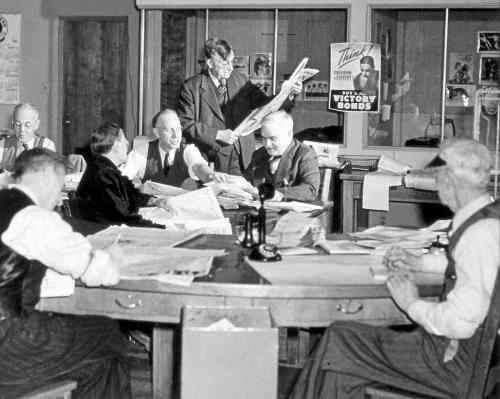
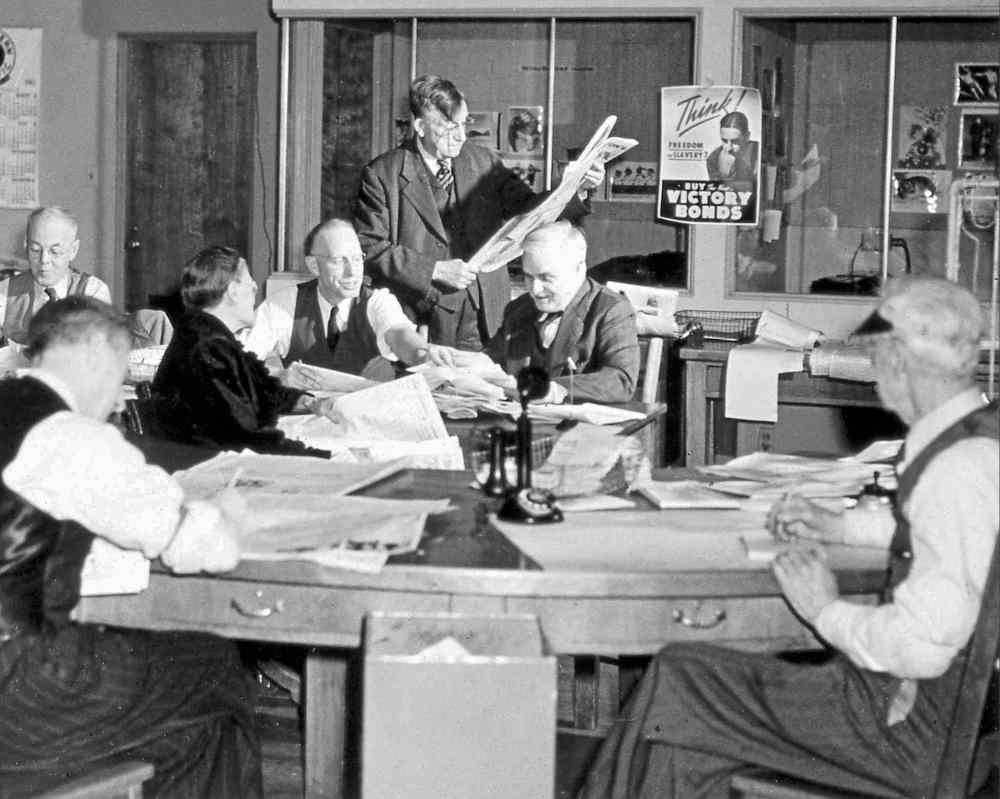
John W. Dafoe (top) and his editorial staff's opposition to the Nazis before the Second World War was rare in Canadian journalism.
Winnipeg Free Press files John W. Dafoe (top) and his editorial staff's opposition to the Nazis before the Second World War was rare in Canadian journalism.

The Free Press front-page articles and lead editorials often dwelled on ever-intensifying European crises, the failure of the League of Nations, collective security and, as the decade came to its dreary conclusion, the incessant pounding of war drums. That editorial page was print-heavy and readers knew it was serious stuff; even the political cartoon was grim.

However, Young writes, the pages of a daily paper contained many other stories to take a reader’s mind off the march to Armageddon. In an alliterative tour de force, he tells us these were: “crime, crops and cinema, to comics, commerce and concerts.”

So, if politics are not to your liking, you can get a feel for Winnipeg life in the 1930s from the stories he harvested from the paper’s back pages.

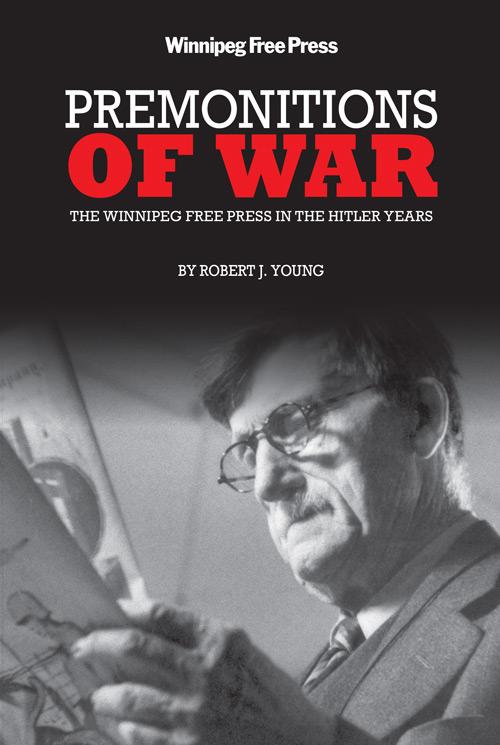
Young dedicates his book to the “memory of those who warned.” Those, he eulogizes, are Winnipeg Free Press editor John W. Dafoe — the “Prophet of the Prairies” — and his editorial staff.

In his skilled encapsulation of the paper’s editorial policy, Young gives his readers a clear and succinct picture of the decade’s unfolding tragedy. In this he provides a fitting tribute to memory of the watchers on Carlton Street.

By letting the editorial staff’s words propel the narrative, readers gain a clear understanding of the dynamics of daily journalism. Modern historians might have developed a more nuanced view of the politics of appeasement, isolationism and the origins of the Second World War, but these editors were writing the first draft of history.

Dafoe and his team believed it was their mission to inform and influence public opinion by making Free Press readers aware of the dangers the unchecked fascist and Nazi dictators posed to world peace.

In this regard, Dafoe and his team were almost unique in Canadian journalism. Of all the major papers, only the Toronto Sun and its European correspondent Matthew Halton spoke out against the rising tide of fascist evil. Others, like the Winnipeg Tribune and the Globe, tended to be conciliatory towards Hitler.
Were the editors successful in changing public opinion? This is difficult to quantify, writes Young, because scientific opinion polls as we know them today did not exist in the early 1930s. Relying on a few letters to the editor, church sermons, straw polls and other anecdotal evidence doesn’t provide an historian with hard evidence.

As an aside, James Gray, an old-time Free Press reporter, wrote in The Winter Years that Dafoe was denounced as “a war monger” and circulation fell-off after his stinging editorial condemning the 1938 Munich agreement. There is no evidence, however, that Dafoe’s team faltered in their mission.

Young’s book complements other works on Winnipeg history by authors Jim Blanchard, Alan Artibise, Jack Bumstead, Esyllt Jones and others. It inspires us to read more on Winnipeg’s social and political history and to be proud of the Winnipeg Free Press‘s heritage of free thinking, independent journalism.


Ian Stewart is a Winnipeg teacher who, in 1973, received a respectable C+ in professor Young’s second-year history course.

History

Updated on Saturday, July 25, 2015 9:22 AM CDT: Formatting.
Report Error Submit a Tip

More Stories

Critical analysis of Manitoba Hydro plans may be frustrating, but it’s necessary

Editorial 4 minute read Preview

Critical analysis of Manitoba Hydro plans may be frustrating, but it’s necessary

Editorial 4 minute read 2:00 AM CDT

Many of this country’s public utilities are virtual monopolies, and because of that, their ability to set rates and their long-term capital plans need review in order to protect their ratepayers.

Read
2:00 AM CDT

Fences to be installed at Whiteshell park site where brothers drowned

Tyler Searle 4 minute read Preview

Fences to be installed at Whiteshell park site where brothers drowned

Tyler Searle 4 minute read Yesterday at 6:13 PM CDT

The Manitoba government will install fences and signs to restrict access to a popular natural attraction in Whiteshell Provincial Park, where two brothers drowned this month and others have died in recent years.

“My heart goes out to the family. We recognize the hardship and the tragedies that are taking place, and so we’re responding as quickly as we can to secure the site,” Environment Minister Mike Moyes said Tuesday, referring to Sturgeon Falls.

“People will still be able to view the falls. They’re still going to be able to enjoy the beauty of that area of Manitoba, but they’re going to be able to do it in a way that ensures that they’re going to remain safe.”

The falls are located between Nutimik and Numao lakes on the Winnipeg River system. Visitors can reach them by hiking a 1.9-kilometre trail that begins at the Nutimik Lake campground.

Read
Yesterday at 6:13 PM CDT

Cyclists whose bikes were stolen shown Winnipeg’s warmer side

Tiago Resko 4 minute read Preview

Cyclists whose bikes were stolen shown Winnipeg’s warmer side

Tiago Resko 4 minute read Monday, Jul. 27, 2026

Fundraising cyclists from New Brunswick who had their bikes stolen in Winnipeg got to see a completely different side of the city over the weekend.

Read
Monday, Jul. 27, 2026

No museum can tell the whole story

Judith Dueck 5 minute read 1:00 AM CDT

The continuing debate over the Canadian Museum for Human Rights’ Uprooted: Nakba Past and Present exhibit has focused significantly on what the exhibit leaves out.

Some critics argue that the exhibit should have explained the United Nations Partition Plan, the Arab rejection of that plan, the 1948 invasion by neighbouring Arab states, the displacement of Jews from Arab countries, Hamas, October 7, the hostages and the reasons for Israeli security measures.

Others argue with equal conviction that it should also have addressed the Deir Yassin massacre, the expansion of Israeli settlements, decades of occupation, the Right of Return, changing demographic realities and the experiences of Palestinian refugees throughout the Middle East.

All of those subjects matter. Many remain the subject of legitimate scholarly debate. But the controversy points to a broader question that extends well beyond this particular exhibit.

Dafoe, Free Press editorial board took stand against Nazis

Reviewed by Ian Stewart 4 minute read Preview

Dafoe, Free Press editorial board took stand against Nazis

Reviewed by Ian Stewart 4 minute read Saturday, Jul. 25, 2015

Consider for a moment three stories covered in the Winnipeg Free Press on April 21, 2015: the officers of a ship that capsized in the Mediterranean Sea carrying 850 refugees were arrested; the paper's editorial writers opined on the finance minister's latest budget; Prime Minister Stephen Harper didn't wear a white Jets sweater to the April 20, 2015 playoff game.

Which story captured the attention of Winnipeg Free Press readers as they sipped their coffee: a developing African refugee crisis, middle-class tax breaks or the sweater? It was the sweater.

Turn back the clock and ask what articles might have captured a reader's attention as they flipped though the morning paper between 1933 and 1939? Thanks to Robert J. Young, retired professor of European history at the University of Winnipeg and expert on the inter-war period, we get to find out.

The Free Press front-page articles and lead editorials often dwelled on ever-intensifying European crises, the failure of the League of Nations, collective security and, as the decade came to its dreary conclusion, the incessant pounding of war drums. That editorial page was print-heavy and readers knew it was serious stuff; even the political cartoon was grim.

Read
Saturday, Jul. 25, 2015

Leave lonely lake life and get back to busy

Maureen Scurfield 5 minute read 2:00 AM CDT

DEAR MISS LONELYHEARTS: I’m going crazy! My husband and I are living up at a lake for the first summer after buying a beautiful new cabin. I thought it was going to be heaven, but it’s been hell for me.

I’m not retired, but I’m able to work at my office job remotely for the summer. The problem is, I’m already lonely and bored while my husband is out fishing. My man goes off in the boat with his buddies in the early morning, often for the whole day and the early evening, too. Now he says he’s “in fisherman’s heaven” with his retired buddies who go explore the many great angling lakes around us.

If it goes on all summer and into early fall, and I’ll be out of my mind by then. Most of the other guys’ wives stay back in the city now. They learned early on it’s a drag to be a fisherman’s “widow.”

I called my boss this morning after my husband left to go fishing. My manager says they’re really busy right now, and could use me there ASAP. Yay! I can come back to the office as soon as I want, but I feel guilty about leaving my husband alone. What should I do?