

How to ease congestion with a hammer
Advertisement
Read this article for free:
or
Already have an account? Log in here »
To continue reading, please subscribe:
Monthly Digital Subscription
$1 per week for 24 weeks*
- Enjoy unlimited reading on winnipegfreepress.com
- Read the E-Edition, our digital replica newspaper
- Access News Break, our award-winning app
- Play interactive puzzles
*Billed as $4.00 plus GST every four weeks. After 24 weeks, price increases to the regular rate of $19.95 plus GST every four weeks. Offer available to new and qualified returning subscribers only. Cancel any time.
Monthly Digital Subscription
$4.99/week*
- Enjoy unlimited reading on winnipegfreepress.com
- Read the E-Edition, our digital replica newspaper
- Access News Break, our award-winning app
- Play interactive puzzles
*Billed as $19.95 plus GST every four weeks. Cancel any time.
To continue reading, please subscribe:
Add Free Press access to your Brandon Sun subscription for only an additional
$1 for the first 4 weeks*
- Enjoy unlimited reading on winnipegfreepress.com
- Read the E-Edition, our digital replica newspaper
- Access News Break, our award-winning app
- Play interactive puzzles
*Your next Brandon Sun subscription payment will increase by $1.00 and you will be charged $17.95 plus GST for four weeks. After four weeks, your payment will increase to $24.95 plus GST every four weeks.
Read unlimited articles for free today:
or
Already have an account? Log in here »
Hey there, time traveller!
This article was published 08/10/2015 (3865 days ago), so information in it may no longer be current.
In another era, the residents of the neighbourhood at Marion Avenue and Archibald Street, upset about a proposed $250-million interchange and underpass, might be heard muttering: “God damn the CPR.” It was a popular phrase at a time when western farmers blamed the railways for everything that went wrong in their lives.
Today, of course, railways are the bane of cities that are forced to build bridges and underpasses at great cost to cope with the new traffic realities of municipal expansion.
Wouldn’t it be easier to relocate the railways? Yes, of course, but it’s not that simple. First, it would cost billions of dollars and require the combined willpower of the rail companies and the three levels of government. More to the point, however, it couldn’t be done fast enough to deal with the urgent need for underpasses at places such as Marion, which actually has two rail lines along its path.
That doesn’t mean the dream shouldn’t be pursued, but if it’s a choice between billions of dollars for rail relocation, or money for roads, public transit and other failing infrastructure, the public is likely to opt for latter.
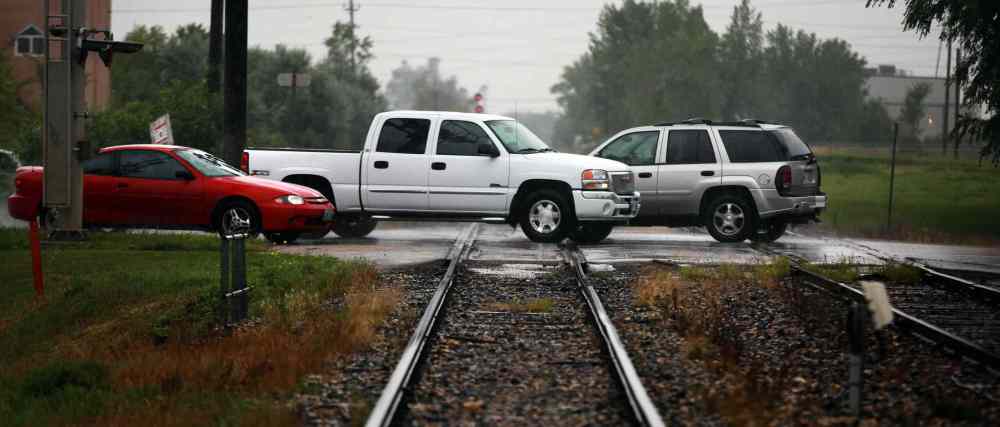
The traffic congestion at Marion and Archibald, moreover, is more complicated than the presence of two rail lines, only one of which is moderately active with four to eight trains a day.
Marion and Archibald was a relatively quiet intersection until the relentless expansion of neighbourhoods to the east and south since the 1960s, including Windsor Park, Southdale, Sage Creek, Island Lakes, the new subdivisions of Transcona, plus industrial and commercial development.
Today, some 35,000 vehicles travel through the intersection. Many from south Winnipeg turn left on Marion to head downtown to work. Traffic heading east or west through the intersection can be stopped by train traffic, which tends to gum up the entire intersection.
Something had to be done, so the city hired a consultant who basically took a sledgehammer to the neighbourhood. Not just a grade separation at the Canadian Pacific Railway line, but a massive interchange that would compel the expropriation of more than 100 homes and businesses. The entire area would resemble a traffic desert, devoid of people and signs of life.
To be fair to the consultant, the terms of the city’s request for proposals required a grade separation and interchange. And after two consultations with the community, the consultant modified the plan in response to community concerns.
Fortunately, St. Boniface Coun. Matt Allard has called for a re-evaluation of the project. The $250-million price tag is preliminary and almost certain to rise dramatically before work actually begins and finishes, Mr. Allard noted.

The terms of the development also need to be modified so engineers can consider other solutions, such as acquiring some land for turning lanes and for expanding Marion Street, as opposed to a Los Angeles-style interchange.
A rail overpass is almost certainly needed as well. Other plans to connect Marion with Dugald Road to streamline traffic flow to and from Lagimodiere Boulevard may also be worthwhile.
All of this could be done without destroying a neighbourhood and the many small businesses that give it character.
Rail relocation, meanwhile, is still a legitimate goal. In fact, it might be called the new national dream, since other cities are suffering under the same burden of spending hundreds of millions of dollars to get over or under rail lines.
Until the country’s political and business elite get serious about the issue, however, cities may be forgiven for recalling the famous rallying cry of farmers: “God damn the CPR.”
Related Articles
Scrap the $250-million road project at Marion and Archibald: Allard
Advertisement Advertise With Us
Advertisement Advertise With Us