

Filmmakers should watch out for villagers with pitchforks

Advertisement
Read this article for free:
or
Already have an account? Log in here »
To continue reading, please subscribe:
Monthly Digital Subscription
$0 for the first 4 weeks*
- Enjoy unlimited reading on winnipegfreepress.com
- Read the E-Edition, our digital replica newspaper
- Access News Break, our award-winning app
- Play interactive puzzles
*No charge for 4 weeks then price increases to the regular rate of $19.95 plus GST every four weeks. Offer available to new and qualified returning subscribers only. Cancel any time.
Monthly Digital Subscription
$4.99/week*
- Enjoy unlimited reading on winnipegfreepress.com
- Read the E-Edition, our digital replica newspaper
- Access News Break, our award-winning app
- Play interactive puzzles
*Billed as $19.95 plus GST every four weeks. Cancel any time.
To continue reading, please subscribe:
Add Free Press access to your Brandon Sun subscription for only an additional
$1 for the first 4 weeks*
*Your next subscription payment will increase by $1.00 and you will be charged $16.99 plus GST for four weeks. After four weeks, your payment will increase to $23.99 plus GST every four weeks.
Read unlimited articles for free today:
or
Already have an account? Log in here »
Hey there, time traveller!
This article was published 27/11/2015 (3699 days ago), so information in it may no longer be current.
It’s not alive! It’s not alive!
That, sadly, is the verdict on this latest cinematic kick at Mary Shelley’s Promethean can.
Screenwriter Max Landis and director Paul McGuigan (a veteran of the PBS series Sherlock) try to take a fresh approach to material that, in recent years, has been subject to everything from an expensive literalist treatment by Kenneth Branagh (Mary Shelley’s Frankenstein, 1994) to the dreary monster-as-superhero revisionism of last year’s I, Frankenstein.
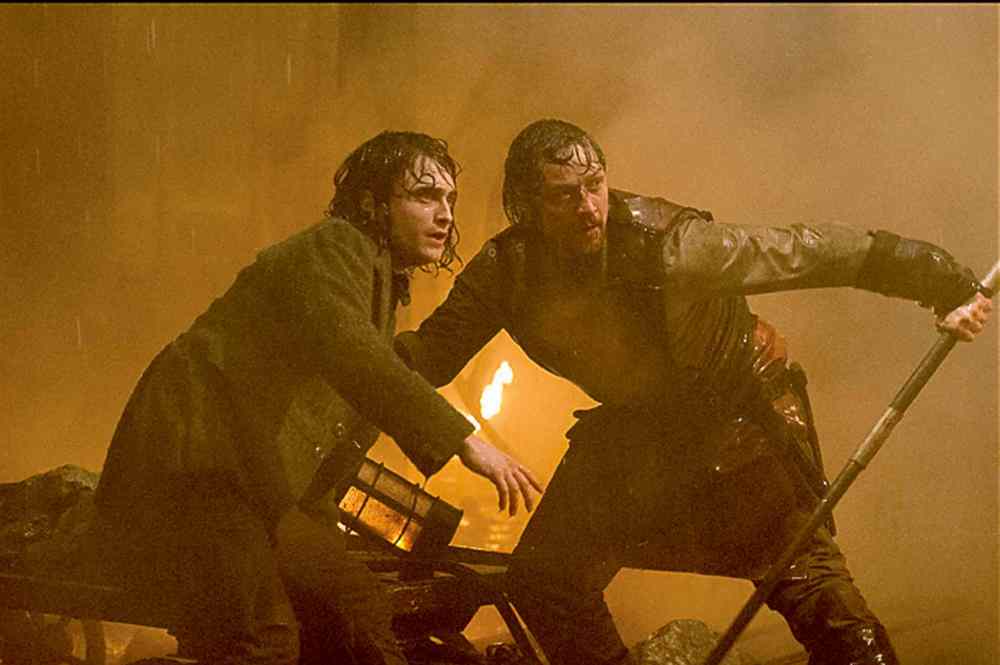
Landis and McGuigan present the tale as an unlikely buddy movie between the brilliant, somewhat unhinged Victorian doc (James McAvoy) and his assistant, Igor (Daniel Radcliffe).
In fact, the movie tells the story through Igor’s eyes, starting before he took the name. We find the pathetic hunchback working as a clown in a particularly brutal circus, where he serves as a human Punch and/or Judy, taking wallops from his fellow performers three shows a day.
But this is not the monosyllabic peon of past Frankenstein iterations. When he’s not being beaten up for the amusement of sneering Dickensian throngs, he studies medicine and anatomy, and serves as the circus doctor.
The worlds collide when the beautiful trapeze artist Lorelei (Jessica Brown Findlay of Downton Abbey) suffers a workplace accident and the slumming Frankenstein meets with Igor while treating the unconscious woman. Victor quickly determines that beneath the clown makeup lurks a budding medical genius, and he offers the pathetic lad an escape from his showbiz bondage.
That proves to be a good deal for “Igor” (he finally gets a name from Victor’s suspiciously absent former roommate), especially after Victor effects a cure for Igor’s hunchback condition within minutes. (Some might read homoerotic undertones in Victor’s sucking-out of Igor’s pus-filled hump, but I emphatically don’t see it.)
They promptly get to work on Victor’s disturbing experiments — reanimating dead animal tissue. Lurking around the periphery is a police detective (Andrew Scott, also of Sherlock fame), who also happens to be a religious zealot offended by ungodly evidence of Victor’s outré experiments.
It amounts to an amusing twist on the original, especially in the way its casts a refreshingly atheistic light on the question of whether or not Victor is playing God. Victor’s rationale for trying to create life demonstrates his psychological frailty more than aspirations to godhood.
In any case, Igor proves to be an altogether more wholesome embodiment of Victor’s benignly intended invention.
But the film shares a problem with the man-monster we know we will see at the film’s climax: It is overly charged.
This is especially true of McAvoy’s performance. In place of the cool, arrogant genius of Frankensteins past, McAvoy plays him at an emotionally hysterical pitch that gets old quickly. (Peter Cushing, you are missed.) The film’s production design is busy, cluttered and digitally enhanced up the yin-yang.
Even given moments of extreme pathos, Radcliffe manages to keep his composure, an eye of calm in the storm of overacting and digital flotsam constantly swirling around him.
Hogwarts, evidently, was a pretty good acting school.
randall.king@freepress.mb.ca
Our newsroom depends on a growing audience of readers to power our journalism. If you are not a paid reader, please consider becoming a subscriber.
Our newsroom depends on its audience of readers to power our journalism. Thank you for your support.
Victor Frankenstein
— Starring Daniel Radcliffe and James McAvoy
— Grant Park, McGillivray, Polo Park, St. Vital, Towne
1– 4A
— 110 minutes
2 stars out of five
Other voices
For much of the movie’s running time, I wished I were watching Mel Brooks’ classic take on Shelley’s yarn, Young Frankenstein. At least that one was intentionally funny.
— Gary Goldstein, Los Angeles Times
It has a wide range of elements: slapstick, gothic horror, romance, meta in-jokes, action and fiery spectacle. But it stitches them all together into a loose, shambling creation that feels like it was never entirely meant to live.
— Tasha Robinson, The Verge
Did you say, Eye-gor? More like eyesore.
— James Verniere, Boston Herald
This un-terrifying film tries to find an interesting twist on the classic Frankenstein tale, but horrifically fails.
— Allan Salkin, New York Daily News
What exec thought this was what people wanted around the holidays? Or ever?
— Matt Pais, RedEye
Our newsroom depends on a growing audience of readers to power our journalism. If you are not a paid reader, please consider becoming a subscriber.
Our newsroom depends on its audience of readers to power our journalism. Thank you for your support.
Advertisement Advertise With Us