

Myanmar migrants begin new lives here
Rohingya people seen as illegal in homeland

Advertisement
Read this article for free:
or
Already have an account? Log in here »
To continue reading, please subscribe:
Monthly Digital Subscription
$1 per week for 24 weeks*
- Enjoy unlimited reading on winnipegfreepress.com
- Read the E-Edition, our digital replica newspaper
- Access News Break, our award-winning app
- Play interactive puzzles
*Billed as $4.00 plus GST every four weeks. After 24 weeks, price increases to the regular rate of $19.95 plus GST every four weeks. Offer available to new and qualified returning subscribers only. Cancel any time.
Monthly Digital Subscription
$4.99/week*
- Enjoy unlimited reading on winnipegfreepress.com
- Read the E-Edition, our digital replica newspaper
- Access News Break, our award-winning app
- Play interactive puzzles
*Billed as $19.95 plus GST every four weeks. Cancel any time.
To continue reading, please subscribe:
Add Free Press access to your Brandon Sun subscription for only an additional
$1 for the first 4 weeks*
*Your next subscription payment will increase by $1.00 and you will be charged $16.99 plus GST for four weeks. After four weeks, your payment will increase to $23.99 plus GST every four weeks.
Read unlimited articles for free today:
or
Already have an account? Log in here »
Hey there, time traveller!
This article was published 14/12/2015 (3749 days ago), so information in it may no longer be current.
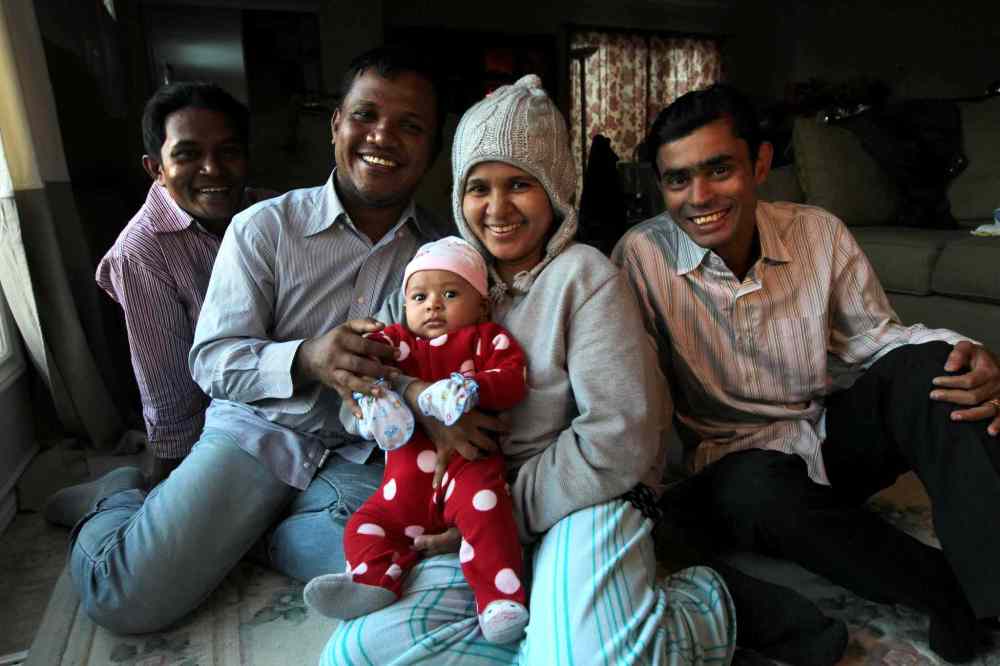
For five refugees from Myanmar who arrived in Winnipeg last month, recent elections that swept human rights hero Aung San Suu Kyi’s opposition party to power don’t offer much hope.
“I don’t think (it) will improve Rohingya lives,” said Mohammed Tayab, who arrived Nov. 24 with four other Rohingya Muslims, including a couple and their baby.
Although they were born in Myanmar, Rohingya are not even considered second-class citizens, said Tayab. The Myanmar government claims Rohingya are illegal migrants from Bangladesh, despite hundreds of thousands of them having lived in the country’s western Rakhine state for centuries. It has been accused by human rights groups of committing acts of genocide in its treatment of Rohingya.
Nobel laureate Suu Kyi has remained “silent” on the plight of the Rohingya even after her opposition party won recent elections in Myanmar, said Tayab, who doesn’t expect anything to change in his lifetime.
Amnesty International says Myanmar’s government in 1982 passed a law that denied citizenship to members of the persecuted ethnic and religious minority. The Rohingya’s rights to a nationality, their freedom of movement and access to education and services were taken away, and the government allowed the arbitrary confiscation of their property.
A team from Yale’s Allard K. Lowenstein International Human Rights Clinic reported recently acts of genocide have been committed against Rohingya in Myanmar. It said government security forces have been killing members of the group with a distinctive language, culture, history and traditions; targeting them for rape, torture, arbitrary detention and other crimes; inflicting conditions to destroy the group — such as confining them to camps and townships with restrictions on movement and deprivation of food, medical care and basic life necessities; and preventing births within the group. Marriage and birth restrictions have been imposed on the Rohingya that are sometimes referred to as “biological genocide,” the team from Yale found.
Two of the Rohingya refugees who arrived in Winnipeg with Tayab — Omar Sarduk and Khin Khin Tay — had a baby girl in Cambodia where the refugees took temporary shelter.
“We had to flee from Myanmar,” said Tayab. “We faced problems with the government,” he said, putting it mildly.
His family was thrust into hardship when the government confiscated their property. It sent him to do forced labour in a prawn fishery. He decided he had to escape Myanmar.
“Before I left, I was beaten,” said Tayab, who fled to Cambodia without a passport.
“I am a stateless person,” he said.
In Phnom Penh, he sold rotis on the street and sent emails to refugee sponsors around the world asking for help. After making 100 inquiries, he got one response — from Winnipeg.
‘Before I left, I was beaten. I am a stateless person’ — Myanmar refugee Mohammed Tayab
Tom Denton, the executive director of Hospitality House Refugee Ministry, sent a reply.

“I was very surprised and happy,” said Tayab. Hospitality House eventually agreed to sponsor him and his friends who arrived safely and are sharing a brand-new home rented for them in the North End.
They’re attending the Entry Program, a four-week primer for newcomers to Manitoba, before they’ll take English-language classes. Tayab, the only one of the group who feels comfortable conversing in English, said he has “no idea” about what kind of job he will get, but in the meantime, he wants to reach out to other members of his persecuted minority.
“I want to work with Rohingya around the world.”
carol.sanders@freepress.mb.ca
Carol Sanders
Legislature reporter
Carol Sanders is a reporter at the Free Press legislature bureau. The former general assignment reporter and copy editor joined the paper in 1997. Read more about Carol.
Every piece of reporting Carol produces is reviewed by an editing team before it is posted online or published in print — part of the Free Press‘s tradition, since 1872, of producing reliable independent journalism. Read more about Free Press’s history and mandate, and learn how our newsroom operates.
Our newsroom depends on a growing audience of readers to power our journalism. If you are not a paid reader, please consider becoming a subscriber.
Our newsroom depends on its audience of readers to power our journalism. Thank you for your support.
Carol Sanders
Legislature reporter
Carol Sanders is a reporter at the Free Press legislature bureau. The former general assignment reporter and copy editor joined the paper in 1997. Read more about Carol.
Every piece of reporting Carol produces is reviewed by an editing team before it is posted online or published in print — part of the Free Press‘s tradition, since 1872, of producing reliable independent journalism. Read more about Free Press’s history and mandate, and learn how our newsroom operates.
Our newsroom depends on a growing audience of readers to power our journalism. If you are not a paid reader, please consider becoming a subscriber.
Our newsroom depends on its audience of readers to power our journalism. Thank you for your support.
Advertisement Advertise With Us
Advertisement Advertise With Us
History
Updated on Monday, December 14, 2015 7:34 AM CST: Replaces photo