

Arabic instruction tailor-made for newcomers looking to eat well
Cooking class made to order

Advertisement
Read this article for free:
or
Already have an account? Log in here »
To continue reading, please subscribe:
Monthly Digital Subscription
$0 for the first 4 weeks*
- Enjoy unlimited reading on winnipegfreepress.com
- Read the E-Edition, our digital replica newspaper
- Access News Break, our award-winning app
- Play interactive puzzles
*No charge for 4 weeks then price increases to the regular rate of $19.95 plus GST every four weeks. Offer available to new and qualified returning subscribers only. Cancel any time.
Monthly Digital Subscription
$4.99/week*
- Enjoy unlimited reading on winnipegfreepress.com
- Read the E-Edition, our digital replica newspaper
- Access News Break, our award-winning app
- Play interactive puzzles
*Billed as $19.95 plus GST every four weeks. Cancel any time.
To continue reading, please subscribe:
Add Free Press access to your Brandon Sun subscription for only an additional
$1 for the first 4 weeks*
*Your next subscription payment will increase by $1.00 and you will be charged $16.99 plus GST for four weeks. After four weeks, your payment will increase to $23.99 plus GST every four weeks.
Read unlimited articles for free today:
or
Already have an account? Log in here »
Hey there, time traveller!
This article was published 28/12/2015 (3657 days ago), so information in it may no longer be current.
When nutritionist Ala’a Eideh volunteers as an instructor in an Arabic nutrition and cooking class that starts next month, she’ll be teaching newcomers from places such as Syria — a place with a cuisine she knows well and loves.
“Giving a cooking class in Arabic for newcomers — especially Syrians — is exciting,” said the international student doing a doctorate in nutrition at the University of Manitoba. She is from Syria’s neighbour, Jordan, where close to a million Syrians have taken refuge. Eideh is thrilled to be volunteering and helping newcomers nourish themselves.
“They need this kind of information.”
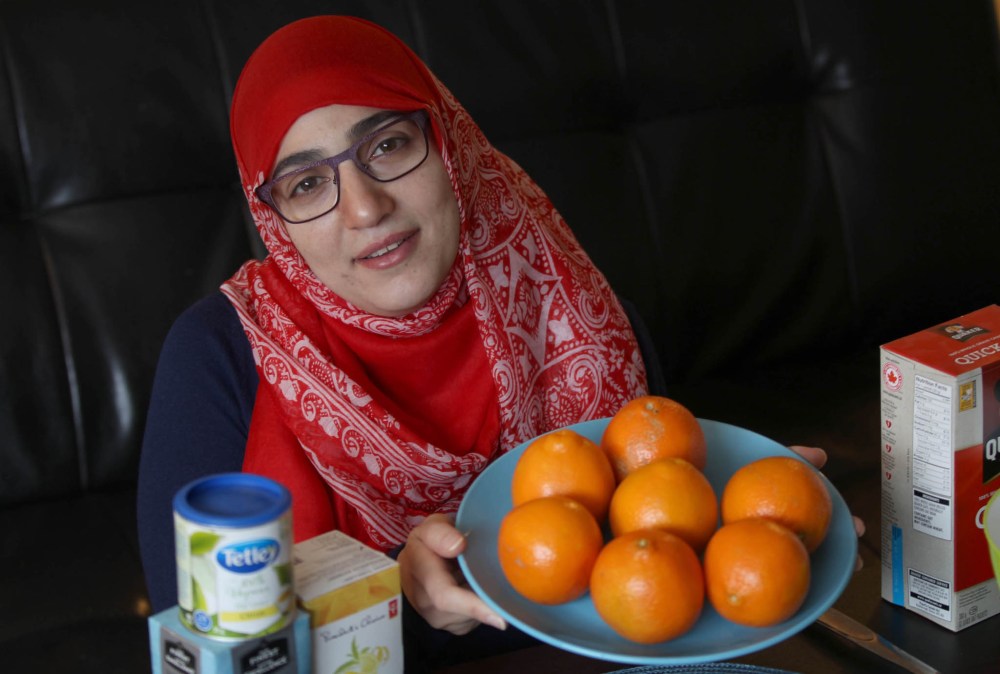
She said she was looking for a new volunteer opportunity when the Immigrant Centre sent out the email about the new Arabic nutrition and cooking class.
“It was designed perfectly for Ala’a,” she said with a laugh. “Not so many people speak Arabic (in Winnipeg).”
And not so many are nutritionists with community education experience.
“I volunteered recently with a community nutrition education program with the WRHA (Winnipeg Regional Health Authority),” she said. That commitment has ended. “Now I have space for something new,” she said.
“As someone who knows Arabic and uses the language fluently, it made me feel like this is something for me to do.”
It’s the first time the long-running cooking and nutrition class for newcomers at the Immigrant Centre has been offered in Arabic, said nutrition services manager Heather Giesbrecht. The idea for it came up after a meeting she attended about Syrian refugees coming to Manitoba.
She sent an email to the University of Manitoba asking if there were any Arabic-speaking nutritionists who’d volunteer to help.
“Within an hour, I had a response.”
Eideh and another nutritionist working on a post-graduate degree stepped up to help, said Giesbrecht.
“They’re qualified individuals.”
The eight-week class meets on Wednesday evenings starting Jan. 27. It’s for men and women with any level of cooking experience. The posters in English and Arabic say it’s for “people who want to learn how to cook healthy Canadian food.”
Kebbeh, one of Eideh’s favourite Syrian dishes, won’t be on the menu. Kebbeh is meatballs made with bulgur wheat, then deep-fried and dipped in yogurt.
‘As someone who knows Arabic and uses the language fluently, it made me feel like this is something for me to do’
— nutritionist Ala’a Eideh (below)
“It’s very tasty” but not very healthy because it’s deep-fried, she said. “Syrians are experts in preparing very tasty food,” said Eideh, who’s visited Damascus more than 20 times. “Tourists love their food. They have their famous traditional dishes mainly made up of wheat products — carbs or starches or, to a lesser extent, veggies and meat,” said the nutritionist.
One of the big challenges Syrians and other Arabic-speaking students will face is supermarket shopping, Eideh expects.
“They’re used to going to small shops and asking questions,” she said. The impersonal nature of grocery stores and the language barrier will be an adjustment, she said. Another challenge will be to find foods that meet their religious dietary requirements.
“The majority are Muslim. They have to find halal options.”
Giesbrecht said the class will tour Superstore.
The students will find their way around Canadian grocery stores and kitchens while learning about diabetes and diet-related chronic illness, according to the lesson plan.
Aside from learning healthy recipes and how to read food labels, they’ll meet new people and practise their English in a safe place where they can share life’s struggles and joys, she said.
“I think food really brings people together,” said Giesbrecht. “Sometimes I think that’s more important than the food.”
carol.sanders@freepress.mb.ca
Carol Sanders
Legislature reporter
Carol Sanders is a reporter at the Free Press legislature bureau. The former general assignment reporter and copy editor joined the paper in 1997. Read more about Carol.
Every piece of reporting Carol produces is reviewed by an editing team before it is posted online or published in print — part of the Free Press‘s tradition, since 1872, of producing reliable independent journalism. Read more about Free Press’s history and mandate, and learn how our newsroom operates.
Our newsroom depends on a growing audience of readers to power our journalism. If you are not a paid reader, please consider becoming a subscriber.
Our newsroom depends on its audience of readers to power our journalism. Thank you for your support.
Carol Sanders
Legislature reporter
Carol Sanders is a reporter at the Free Press legislature bureau. The former general assignment reporter and copy editor joined the paper in 1997. Read more about Carol.
Every piece of reporting Carol produces is reviewed by an editing team before it is posted online or published in print — part of the Free Press‘s tradition, since 1872, of producing reliable independent journalism. Read more about Free Press’s history and mandate, and learn how our newsroom operates.
Our newsroom depends on a growing audience of readers to power our journalism. If you are not a paid reader, please consider becoming a subscriber.
Our newsroom depends on its audience of readers to power our journalism. Thank you for your support.
Advertisement Advertise With Us
Advertisement Advertise With Us
History
Updated on Monday, December 28, 2015 7:49 AM CST: Photo changed.