

The training basket of Daryl Hurrie

Advertisement
Read this article for free:
or
Already have an account? Log in here »
To continue reading, please subscribe:
Digital Subscription
One year of digital access for only $1.44 a week*
- Enjoy unlimited reading on winnipegfreepress.com
- Read the E-Edition, our digital replica newspaper
- Access News Break, our award-winning app
- Play interactive puzzles
*Billed as $5.77 plus GST every four weeks. After 52 weeks, price increases to the regular rate of $19.95 plus GST every four weeks. Offer available to new and qualified returning subscribers only. Cancel any time.
To continue reading, please subscribe:
Add Free Press access to your Brandon Sun subscription for only an additional
$1 for the first 4 weeks*
- Enjoy unlimited reading on winnipegfreepress.com
- Read the E-Edition, our digital replica newspaper
- Access News Break, our award-winning app
- Play interactive puzzles
*Your next Brandon Sun subscription payment will increase by $1.00 and you will be charged $17.95 plus GST for four weeks. After four weeks, your payment will increase to $24.95 plus GST every four weeks.
Read unlimited articles for free today:
or
Already have an account? Log in here »
Hey there, time traveller!
This article was published 02/01/2016 (3803 days ago), so information in it may no longer be current.
Just call him the mad (sport) scientist.
Daryl Hurrie heads to work each day and creates. His job as the director of sport physiology at the Canadian Sport Centre Manitoba (CSCM) calls for applied research and innovation, and he’s quite happy to oblige, especially the latter.
“In order to work with people with exceptional human physiology is to see how they respond to stress,” Hurrie says. “That can be anything — thermal stress, training stimulus or a game or competition.”
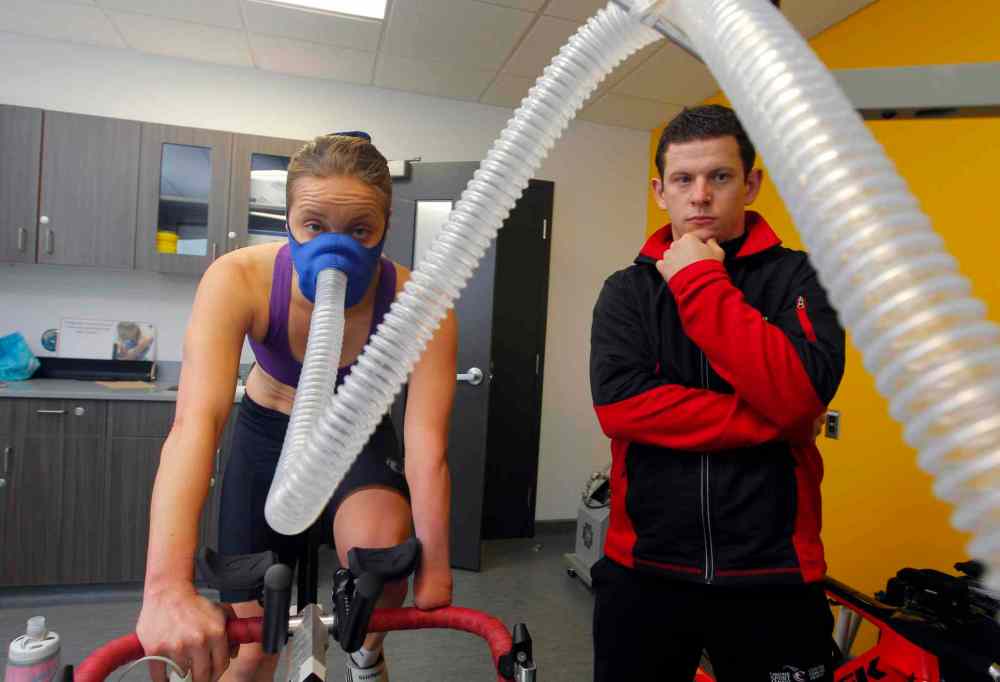
While some of us curse printers that jam and loathe memos in our workplaces, Hurrie throws around words like chambers, pills, critical levels, artificial stimuli, modalities and interventions.
What he does with those words and the information derived from them is simple (to him at least). He understands what that stress does to the body and then the fun begins.
“I get to figure out how to get the body to react through artificial means,” he says. “We take on training intervention, so that when the body competes, it’s not a shock to the system. They can handle the stress quite well.”
And he self-experiments: anything he uses on a client is first used on himself.
“I want to know what it feels like to be hypoxic (when the body is deprived of adequate oxygen), or what it feels like to be in a thermal chamber or getting electrical and magnetic stimulation,” he says.
See? Mad scientist.
It’s not what you would call a normal childhood aspiration — to grow up one day and figure out how manipulate and trick the body. And it wasn’t until his teenage years when Hurrie found his calling.
At 16, Hurrie tore his anterior cruciate ligament. At first he didn’t realize it, and worked on strengthening it while he kept playing.
“I thought I had fixed it, but I was in a playoff game and planted my leg. Kind of like the Exorcist, I spun around 360, and fell over. I had to have reconstructive surgery, but it also got me on the whole thing of training and how to change the body and how to make it respond in artificial environments,” he says.
Numerous courses later and Hurrie had a bachelor’s degree in exercise sport science from the University of Manitoba.
He’s currently working on his PhD in extreme environmental situations with exercise, with a focus on thermal regulation.

“It’s just a deep-seeded interest in the body and how it all works together,” Hurrie says.
If it sounds a little over-the-head, that’s because it is. But it’s beneficial. While Hurrie’s research at the moment looks at hypothermia, his job at CSCM has him studying the blazing heat athletes with encounter at the Olympic Games in Brazil next summer.
“My position needs me to not only be a jack of all trades, but also a master of all trades,” he says. “Any Olympian, Paralympian or high-level athlete that has come through this province, I’ve likely worked with them.”
Hurrie’s fitness background includes stints in Winnipeg’s premier division in soccer. He also played in the Manitoba Major Junior Hockey League. And he likes to lift. He even does normal things like biking with his dogs and playing rec hockey.
“I just love it all,” he says.
Scott Billeck is a general assignment reporter for the Free Press. A Creative Communications graduate from Red River College, Scott has more than a decade’s worth of experience covering hockey, football and global pandemics. He joined the Free Press in 2024. Read more about Scott.
Every piece of reporting Scott produces is reviewed by an editing team before it is posted online or published in print — part of the Free Press‘s tradition, since 1872, of producing reliable independent journalism. Read more about Free Press’s history and mandate, and learn how our newsroom operates.
Our newsroom depends on a growing audience of readers to power our journalism. If you are not a paid reader, please consider becoming a subscriber.
Our newsroom depends on its audience of readers to power our journalism. Thank you for your support.
Favourite workout: It’s not a single workout, but a workout week, being able to string together several workouts. For me, it would be a four-day workout where I could work out every part of the body individually and be able to do it consistently.
Favourite workout song: I really like songs that have are in a certain key: minor-key music. Something like Tool, System of a Down, etc. If it’s endurance stuff, anything with a high beat rate. The literature states that music with a certain tone and cadence — pop songs — drive different parts of the brain.
Fitness tip: Consistency in application. Your mind will be your biggest limitation. You just have to be committed to it and be persistent. It’s like that old (Wayne) Gretzky line, if you never shoot on net, you’ll never score.
What’s in your fridge: Some hummus, mangos and bananas are go-to fruits and I like a 50-50 split of Tropicana 50 extra-pulp orange juice mixed with some carbonated water. Greek yogurt, cottage cheese, pulled pork, extra-lean ground beef and eggs. Also variety of espresso beans in the freezer to grind my java, key for any sport scientist.
Guilty pleasure: I don’t know what the heck they put in Heluva Good! dip (French onion), is it laced with cocaine? That is my guilty pleasure.
Scott Billeck is a general assignment reporter for the Free Press. A Creative Communications graduate from Red River College, Scott has more than a decade’s worth of experience covering hockey, football and global pandemics. He joined the Free Press in 2024. Read more about Scott.
Every piece of reporting Scott produces is reviewed by an editing team before it is posted online or published in print — part of the Free Press‘s tradition, since 1872, of producing reliable independent journalism. Read more about Free Press’s history and mandate, and learn how our newsroom operates.
Our newsroom depends on a growing audience of readers to power our journalism. If you are not a paid reader, please consider becoming a subscriber.
Our newsroom depends on its audience of readers to power our journalism. Thank you for your support.
Advertisement Advertise With Us
Advertisement Advertise With Us