

Mixed feelings about new format
Curling is extremely resistant to change, for better or worse
Advertisement
Read this article for free:
or
Already have an account? Log in here »
To continue reading, please subscribe:

Digital Subscription
One year of digital access for only $205*
- Enjoy unlimited reading on winnipegfreepress.com
- Read the E-Edition, our digital replica newspaper
- Access News Break, our award-winning app
- Play interactive puzzles
*First annual payment billed as $205.00 + GST for one year. This annual subscription will automatically renew at $233.00 + GST every 52 weeks (10% off the regular annual price of $259.35). Offer available to new and qualified returning subscribers only. Cancel any time.
To continue reading, please subscribe:
Add Free Press access to your Brandon Sun subscription for only an additional
$1 for the first 4 weeks*
- Enjoy unlimited reading on winnipegfreepress.com
- Read the E-Edition, our digital replica newspaper
- Access News Break, our award-winning app
- Play interactive puzzles
*Your next Brandon Sun subscription payment will increase by $1.00 and you will be charged $17.95 plus GST for four weeks. After four weeks, your payment will increase to $24.95 plus GST every four weeks.
Read unlimited articles for free today:
or
Already have an account? Log in here »
Hey there, time traveller!
This article was published 12/02/2016 (3838 days ago), so information in it may no longer be current.
SELKIRK — Change comes very, very slowly to a sport in which the objects in play — the rocks — are still gathered by hand on a tiny, obscure Scottish island named Ailsa Craig.
There are still oldtimers, for instance, who bemoan the regulation curling game was ever shortened from 12 ends to 10 ends, almost 40 years ago.
If it’s worth doing, it’s worth doing for 41/2 hours, goes that argument.
And the eight-end games they play on the Grand Slam circuit nowadays? Heresy.
The same skeptics will tell you sweeping has never been as effective since they did away with the thundering corn brooms. And the fact all evidence is to the contrary — that the modern curling brush is a miracle of science and the fitter and buffer curlers who wield them can make a 45-pound rock dance?
Don’t bother us with your facts, young man.
None of this is to complain, mind you. Indeed, in a world of constant change and a bombardment of information, I like that curling is still played, more or less, the same way the Scottish Settlers played it on the frozen Red River over 100 years ago.
And so it goes here this week at the Manitoba men’s curling championship, an event as quaint and unyielding as any in the sport.
Do you know why there are still an unwieldy 32 teams every year in the Manitoba men’s provincials, even though the number of curlers and curling clubs in this province has dropped precipitously in the last couple of decades and the gulf between the handful of teams that can actually win this event and everyone else has never been wider?
Because there have always been 32 teams in the Manitoba provincials. End of story. It never seems to occur to anyone you need any better answer than that.
And so against that backdrop, it should come as a surprise to no one the men and women of this sport have been slow to adopt what has the potential to be the biggest single innovation the sport has seen — the acceptance of mixed doubles curling as a full medal Olympic event beginning in 2018.
No one was sure what to expect last summer when the IOC announced it had granted medal status to a sub-discipline of curling that was invented out of thin air a decade ago as a way to get more Olympic medals for curling.
It’s pretty much like regular curling but with some twists — one man and one woman per team; six stones an end instead of eight; one rock from each team is pre-positioned on the centre line.
(True story: A World Curling Federation executive who helped develop mixed doubles once told me: “If you toboggan head-first down a hill and it’s called skeleton and if you toboggan feet first and it’s called luge, there’s no reason mixed doubles can’t be a medal sport, too.”)
This winter has been the first in which the sport’s governing body in this country, Curling Canada, has put any serious resources into trying to make Canadian mixed doubles curlers the same kind of international powerhouse they are in the regular old men’s and women’s games.
Winnipeg’s Jeff Stoughton, who in addition to three Brier titles was also a two-time Canadian mixed champion, has been hired to try and get a fledgling national mixed doubles program off the ground.
But the response has been tepid. While a handful of curlers have paired off full time and spent the winter playing nothing but mixed doubles, the majority who have played it at all this winter are simply the same old suspects from the men’s and women’s games, pairing off after a regular bonspiel and tossing a few ends of mixed doubles for kicks and giggles.
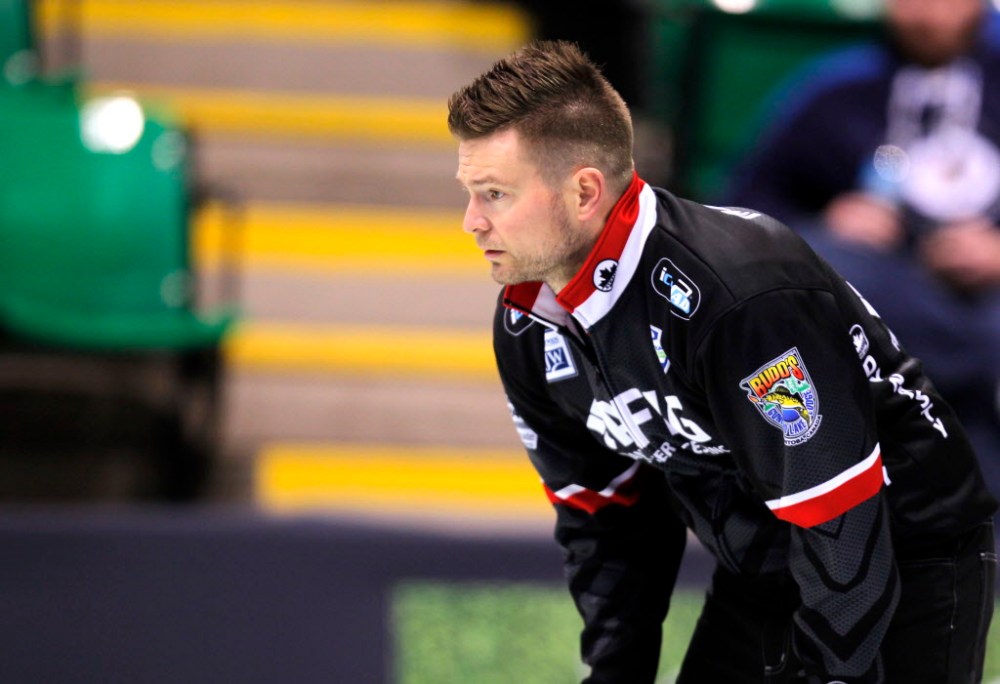
Take Mike McEwen, for instance, who paired off with his wife, Jennifer Jones lead Dawn McEwen, at a mixed doubles event that followed the conclusion of a Grand Slam event in Oshawa, Ont., in November.
The McEwens won the event to qualify for a 32-team national mixed doubles championship next month in Saskatoon. But McEwen didn’t sound like he was taking it too seriously.
“We won, but to be honest, I still have no idea if we’re even any good at it,” he said.
“We just kind of crossed our fingers and hoped we’d be OK. Really, we only got into it at first because it seemed like it’d be something fun to try as a couple.”
Reid Carruthers curled in the same event with Rachel Homan second Joanne Courtney, while Jones curled with her husband, Kevin Koe second Brent Laing. By all accounts, everyone had a blast.
“It’s a lot of fun,” said Carruthers. “And Joanne’s a lot better sweeper than I am.”
But having fun is one thing — building an Olympic-calibre national mixed doubles program is quite another. And while an Olympic medal in mixed doubles in 2018 would presumably shine just as bright as a regular curling medal, there’s still a lot of skeptics out there.
Take reigning Canadian junior champ Matt Dunstone, who at 20 would seem to be exactly the kind of demographic curling types are counting on to grow mixed doubles in this country.
“I’ve played it a couple of times, but I’m not much of a fan. I prefer the team game a lot more,” Dunstone said Friday.
And the Olympic carrot?
“Nope. I really have no desire to play mixed doubles, whatsoever,” he said.
Leaving aside the Olympic medal at stake in 2018, there is also this: with curling clubs closing and the grassroots of the sport in this country shrinking, there’s hope that — if mixed doubles does catch on — it could help struggling clubs.
With just two players instead of four, it should theoretically be easier to put together a mixed doubles team and find a game. And the mixed gender element also offers a social aspect that could entice the casual curler back into the clubs.

But so far? Mostly crickets.
Maybe, after everyone sees it played on the biggest stage of all at the Winter Olympics in PyeongChang, South Korea, mixed doubles will catch on in this country.
Until then, change will continue to come very slowly to curling.
paul.wiecek@freepress.mb.ca
Twitter: @PaulWiecek
Related Articles
Jones favourite to repeat at Scotties Nunavut women win their Scotties debut


Advertisement Advertise With Us
Advertisement Advertise With Us