Too close for comfort

Local playwright didn't have to look past his own backyard for inspiration

Advertisement

Advertise with us

In his book of essays, We Are All Treaty People, Calgary political science professor Roger Epp wrote that the most meaningful work of reconciliation between white and indigenous people would not be in the corridors of power but “in small, face-to-face initiatives for which the imperative is greatest where communities exist in close proximity.”

Read this article for free:


or

Already have an account? Log in here »

To continue reading, please subscribe:

Subscribe and receive a limited-edition Free Press branded hat or tote.

Digital Subscription

One year of digital access for only $205*

  • Enjoy unlimited reading on winnipegfreepress.com
  • Read the E-Edition, our digital replica newspaper
  • Access News Break, our award-winning app
  • Play interactive puzzles

*First annual payment billed as $205.00 + GST for one year. This annual subscription will automatically renew at $233.00 + GST every 52 weeks (10% off the regular annual price of $259.35). Offer available to new and qualified returning subscribers only. Cancel any time.

To continue reading, please subscribe:

Add Free Press access to your Brandon Sun subscription for only an additional

$1 for the first 4 weeks*

  • Enjoy unlimited reading on winnipegfreepress.com
  • Read the E-Edition, our digital replica newspaper
  • Access News Break, our award-winning app
  • Play interactive puzzles
Start now

*Your next Brandon Sun subscription payment will increase by $1.00 and you will be charged $17.95 plus GST for four weeks. After four weeks, your payment will increase to $24.95 plus GST every four weeks.

Hey there, time traveller!
This article was published 09/03/2016 (3808 days ago), so information in it may no longer be current.

In his book of essays, We Are All Treaty People, Calgary political science professor Roger Epp wrote that the most meaningful work of reconciliation between white and indigenous people would not be in the corridors of power but “in small, face-to-face initiatives for which the imperative is greatest where communities exist in close proximity.”

Winnipeg playwright Steven Ratzlaff takes that concept and runs with it in Reservations, a pair of one-act plays premièring tonight at the Rachel Browne Theatre under the auspices of Theatre Projects Manitoba.

In the first play, Pete’s Reserve, an ailing Mennonite farmer (played by Ratzlaff) decides to give his land to a neighbouring First Nation, a decision that will have hard implications for his daughter.

In the second play, Standing Reserve, a white foster couple must work with a representative of a First Nations Child and Family Services agent to provide for the cultural needs of the children in their care.
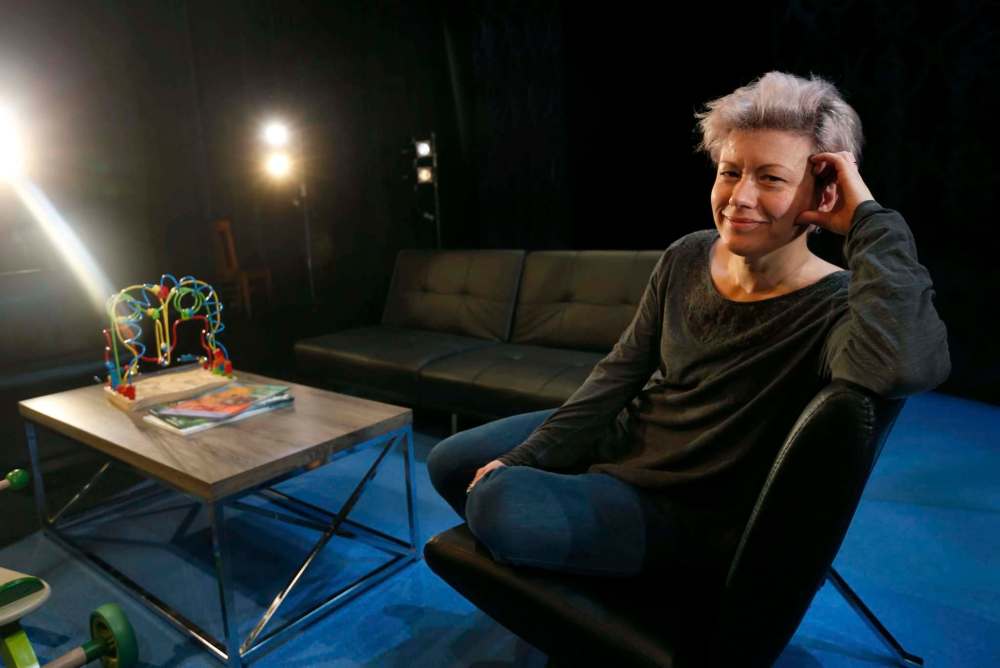
WAYNE GLOWACKI / WINNIPEG FREE PRESS
Emma Tibaldo, co-director of Reservations.
WAYNE GLOWACKI / WINNIPEG FREE PRESS Emma Tibaldo, co-director of Reservations.

The inspiration for the plays, Ratzlaff says, comes from just living Winnipeg right now.

“It’s almost impossible to be a citizen of this city without being confronted with the issues relating to indigenous children in care and all the issues and the history that’s behind this moment,” says Ratzlaff during a rehearsal break at the Rachel Browne Theatre. “Just being here and knowing people.”

In writing Standing Reserve, Ratzlaff says he was also inspired by a Winnipeg Free Press article by the late Lindor Reynolds “about a dispute between a white foster family and a First Nations agency.

“I was struck by that,” he says. “I started to think about that, because everyone involved is well-intentioned, but you end up at loggerheads, stuck. And as a playwright, I am interested in people who are stuck.”

For Cree actress Tracey Nepinak, the dialogue that takes place on the stage serves as a catalyst for dialogue outside the theatre.

“I cried when I first read it,” she says. “The issue of racism right now in our city is at a boiling point. It’s a seething thing — it’s happening and we all know it and we feel it, but nobody wants to talk about it.
WAYNE GLOWACKI / WINNIPEG FREE PRESS
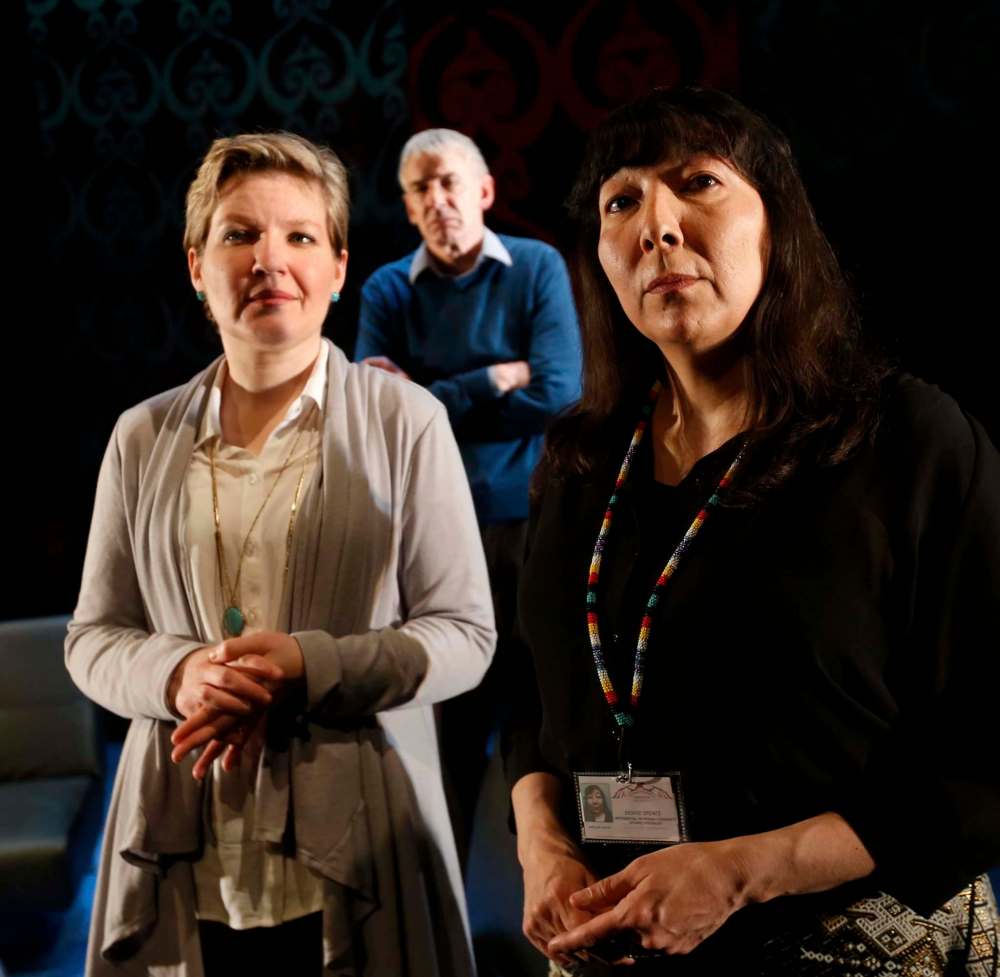
From right, Tracey Nepinak, Steven Ratzlaff and Sarah Constible in a scene from Ratzlaff's Reservations at Theatre Projects.
WAYNE GLOWACKI / WINNIPEG FREE PRESS From right, Tracey Nepinak, Steven Ratzlaff and Sarah Constible in a scene from Ratzlaff's Reservations at Theatre Projects.

“I love that this play gives people the opportunity to stand back and see themselves, or maybe identify with one of the characters and have one of the other characters shed some light on the other side.”

“I don’t think any other theatre is addressing any of that right now,” she says.

Lately, Nepinak has been going through a particularly regal period of her career, playing Queen Isabella in a production of Marlowe’s Edward II last fall, and Cleopatra in a Shakespeare in the Ruins production of Antony and Cleopatra last summer. In Reservations, she, Ratzlaff and Sarah Constible all do double-duty, playing different characters in each play. If being queenly can be demanding, doing two roles in one evening in Reservations is downright challenging.

“It’s a little exhausting,” she says.

Behind the scenes, it took two directors to bring Ratzlaff’s work to the stage: Winnipeg First Nations playwright Ian Ross and Montreal-based directior Emma Tibaldo, the artistic director of Playwrights’ Workshop Montreal.

Tibaldo says doubling up on directors was unusual but necessary to the work.

“The play needed two points of view because there are two points of view in the play and they’re very specific and very clear from the perspective of the settler and the perspective of the indigenous characters,” she says. “So it was important that both voices be present and we could discuss things on our own and come to an understanding of what the plays were trying to convey.”

randall.king@freepress.mb.ca@FreepKing

Randall King

Randall King
Writer

Randall King writes about film for the Winnipeg Free Press.

Our newsroom depends on a growing audience of readers to power our journalism. If you are not a paid reader, please consider becoming a subscriber.

Our newsroom depends on its audience of readers to power our journalism. Thank you for your support.

Report Error Submit a Tip

More Stories

The circle of life — garden-sized

5 minute read Preview

The circle of life — garden-sized

5 minute read 2:00 AM CDT

“The lesson I have thoroughly learnt, and wish to pass on to others, is to know the enduring happiness that the love of a garden gives.” — Gertrude Jekyll (1843-1932), horticulturalist

It’s a chilly day for August — more like fall — but in the garden things are progressing as nicely as if every day this summer had been the perfect combination of sun and showers.

The peonies are spent, their heavy heads with a hangdog look. Soon the petals will fall, revealing the jester-hat seedpods within. The lilacs, too, their beautiful, fragrant blossoms now transformed into brown scruff.

But the day lilies are plumping up, ready for their big reveal. And the roses are still magnificent — dozens and dozens of fuchsia, red, white and coral blooms that turn our stone circle into a heavenly scented bower. It is here where we come after a hard day’s work in the garden, newly scrubbed and wearing fresh clothes, to sit at a little bistro table and have a glass of wine and enjoy the results of our labour.

Read
2:00 AM CDT

AI bio-weapons loom

Gwynne Dyer 4 minute read 2:00 AM CDT

‘Artificial intelligence’ based on large language models is shaping up to be the most efficient destroyer of value since the South Sea Bubble. After “the Crash”, which is inevitably coming, some specific functions of AI will eventually turn out to be genuinely revenue-generating, and a lot of jobs will duly disappear. But the biggest winner (and potentially biggest loser) is medical science.

Dr. Brian Hie, a chemical engineer at Stanford University in California, has just revealed that his team has made the first viruses designed by artificial intelligence. They are ‘bacteriophages’, viruses that only infect bacteria and are widely used to treat people with infections that resist other treatments.

However, natural bacteriophages sometimes fail, so Dr. Hie used generative AI to design new ones that might do the job. The AI generated thousands of designs for new genomes that more or less fit the bill, and he chose around 300 of them to build in the lab. It’s hard work, not magic, but he ended up with 16 ‘novel’ bacteriophages that might work.

He applied them to petri dishes containing two harmful strains of E. coli, a common bacteria that lives in the human gut, and they killed the bacteria off. It’s still early days, but if it is truly becoming possible to tailor-make bacteriophages that target specific bacteria, then we may be getting a major new weapon in the struggle against antibiotic resistance.

Downtown records net zero business loss

Free Press staff 2 minute read 2:00 AM CDT

Downtown Winnipeg counted the same number of business openings as closures this spring.

‘Exciting news’ on rail relocation coming

Carol Sanders 5 minute read Preview

‘Exciting news’ on rail relocation coming

Carol Sanders 5 minute read Yesterday at 2:00 AM CDT

Premier Wab Kinew is expected to make an announcement concerning long-awaited Winnipeg rail relocation later this week.

Former federal transport minister and Manitoba MP Lloyd Axworthy, who Kinew tasked in October 2024 with leading a two-year rail relocation feasibility study, confirmed there would be an announcement Wednesday.

“We’ve had this rail study group which I’ve chaired and we’ve been responsible for developing recommendations,” Axworthy said Monday.

The longtime champion for Winnipeg rail relocation, who is vacationing at his cottage on Lake Winnipeg, deferred to the premier’s office for information, but confirmed he will attend Wednesday’s news conference.

Read
Yesterday at 2:00 AM CDT

Fun drop-in last chance to mentor grads of inner-city school with excellent track record

Maggie Macintosh 6 minute read Preview

Fun drop-in last chance to mentor grads of inner-city school with excellent track record

Maggie Macintosh 6 minute read 2:00 AM CDT

Summer break may be in full swing, but Gonzaga Middle School invited graduates back to the building for water balloon fights and academic, employment and support services this week.

Roughly 30 alumni, including teenagers and twentysomethings, stopped by the grades 6-8 school in North Point Douglas on Tuesday afternoon. They were greeted with slime-making kits, ice cream sundaes and staff ready to answer questions.

The initiative — the final grad drop-in organized this summer — is a new extension of the mentorship and holistic programming baked into the funded independent school’s mandate.

“We have 22- and 23-year-olds coming back and checking in and asking for help on their university papers,” principal Rex Ferguson-Baird said.

Read
2:00 AM CDT

A new chapter: Renamed Winnipeg Book Festival takes to The Forks this fall

Ben Sigurdson 5 minute read Preview

A new chapter: Renamed Winnipeg Book Festival takes to The Forks this fall

Ben Sigurdson 5 minute read Yesterday at 4:22 PM CDT

Winnipeg’s long-running annual literary festival returns this fall, once again featuring a slate of authors, local and beyond, ready to engage with readers.

New this year is pretty much everything else, including a new name, executive director and team of staff — as well as a shift to a tight, condensed timeline and a move to hold all events under one roof.

The festival formerly known as Thin Air/Livres en fête is now the Winnipeg Book Festival; the event takes place Oct. 1-4 at The Forks Market, with most events offering free admission.

It’s a lot of changes for the stalwart literary festival, which was run for more than two decades by Charlene Diehl, who stepped away in late 2025.

Read
Yesterday at 4:22 PM CDT