Road to freedom for POWs captivates
Advertisement
Read this article for free:
or
Already have an account? Log in here »
To continue reading, please subscribe:

Digital Subscription
One year of digital access for only $205*
- Enjoy unlimited reading on winnipegfreepress.com
- Read the E-Edition, our digital replica newspaper
- Access News Break, our award-winning app
- Play interactive puzzles
*First annual payment billed as $205.00 + GST for one year. This annual subscription will automatically renew at $233.00 + GST every 52 weeks (10% off the regular annual price of $259.35). Offer available to new and qualified returning subscribers only. Cancel any time.
To continue reading, please subscribe:
Add Free Press access to your Brandon Sun subscription for only an additional
$1 for the first 4 weeks*
- Enjoy unlimited reading on winnipegfreepress.com
- Read the E-Edition, our digital replica newspaper
- Access News Break, our award-winning app
- Play interactive puzzles
*Your next Brandon Sun subscription payment will increase by $1.00 and you will be charged $17.95 plus GST for four weeks. After four weeks, your payment will increase to $24.95 plus GST every four weeks.
Read unlimited articles for free today:
or
Already have an account? Log in here »
Hey there, time traveller!
This article was published 19/03/2016 (3843 days ago), so information in it may no longer be current.
Many Canadians may know little about Bangladesh besides George Harrison and Ravi Shankar’s fundraising concerts and some tragedies involving floods and sweatshops.
Those on the Indian subcontinent, where Winnipeg author Faith Johnston spends part of each year, know how Bangladesh’s independence throes in the early 1970s led to a refugee crisis — inspiring Harrison and Shankar — and, more importantly, a brief war between India and Pakistan.
Four Miles to Freedom, Johnston’s third book, follows India Air Force (IAF) prisoners of war in Pakistan. Johnston is married to retired IAF Air Commodore Manbir Singh.
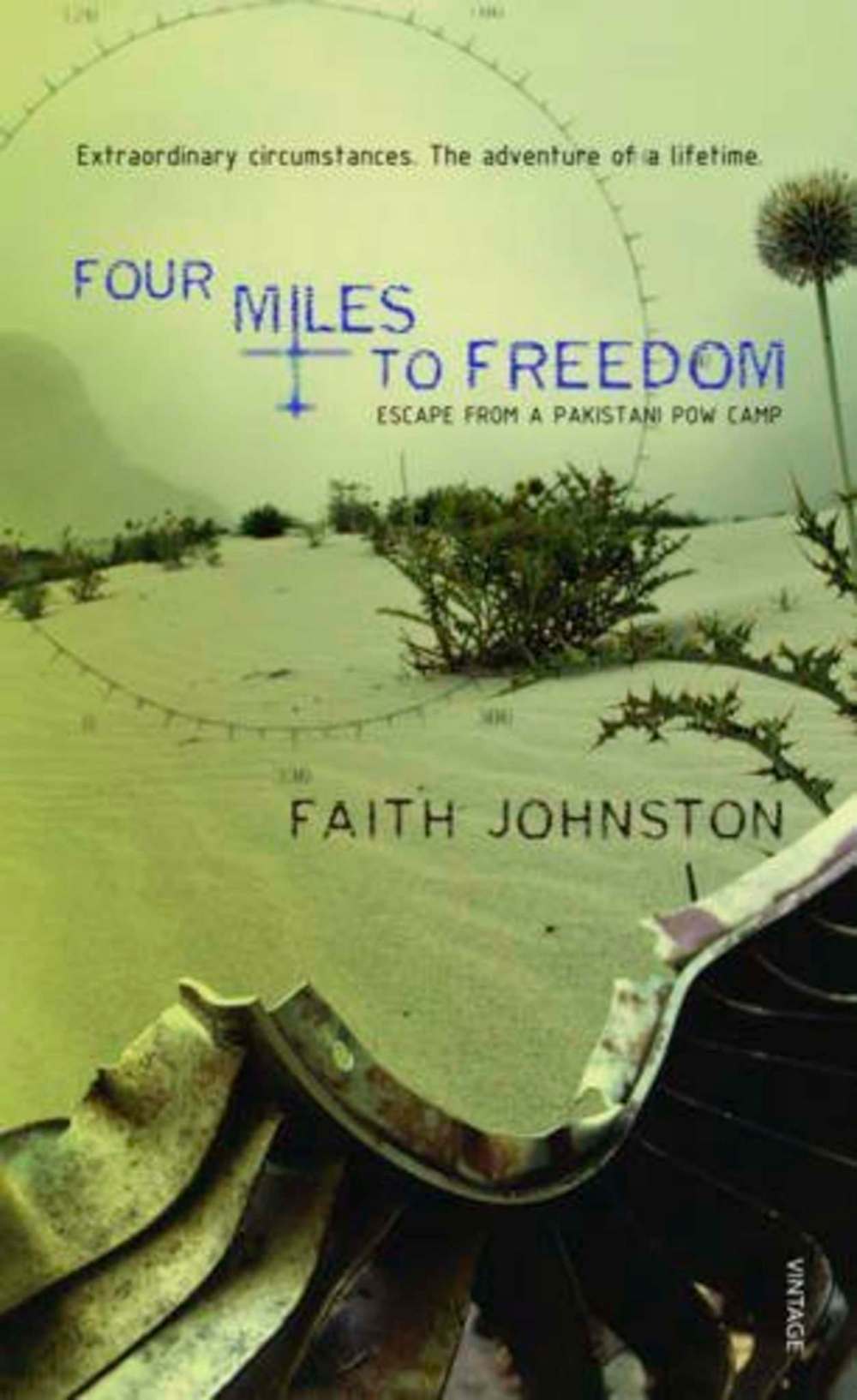
Her 2006 book, A Great Restlessness, is a biography of Canadian parliamentarian Dorise Nielsen. In 2012, The Only Man in the World was shortlisted for the Manitoba Book Awards’ Margaret Laurence Award for Fiction. Four Miles to Freedom was published in India in 2013, and is now being released in North America.
The refreshingly light-hearted story centres on IAF Flight Lieutenant Dilip Parulkar, who was shot down and captured in December, 1971, a week before the end of the war, and interred in Rawalpindi, Pakistan, with 12 other captured officers.
Parulkar, along with Malvinder Singh Grewal and Harish Sinhji, finally made an escape in August 1972. Their adventures making for the Khyber Pass to Afghanistan are interspersed with details of their confinement and relations with the other officers, while negotiations between India and Pakistan drag on, months longer than the war itself.
Before joining the other prisoners, Parulkar and Grewal had been separately interviewed by Chuck Yeager, late in his career as a U.S. adviser to the Pakistani Air Force. Yeager, “in the hope of pressuring the American government to supply Pakistan with more planes… had predicted India could win a war against Pakistan in two weeks.” Correctly, it turns out.
Besides this note about American involvement, and the mention that many of the IAF planes were Russian MIGs, Johnston doesn’t delve into the Cold War ramifications of the 1971 war, rather concentrating on the lives of the prisoners and their often surprisingly cordial relationships with their Pakistani captors.
Several of the downed flyers seemed to have been in more danger from Pakistani civilians before, rather than after, their incarceration in the POW camp.
For Parulkar, “escape wasn’t just a matter of duty. Planning and executing an escape, using his wits to counter all obstacles, this was the ultimate adventure.”
Perhaps a shortcoming of the story is its lack of tension, even as the escapees face dangerous situations and risk discovery before and after getting out of the Rawalpindi camp. Parulkar was inspired by both the film The Great Escape and the novel Papillon, but his story seems less dangerous — almost less serious — than those works which, unlike Four Miles to Freedom, may have been somewhat fictionalized.
Still, the preparations Parulkar and his fellow captives make are enjoyably ingenious, and their subterfuges to outfox their captors are entertaining, if sometimes quixotic. Lieut. Tejwant Singh attempts to concoct a hot air balloon with which to escape over the prison camp walls and barbed wire.
Also engaging is the prisoners’ isolation and their wistful desire for timely and accurate news. While 600 Indian military prisoners — including the dozen airmen — are being held by Pakistan, “India and Bangladesh hold a whopping 93,000 POWs.”
Several times escape plans are delayed or put on hold when a prisoner exchange might finally be worked out. However, it was almost a year before the bulk of the prisoners were repatriated.
Four Miles to Freedom might not be the most suspenseful book about prisoners of war, but its blithe tone and charming, well-drawn characters make for a satisfying read.
Bill Rambo teaches at The Laureate Academy in St. Norbert.