

For Odin’s sake
Let's send these Viking myths to Valhalla
Advertisement
Read this article for free:
or
Already have an account? Log in here »
To continue reading, please subscribe:
Digital Subscription
One year of digital access for only $75*
- Enjoy unlimited reading on winnipegfreepress.com
- Read the E-Edition, our digital replica newspaper
- Access News Break, our award-winning app
- Play interactive puzzles
*Billed as $5.77 plus GST every four weeks. After 52 weeks, price increases to the regular rate of $19.95 plus GST every four weeks. Offer available to new and qualified returning subscribers only. Cancel any time.
Monthly Digital Subscription
$4.99/week*
- Enjoy unlimited reading on winnipegfreepress.com
- Read the E-Edition, our digital replica newspaper
- Access News Break, our award-winning app
- Play interactive puzzles
*Billed as $19.95 plus GST every four weeks. Cancel any time.
To continue reading, please subscribe:
Add Free Press access to your Brandon Sun subscription for only an additional
$1 for the first 4 weeks*
- Enjoy unlimited reading on winnipegfreepress.com
- Read the E-Edition, our digital replica newspaper
- Access News Break, our award-winning app
- Play interactive puzzles
*Your next Brandon Sun subscription payment will increase by $1.00 and you will be charged $17.95 plus GST for four weeks. After four weeks, your payment will increase to $24.95 plus GST every four weeks.
Read unlimited articles for free today:
or
Already have an account? Log in here »
Hey there, time traveller!
This article was published 09/04/2016 (3692 days ago), so information in it may no longer be current.
It’s almost impossible to escape marauding Vikings these days.
Wherever you look — in newspapers, magazines or the big-screen TV in your den — chances are you’ll be confronted by these ferocious Norse warriors.
Last week, for instance, archeologists armed with satellite technology unveiled a discovery that could rewrite our history — a second Viking settlement in North America, farther south than ever known.
If the results are verified, then Point Rosee on the southwest coast of Newfoundland would be only the second confirmed Viking settlement in North America. The first site is at L’Anse Aux Meadows, near the northernmost tip of Newfoundland, about 600 kilometres away.
The new Canadian site, with telltale signs of iron-working, was discovered last summer after infrared images from outer space showed possible man-made shapes under discoloured vegetation.
“Either it’s… an entirely new culture that looks exactly like the Norse and we don’t know what it is, or it’s the westernmost Norse site that’s ever been discovered,” archeologist Sarah Parcak told the Washington Post.
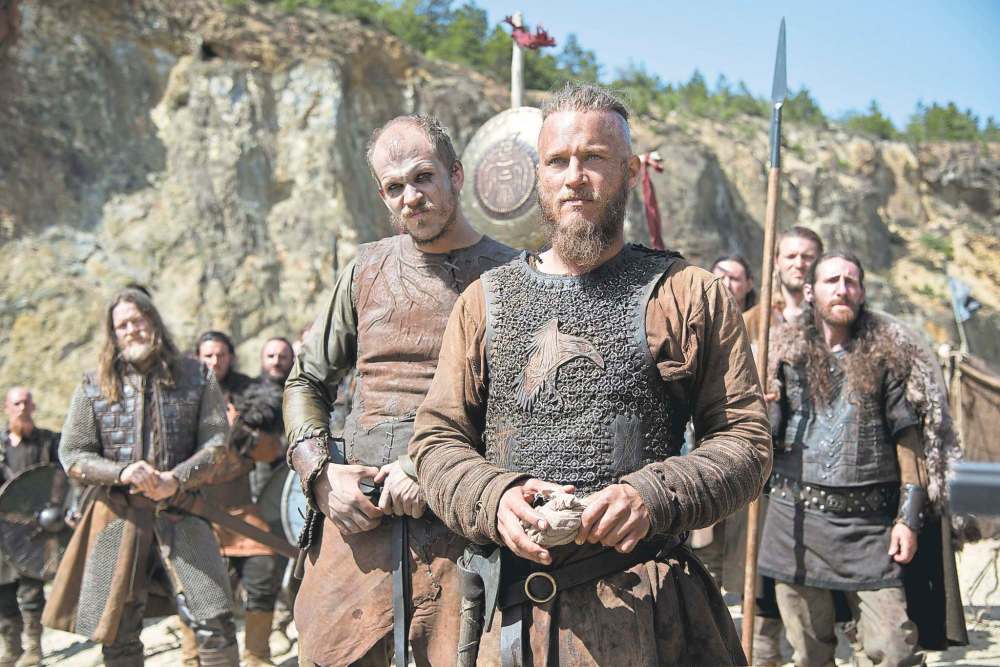
Almost as exciting was news last month that History Channel has renewed the wildly popular series Vikings for a 20-episode fifth season. The award-winning TV show follows the epic adventures of these iconic raiders and explorers of the Dark Ages.
Which makes this the perfect time to separate fact from fiction with our slightly barbaric list of the Top Five Things You Didn’t Know About These Seafaring Scandinavians:
5) The myth: Take your stinking paws off me, you damned dirty Viking
The reality: We’ve all seen movies and read books wherein Vikings were portrayed as filthy, wild-looking savages. It appears the opposite was true as Vikings developed a reputation for their excellent personal hygiene and may have been history’s first clean freaks. “Between rowing boats and decapitating their enemies, Viking men must have stunk to high Valhalla, right?” quips the website History.com. “Quite the opposite. Excavations of Viking sites have turned up tweezers, razors, combs and ear cleaners made from animal bones and antlers. Vikings also bathed at least once a week and enjoyed dips in natural hot springs.” VisitDenmark.com insists the Anglo-Danes occupying parts of Great Britain were described as “excessively clean” by their Anglo-Saxon neighbours, as they insisted on weekly baths — they reportedly made a form of soap from horse chestnuts — and keeping their hair well-groomed. In fact, to conform to their culture’s ideals of beauty, brown-haired Vikings, typically men, were known to use a strong lye soap to bleach their hair and beards blond, treatments that likely helped ward off the itchy problem of head lice. According to Danishnet.com, personal grooming tools are among the most common items found in Viking burial mounds. Vikinganswerlady.com says English cleric, John of Wallingford, complained bitterly that Viking men combed their hair, bathed on Saturdays and changed their woollen garments frequently in a heathen attempt to seduce high-born English women.
4) The myth: It’s a Viking Man’s World
The reality: OK, it wasn’t exactly a feminist paradise, but Viking women enjoyed some rights other women did not, provided they weren’t “thralls,” the term for captured slaves. While they were expected to mind the household when their husbands were away raiding and trading, women could inherit property, request a divorce — if their hubby displayed too much chest hair, for example — and reclaim their dowries if a marriage failed. “Many believe that the Viking Age was a male-dominated era, in which men in warships fought, raided monasteries or set out on long trading voyages, while the women stayed at home on the farm, spinning and weaving,” Gunnar Andersson writes in Vikings: Lives Beyond The Legends, the 2013 companion book for the Swedish History Museum’s travelling exhibit of Viking artifacts. “But archeological and written sources paint a very different picture. Artifacts in Viking Age graves often symbolize the different social roles of men and women. They also show that there were rich and powerful people of both genders… Rather than the male-dominated hierarchies of the Medieval period, the relationship between the sexes during the Viking Age seems to have been more complementary, with the contribution made by women to reproduction no less valued than that of men.” The book also notes that a Viking woman responsible for a home held great power because “the farm was the centre of Scandinavian society and thus of vital importance.”
3) The myth: Vikings only row, row, rowed their boats
The reality: What you need to remember is that Vikings were Nordic people. They were Scandinavians before Scandinavia existed. So if they were not climbing aboard their longboats for voyages to raid other cultures, they would be strapping on skis or skates to whiz across the frozen wastes. Yes, even before the Winter Olympics and the National Hockey League, these iconic warriors were skating and skiing. “Scandinavians developed primitive skis at least 6,000 years ago, though ancient Russians may have invented them even earlier,” History.com notes. “By the Viking Age, Norsemen regarded skiing as an efficient way to get around and a popular form of recreation.” In some ancient Norse myths, the god Thor is sometimes described as being a good skier. Danishnet.com notes many sledges, skis and skates have been recovered from the Viking Age. A typical sledge was just a light frame mounted on skis, then pulled by hand to transport furs from the northern regions of Finland, Sweden and Norway. “As early as the Bronze Age, skis were in use in northern Scandinavia,” Danishnet.com says. “They are generally made of pine and seem to be up to two metres long. Pine was chosen because natural tree resin lubricates the underside.” As for Viking skates, these were made from the foot bones of horses, cows or elk, though a pair of copper blades dating from AD 200 have been found in Finland. Unlike today’s blades, Viking skates were like short skis and “the skater got momentum by pushing themselves over the ice with one or two iron-tipped sticks.” Iron-tipped sticks? We assume Vikings also spent long stretches in the first penalty box.
2) The myth: Hey, who you callin’ a Viking?
The reality: Back in the day, Vikings typically didn’t call each other Vikings. Today, it’s the collective term we use to describe Scandinavian explorers, traders and warriors who raided and settled large parts of Europe, Asia and the North Atlantic islands from the eighth to the mid-11th centuries. In Viking times, however, it was basically a term referring to an occupation, namely anyone taking a trip to sea. “It has a number of definitions, but is mostly used to describe a situation or an activity. Men, women, youths, even children, could all have gone out on a ‘viking,’ meaning a commercial trip or raid. In other words, people did not refer to themselves as a Viking unless they were on a viking,” Andersson writes in Vikings: Lives Beyond The Legends. So what did Vikings call one another? Well, according to Andersson’s book: “This is not really known, but individuals possibly used their farm or village names, in the same way that someone living in London is called a Londoner, and so on. In the written sources, the term Norraener menn (Norse men) was used as a designation for all Nordic peoples, except the Sami in the northernmost parts of Scandinavia.” The word really only became popular in the 19th century.

1) The myth: Is that a horn on your head or…
The reality: Easily the biggest and most common myth about these legendary warriors is the notion they went into battle wearing horned helmets. We hate to break it to you, but there are no records of such helmets ever having existed. “Vikings did not wear horned helmets,” declares VisitDenmark.com. “There is no evidence to suggest they ever did, apart from in some ritual ceremonies. Having horned helmets would seriously impede your ability to fight effectively in close combat. Viking helmets were in fact conical, made from hard leather with wood and metallic reinforcement, or made in iron with a mask and chain mail.” Why do we want to think of them wearing horned helmets? Well, it depends on who you ask. “An explanation for the helmet with horns myth is that Christians in contemporary Europe added the detail to make the Vikings look even more barbarian and pagan, with horns like Satan’s on their head. It should be noted that the Norse god Thor wore a helmet with wings on it, which do look somewhat similar to horns,” notes the website ListVerse.com. For its part, VisitDenmark.ca says the idea became popular during the 19th century when romanticized and nationalistic views of Vikings became popular. The only authentic Viking helmet ever recovered was (sniff!) horn-free.
As much as we hate stereotypes, were are extremely happy to report that modern-day Vikings are proud to wear horns on their helmets when they battle their bitterest enemies. Otherwise, the Green Bay Packers would just make fun of them.
doug.speirs@freepress.mb.ca