Officials say it could take months to extinguish massive Alberta blaze
Advertisement
Read this article for free:
or
Already have an account? Log in here »
To continue reading, please subscribe:
Digital Subscription
One year of digital access for only $1.44 a week*
- Enjoy unlimited reading on winnipegfreepress.com
- Read the E-Edition, our digital replica newspaper
- Access News Break, our award-winning app
- Play interactive puzzles
*Billed as $5.77 plus GST every four weeks. After 52 weeks, price increases to the regular rate of $19.95 plus GST every four weeks. Offer available to new and qualified returning subscribers only. Cancel any time.
To continue reading, please subscribe:
Add Free Press access to your Brandon Sun subscription for only an additional
$1 for the first 4 weeks*
- Enjoy unlimited reading on winnipegfreepress.com
- Read the E-Edition, our digital replica newspaper
- Access News Break, our award-winning app
- Play interactive puzzles
*Your next Brandon Sun subscription payment will increase by $1.00 and you will be charged $17.95 plus GST for four weeks. After four weeks, your payment will increase to $24.95 plus GST every four weeks.
Read unlimited articles for free today:
or
Already have an account? Log in here »
Hey there, time traveller!
This article was published 07/05/2016 (3814 days ago), so information in it may no longer be current.
FORT MCMURRAY, Alta. – Fire officials are bracing themselves for a long, long fight against the blaze that forced the evacuation of Fort McMurray and has eaten up more than 2,000 square kilometres of northern Alberta forest.
“Unless we have a significant rain event of 100 millimetres of rain, we expect to be out fighting the fire in the forested area for months to come,” Chad Morrison with Alberta Wildfires told a media briefing Saturday afternoon.
“That’s not uncommon with such large fires.”
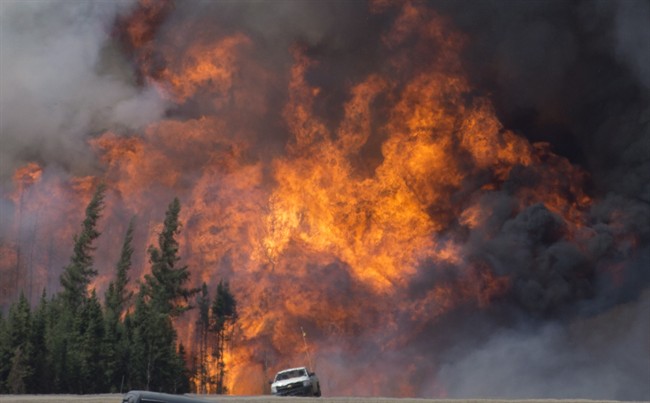
As for the city of Fort McMurray, he said he expected they would get a good handle on the situation “over the next coming month or two.”
There still is no timeline for any of the 80,000 evacuated residents to be allowed back into their homes, but the Alberta government has begun preliminary planning, though it stresses fighting the fire is still the first priority.
Fire officials said the wind whipped inferno doubled in size Saturday, and depending on the weather, could reach the Saskatchewan border by early Sunday morning.
The good news was that the fire was burning away from communities. Premier Rachel Notley said firefighters continued working to protect the downtown and homes in Fort McMurray and held the line for a second straight day.
She added the gas supply has been turned off in the city and the power grid has been damaged. Water in the city isn’t drinkable and hazardous material will have to be cleaned up to make the community safe.
“The return won’t be in coming days,” said the premier. “Once the immediate fire damage is completed there will be an enormous amount of work to do to make the city safe and habitable.”
RCMP Insp. Kevin Kunetzki said Saturday that during their checks of houses in the city, officers are seeing significant signs of water and smoke damage.
Scott Long of the Alberta Emergency Management Agency said that may have been one of the costs of protecting the community.
He said firefighters use large, industrial sprinklers to “spray continuous amounts of water on houses to protect them from embers, sparks, etc., from spontaneous combustion, from the heat. So it’s quite possible there could be water damage.”
On top of that, a few days ago water bombers were dropping their loads on some of the houses in the highest-risk neighbourhoods.
“So a little bit of water damage in the basement is acceptable at this point,” Long said.
Non-essential personnel at both Syncrude and Suncor oil facilities in the area have been evacuated as a precaution.
“We do expect the fire to bump again the edge of the south end of the Suncor facility today,” said Morrison, but he added the companies’ highly trained industrial fire department would remain to protect the facilities.
“These sites are very resilient to wildfires, largely because they’re free and clear of vegetation and trees.”
Noralta Lodge, an oilsands housing facility where RCMP and firefighters have been staying, was placed on a two-hour evacuation notice.
“They have a solid evacuation plan in place,” said Morrison. “If they’re under any kind of a threat there will be a safe, controlled evacuation.”
The Provincial Operations Centre said in an email late Saturday night that most of the 25,000 people who were evacuated to oilsands work camps north of Fort McMurray had been relocated via airlifts and police escorted convoys to locations south of the city.
The centre said those who remain in the camps are primarily oil industry workers involved in the fire fight.
The centre added that industry and government were working Saturday evening with the Fort Mackay First Nation to fly out 60 vulnerable elders.
Federal Public Safety Minister Ralph Goodale said firefighters from other provinces were being brought in to relieve those who have been battling what he calls “this beast of a fire” for a week.
Eighty firefighters from Ontario have already arrived. Goodale told a news conference in Regina that another 44 are on their way from Quebec and 22 from New Brunswick. Equipment, such as pumps, hoses and tankers, are also coming from other provinces.
“What we’re trying to do, with the co-operation of other provinces and territories, is bring in rotations of other firefighters that can give them a break.”
Canadian Press videos
Wildfire over 210,000 acres in size:
wfpvideo:115051086:wfpvideo
Evacuees forced out of shelters:
wfpvideo:115045597:wfpvideo
Biggest victory people are safe:
wfpvideo:115045596:wfpvideo
Evacuees grateful for help:
wfpvideo:115034876:wfpvideo
Ottawa offers total support:
wfpvideo:115029740:wfpvideo
Related Articles
Fort McMurray evacuees mark milestones




Advertisement Advertise With Us
Advertisement Advertise With Us