

Slave Lake experience suggests fire cleanup to test Fort McMurray
Advertisement
Read this article for free:
or
Already have an account? Log in here »
To continue reading, please subscribe:
Monthly Digital Subscription
$0 for the first 4 weeks*
- Enjoy unlimited reading on winnipegfreepress.com
- Read the E-Edition, our digital replica newspaper
- Access News Break, our award-winning app
- Play interactive puzzles
*No charge for 4 weeks then price increases to the regular rate of $19.95 plus GST every four weeks. Offer available to new and qualified returning subscribers only. Cancel any time.
Monthly Digital Subscription
$4.99/week*
- Enjoy unlimited reading on winnipegfreepress.com
- Read the E-Edition, our digital replica newspaper
- Access News Break, our award-winning app
- Play interactive puzzles
*Billed as $19.95 plus GST every four weeks. Cancel any time.
To continue reading, please subscribe:
Add Free Press access to your Brandon Sun subscription for only an additional
$1 for the first 4 weeks*
*Your next subscription payment will increase by $1.00 and you will be charged $16.99 plus GST for four weeks. After four weeks, your payment will increase to $23.99 plus GST every four weeks.
Read unlimited articles for free today:
or
Already have an account? Log in here »
Hey there, time traveller!
This article was published 12/05/2016 (3527 days ago), so information in it may no longer be current.
EDMONTON – Cleaning up Fort McMurray’s wildfire will test the city’s ability to handle everything from asbestos to rotting food and leave a lasting legacy of higher costs and dangerous residue.
So says Tom Moore — and he should know. Moore manages the landfill at Slave Lake, where one-third of the town was gutted by a fire five years ago this month.
“It overwhelms you,” Moore recalled Thursday. “I received, in about four months time, about three years of waste into my facility.”
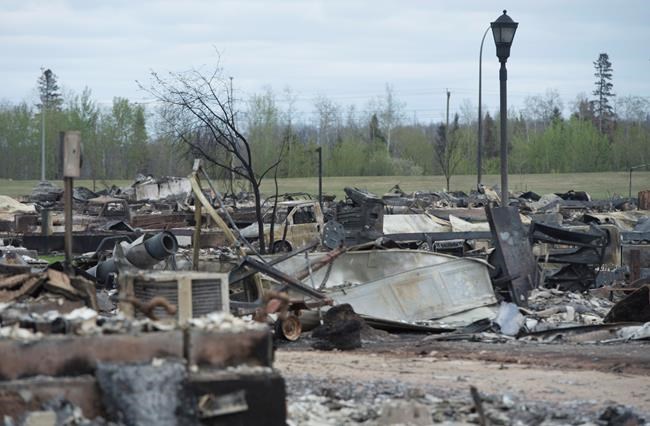
Moore said the landfill took in about 40,000 tonnes of waste after the fire destroyed more than 400 buildings. The influx forced the dump to expand as well as to buy bigger equipment and upgrade its roads.
“There are landfills in Alberta that receive hundreds of thousands of tonnes every year,” said Moore. “But if all of a sudden they’re receiving four times that, in a short period of time, that’s devastating.”
Most of the concrete and metal was recycled, but much of the rest of that waste was problematic.
“All of the houses have been shut off from their power. Now you’ve got refrigerators full of food. You have to handle that safely so nobody gets sick and nobody gets exposed to that.”
More than 4,200 refrigerators and freezers were hauled to the Slave Lake landfill. Moore, who’s also the informal chairman of waste officials who have all experienced disaster recovery, said High River, Alta., sent 7,500 refrigerators full of food to its landfill after the 2013 flood.
Then there’s the ash. Slave Lake’s ash, all of which went to the landfill, was tainted with levels of heavy metals including lead and arsenic that were many times higher than guidelines.
“We made sure all our operators had the right type of respirators,” Moore said. “Every day we changed out the filters in the cabs on the equipment.”
Moore said that ash is still leaching toxins. Contaminants haven’t been found in groundwater off the site, but workers have to drain and test fluids that collect in the bottom of the landfill twice a year instead of once annually — at twice the expense.
The municipality had to spend about $2 million upgrading its landfill after the fire.
“Right now, we’re actually having some financial issues,” Moore said.
“We had to dig this cell, we had to buy equipment and now we’ve got some big debt that we’ve got to pay that we don’t have revenue for. It is a financial burden.”
Any problems experienced by Slave Lake are likely to be much more severe in Fort McMurray, which lost more than 2,400 buildings.
“They’re going to receive probably five times their normal waste going into their facility for a while,” said Moore.
Scott Long of the Alberta Emergency Management Agency said Thursday that officials are already considering waste disposal.
“All of these things are being looked at right now by a large team of specialists in conjunction with Regional Emergency Operations Centre,” he said at a press briefing. “We’re doing this as safely and quickly as we can.”
Janice Coffin of Alberta Environment said staff from the department have been deployed to Fort McMurray to start initial sampling of ash, river water quality and air monitors.
“They will be visiting oil sands monitoring sites and doing general surveillance,” she said in an email.
Moore said he’s already been in touch with Fort McMurray municipal officials to offer advice. His group has people with experience from floods to fires to accidental deaths in landfills.
“After our disaster and the one in High River, we said we need some group that can be available to call and help through these disasters. We had nobody when we had ours.”
— Follow Bob Weber on Twitter at @row1960