Locked-in syndrome disconnects brain from body
Advertisement
Read this article for free:
or
Already have an account? Log in here »
To continue reading, please subscribe:

Digital Subscription
One year of digital access for only $205*
- Enjoy unlimited reading on winnipegfreepress.com
- Read the E-Edition, our digital replica newspaper
- Access News Break, our award-winning app
- Play interactive puzzles
*First annual payment billed as $205.00 + GST for one year. This annual subscription will automatically renew at $233.00 + GST every 52 weeks (10% off the regular annual price of $259.35). Offer available to new and qualified returning subscribers only. Cancel any time.
To continue reading, please subscribe:
Add Free Press access to your Brandon Sun subscription for only an additional
$1 for the first 4 weeks*
- Enjoy unlimited reading on winnipegfreepress.com
- Read the E-Edition, our digital replica newspaper
- Access News Break, our award-winning app
- Play interactive puzzles
*Your next Brandon Sun subscription payment will increase by $1.00 and you will be charged $17.95 plus GST for four weeks. After four weeks, your payment will increase to $24.95 plus GST every four weeks.
Read unlimited articles for free today:
or
Already have an account? Log in here »
Hey there, time traveller!
This article was published 13/05/2016 (3802 days ago), so information in it may no longer be current.
Not asleep but not yet awake, Brisa Alfaro could hear her doctors’ prognosis: she might never walk or talk again, and she may never eat or breathe on her own.
Maybe — just maybe — she would show involuntary movement, she heard them say.
She couldn’t respond. She started to panic.
At the age of 32, Alfaro had experienced a brain-stem stroke, causing a rare condition called locked-in syndrome — one that leaves patients paralyzed but painfully aware of the world.
She could hear — but she could not move or see or speak.
She could not tell everyone she was OK.
“I just didn’t want them to give up,” Alfaro told the Washington Post. “I didn’t want anyone to give up because I was still in there. I just needed time and for people to believe in me.”
Eventually, Alfaro woke up and began to recover. She recently shared her story with the Post — though one of her doctors remains skeptical about what Alfaro thinks she heard while she was locked in.
In March 2014, Alfaro, a nail technician, travelled from her home in Southern California to a trade show in New York.
On the flight, she said, she had an allergic reaction — her eyes started to itch, and her face started to swell. She took some Benadryl and called her mom. When her condition had not improved the next morning, she went to a hospital in Queens.
While in the emergency room, she said, she had a “pons stroke,” which occurs in a portion of the brain stem, and slipped into a coma.
She was quickly transferred to a hospital in Manhattan, and her mother hopped a plane bound for the East Coast.
When Linda Alfaro arrived at New York-Presbyterian Hospital, her daughter was unconscious, intubated and hooked up to machines to help her breathe. When doctors poked her, she did not respond, her mother said.
Doctors stood at Alfaro’s bedside and broke the troubling news about her future to her mother.
“I was in a coma for several days,” Alfaro later wrote in a first-person account of her hospitalization for Nails magazine. “Before I was fully conscious, I heard a doctor pronounce what he thought was my fate to the other doctors.
“‘If she makes it past these next three days, she will never move again.’”
She added: “I was so scared, because I couldn’t move anything from my neck down — just as I had heard. I couldn’t even talk, let alone move any of my limbs.”
Her mother was terrified, too.
“I was in denial,” Linda Alfaro told the Post. “I remember, when they were telling me that, I said, ‘nope.’ I tuned them out. I didn’t want to hear it.”
In the long days that followed, the Alfaros fought for the 32-year-old’s recovery.
Linda Alfaro said she sat by her daughter’s bedside and tried to bring her back — talking to her, touching her, playing her favourite music from childhood.
She saw her daughter’s fingers twitch, she said, but doctors told her they thought it was a reflexive movement.
She told her daughter to think about her eyes, her nose, her hands, her feet.
“I kept telling her that her brothers were coming and she needed to try really hard,” she said. “When her first brother came, she heard his voice and opened her eyes.”
Her eyes were open, her mother said, but were darting around without focus.
“But I knew it was intentional,” Linda Alfaro said. “I was laughing and crying.”
Barry Czeisler, who was one of Alfaro’s doctors at New York-Presbyterian Hospital, said locked-in syndrome is a condition that can occur when there is damage to the brain stem, disconnecting the brain from the body.
“They can only move their eyes up and down but otherwise cannot speak, move their mouths or any other part of their bodies,” he told the Post. “But, at the same time, they remain fully conscious.
“They’re fully conscious but unable to communicate with the rest of the world.”
The nightmarish condition, which can be caused by stroke or an overdose of medication, has no cure, according to the National Institute of Neurological Disorders and Stroke. Nor is there a standard course of treatment for the rare syndrome, according to the institute.
Czeisler, now an assistant professor at the NYU School of Medicine, said a major danger with the condition is it can go undiagnosed.
“Imagine if you’re a patient,” he said, “you’re conscious — fully aware — and you can hear doctors talking about your current condition and prognosis without knowing you can hear them. Imagine how anxiety-provoking that is.”
Czeisler said in Alfaro’s case, doctors were quickly attuned to her condition.
Alfaro was in a coma only a day or two, he said, and then doctors discovered she was locked in.
He said he may have told her family that, based on her MRI results, doctors thought she may not move again, but he had the conversation with them in a separate room.
Alfaro said she thinks the conversation she remembers was among other doctors.
“I thought I had to get better. I had to show them I was going to be fine,” Alfaro said. “The first thing I moved was my fingers. It gave everyone hope.”
Soon, Alfaro started working with her doctors on her recovery.
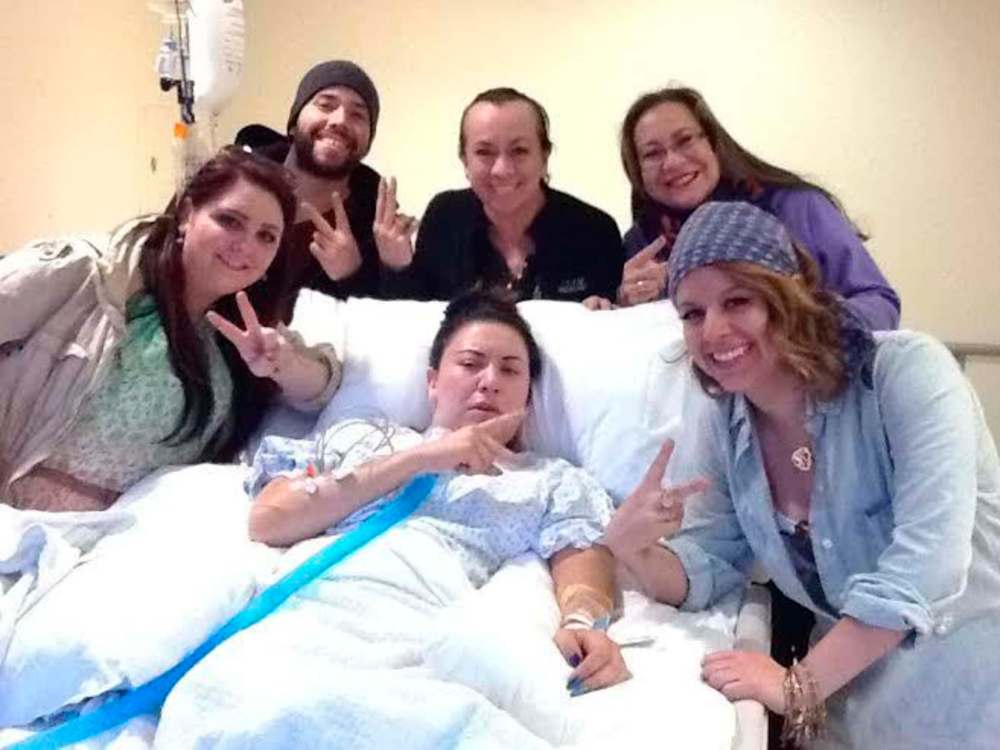
Alfaro started communicating — giving her doctors the peace sign or a thumbs-up.
Her friends brought in a whiteboard so she could try to form words.
She relearned how to hold up her head, how to sit up, how to eat. She learned to roll in a wheelchair, walk with a cane and then walk on her own.
When Alfaro was strong enough, she said, she was transferred back to California for therapy at Ballard Rehabilitation Hospital in San Bernardino.
According to her account in Nails magazine:
“Although I was improving quickly and regaining strength on both my right and left sides, I had to relearn how to do everything that used to be second nature: brushing my teeth, taking a shower, doing my hair, getting dressed. Not only were these things a challenge, they were exhausting. Doing simple tasks felt as if I was running a marathon. I exercised and practised my daily routines; I even had to relearn to chew my food and swallow properly before I could finally eat.”
She said she continued with physical therapy and then joined a gym.
Alfaro said two years later she’s still trying to heal. Physically, she said, she’s nearly there, but mentally “it’s a whole other story.”
“You may never achieve your old self again but you can learn to work with new you and help inspire other people,” she said. “That’s been my main goal in life. My whole purpose has changed now.”
— Washington Post