

Finance ministers reach CPP agreement; premiums to increase in 2019
Advertisement
Read this article for free:
or
Already have an account? Log in here »
To continue reading, please subscribe:

Digital Subscription
One year of digital access for only $205*
- Enjoy unlimited reading on winnipegfreepress.com
- Read the E-Edition, our digital replica newspaper
- Access News Break, our award-winning app
- Play interactive puzzles
*First annual payment billed as $205.00 + GST for one year. This annual subscription will automatically renew at $233.00 + GST every 52 weeks (10% off the regular annual price of $259.35). Offer available to new and qualified returning subscribers only. Cancel any time.
To continue reading, please subscribe:
Add Free Press access to your Brandon Sun subscription for only an additional
$1 for the first 4 weeks*
- Enjoy unlimited reading on winnipegfreepress.com
- Read the E-Edition, our digital replica newspaper
- Access News Break, our award-winning app
- Play interactive puzzles
*Your next Brandon Sun subscription payment will increase by $1.00 and you will be charged $17.95 plus GST for four weeks. After four weeks, your payment will increase to $24.95 plus GST every four weeks.
Read unlimited articles for free today:
or
Already have an account? Log in here »
Hey there, time traveller!
This article was published 20/06/2016 (3737 days ago), so information in it may no longer be current.
VANCOUVER – Both Canadian workers and their employers will soon be on the hook for higher contributions to the Canada Pension Plan after the federal government reached an agreement with most of the provinces Monday to revamp the program for the first time in nearly two decades.
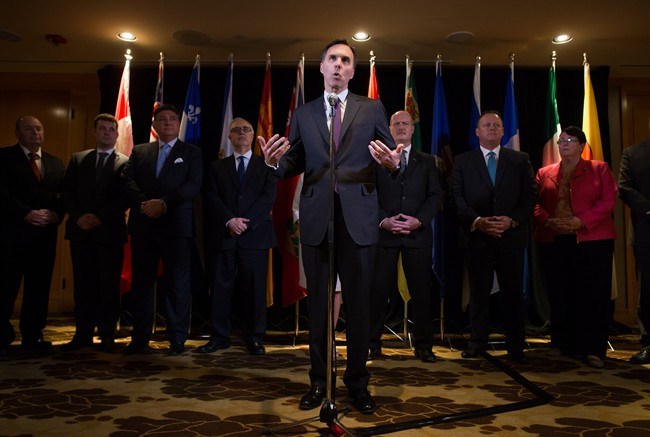
Federal Finance Minister Bill Morneau said the change means future generations of Canadians will be able to retire in dignity, no matter the state of their finances.
“We have come to a conclusion that we are going to improve the retirement security of Canadians,” Morneau said. “We’re going to improve the Canada Pension Plan that will make a real difference in future Canadians’ situations.”
By 2023, an extra $34 a month in pension premiums will mean up to $4,300 more in annual payouts come retirement time for the average Canadian wage earner.
The agreement-in-principle, which only Quebec and Manitoba neglected to endorse, will see an increase in monthly premiums phased in starting at $7 a month in 2019 for a typical worker earning about $55,000.
Once the plan is fully implemented, the maximum annual benefits will increase by about one-third to $17,478.
Mandatory matching contributions will also mean a jump in payroll expenses for employers.
A change to the CPP needs the consent of Ottawa and a minimum of seven provinces representing at least two-thirds of the country’s population.
Morneau said Quebec — which has its own pension plan — and Manitoba continue to be part of the process, despite not signing on to the agreement.
“Quebec is in a different situation,” he said. “The Quebec pension plan is a different vehicle. The costs are different than the Canadian Pension Plan. The idea that more analysis is required is something that we completely understood around the table.”
For Manitoba, Morneau said the deal comes too soon for the province’s new Tory government.
“Manitoba is a brand new government. They’ve been in power for four weeks, so they were a productive voice around the table, a voice of continued interest in working together, but of course this comes pretty fast and hard for them.”
Ontario Finance Minister Charles Sousa said young Canadians will reap the benefits from Monday’s decision.
“Today, this federal government has shown great leadership and great desire to do something of great benefit for our young people.”
Sousa said the plan would replace the one his government had been working on.
British Columbia Finance Minister Mike de Jong, who had reservations about expanding the CPP, said he came on board because the plan is affordable.
“I think we have reached a balanced approach to setting the objectives that were set out.”
Provinces will have until July 15 to officially sign on to the agreement before it becomes formalized.

Heading into Monday’s federal-provincial meeting, it was still unclear whether Ottawa would piece together the minimum required provincial support for change. Saskatchewan, for example, did not originally support CPP enhancement.
Sources said Ottawa made a major 11th-hour push in hopes of securing enough country-wide support to boost the CPP and suggested Prime Minister Justin Trudeau was involved in the extra effort.
There hasn’t been such a level of consensus on CPP reform at a national scale since the 1990s.
However, critics have warned that expanding the CPP would squeeze workers and employers for additional contributions, and hurt the still-fragile Canadian economy.
The federal government intensified its lobbying efforts over the final days and hours of ongoing meetings as it tried to attract support from enough provinces to ensure a CPP upgrade, said sources with knowledge of the talks.
Related Articles
Pallister can only take one position on CPP changes

Advertisement Advertise With Us
Advertisement Advertise With Us