

Arrows pointing up
Winnipeg has been a target for pole archers for nearly a century
Advertisement
Read this article for free:
or
Already have an account? Log in here »
To continue reading, please subscribe:
Digital Subscription
One year of digital access for only $1.44 a week*
- Enjoy unlimited reading on winnipegfreepress.com
- Read the E-Edition, our digital replica newspaper
- Access News Break, our award-winning app
- Play interactive puzzles
*Billed as $5.77 plus GST every four weeks. After 52 weeks, price increases to the regular rate of $19.95 plus GST every four weeks. Offer available to new and qualified returning subscribers only. Cancel any time.
To continue reading, please subscribe:
Add Free Press access to your Brandon Sun subscription for only an additional
$1 for the first 4 weeks*
- Enjoy unlimited reading on winnipegfreepress.com
- Read the E-Edition, our digital replica newspaper
- Access News Break, our award-winning app
- Play interactive puzzles
*Your next Brandon Sun subscription payment will increase by $1.00 and you will be charged $17.95 plus GST for four weeks. After four weeks, your payment will increase to $24.95 plus GST every four weeks.
Read unlimited articles for free today:
or
Already have an account? Log in here »
Hey there, time traveller!
This article was published 23/07/2016 (3612 days ago), so information in it may no longer be current.
In the immortal words of Sir Isaac Newton, what goes up must come down.
“That’s the thing, eh?” says Don Bouvier, president of the St. Sebastian Archery Club, an eagle-eyed outfit that has been practising and promoting the sport of pole archery in Winnipeg since — get this — 1926.
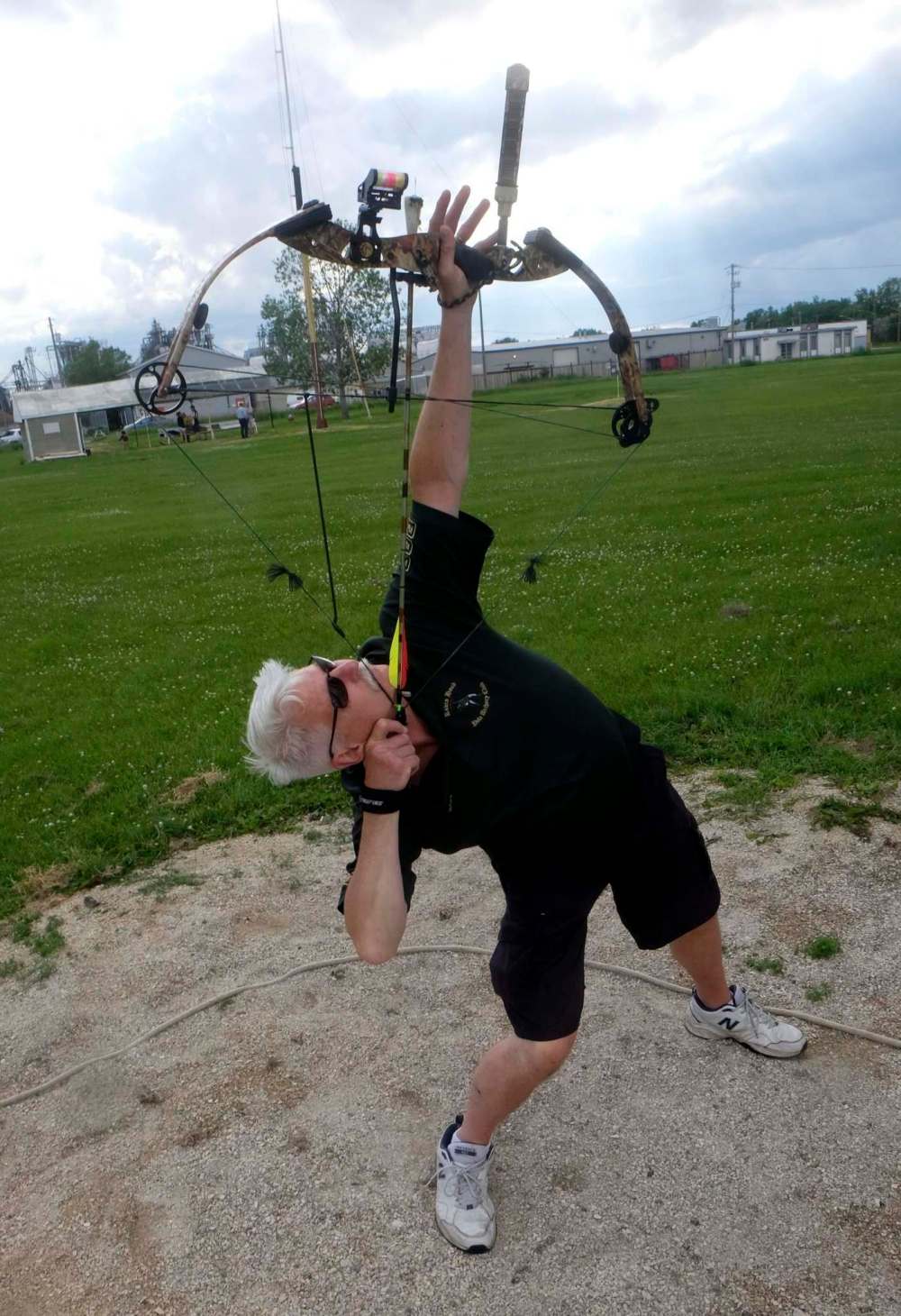
“One of our guys in particular doesn’t always pay the best attention and he’s been hit (by falling arrows) a fair number of times. We use blunt tips instead of sharp (tips) but they’re still going to leave a mark if you take one in the head.”
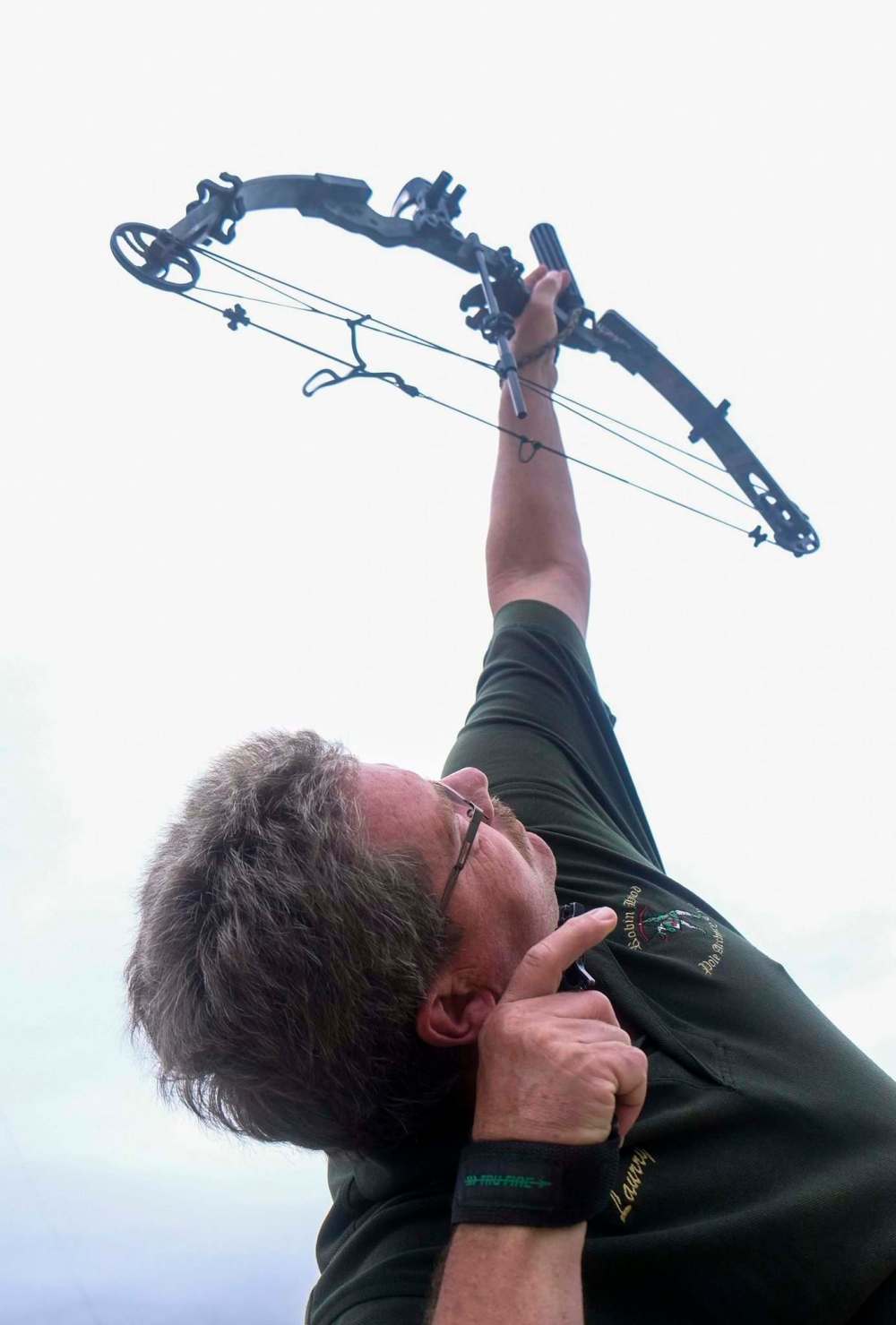
Never heard of pole archery? Here’s a quick primer. The activity, also called popinjay, dates back to the 1300s, when European marksmen used to tether songbirds to the top branches of trees and launch arrows at them in preparation for hunting season. Animal lovers will be pleased to hear fake birds eventually replaced the real deal but the goal remains the same: cock your bow, aim and fire at a series of targets suspended high in the sky.
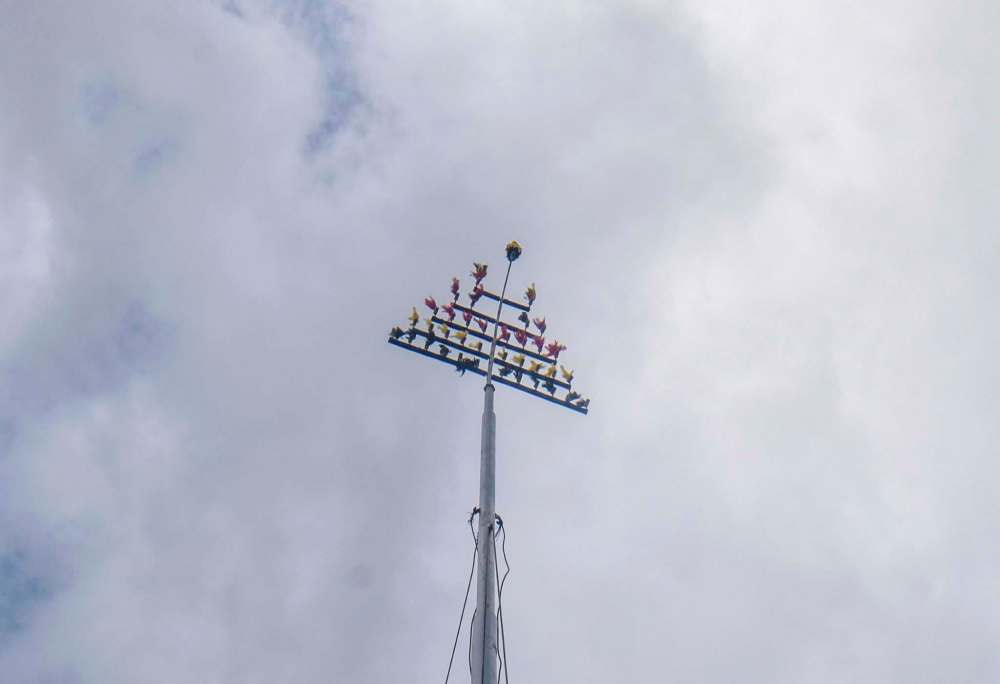
“There are 32 ‘birds’ up there and each one is worth a different number of points, if you manage to knock any of them down,” Bouvier says, pointing to the apex of his club’s 33-metre-tall mast, a gift from the then-city of St. Boniface when Archery Park, the Mission Street green space St. Sebastian calls home, was established in the mid-1950s.
“The bird at the very top is the king bird; he’s worth four points and hitting him is kind of like getting a hole-in-one in golf,” he goes on, mentioning he joined St. Sebastian, named for the patron saint of archery, 25 years ago after being encouraged to give pole archery a try by the father of a kid he was coaching in hockey.
“What we do on archery nights is shoot for an hour, count up everybody’s points, then lower the pole — it pivots all the way down — put the birds back on and shoot for another hour.”
Pole archery — a demonstration sport at the 1920 Olympics in Antwerp, Belgium — was introduced to Manitoba a century ago by Belgian immigrants. The sport is still immensely popular in Belgium, where close to 100,000 participants belong to designated popinjay clubs.
It’s a different story outside of the western European nation, however.
“There are a few more (clubs) in the northern part of France, one in Amsterdam that I’m aware of, plus the odd organization in Scotland and England,” Bouvier says, noting his troupe intended to celebrate its 90th anniversary overseas earlier this year, only to have those plans scuttled by the March terrorist attack in Brussels.
“There used to be a club in Dryden (Ont.) — at one time there was a circuit all the way down to Chicago — but they’re all gone now, as far as I know, so when it comes to this part of the world, it’s pretty much us.”
“Us” is the Manitoba Pole Archery Association — a governing body that oversees St. Sebastian, the Robin Hood Pole Archery Club (which was founded in 1929), the St. Sebastianette Archery Club (an all-female group established in 1975), and the four-year-old Mockingjay Archers Pole Archery Club, which is based in Richer.
Continued
The three Winnipeg clubs hold a “shoot” every Wednesday night from May to September, weather permitting. (Each group has its own pole as well as its own wooden shelter where people waiting their turn can take cover from falling projectiles.)
“Rain and wind doesn’t bother us too much but lightning is a different story,” Bouvier says, eyeing a bank of dark clouds in the distance.
“I mean, standing under a 100-foot metal pole during a thunderstorm probably isn’t the brightest idea in the world.”
John Mozol belongs to the Robin Hood Archery Club, which was formed 87 years ago after St. Sebastian had grown so large it stopped accepting new members.
Mozol, 83, wasn’t particularly curious about archery when he attended his first shoot some 70 years ago. Rather, he was more interested in going home with a couple of bucks in his pocket.
“One of my friend’s dads was a shooter and back then all the guys who shot would throw a quarter or two into a pot,” says Mozol, who is old enough to remember Winnipeg’s original pole archery site, which was just east of Rue des Meurons near Rue Deschambeault. “Our job was to fetch their arrows for them wherever they landed and at the end of the night, they gave us the money from the kitty.”
Since then, Mozol has become a three-time winner of his club’s King Trophy; at Robin Hood’s first shoot of the year, the king bird is the only target on the pole and whoever knocks it off first lays claim to the trophy as well as the right to shoot first at every meet that year.)
Mozol says the technology of the sport has changed extensively since he started coming out regularly in 1949. Early on, most members used recurve bows or longbows — the sort you’d spot in an old Errol Flynn movie — while today, many of the shooters, some of whom are as young as 12, employ compound bows, he says, which have a far greater range.
“(The arrows) go so high, every once in a while the wind will catch one and take it out towards the street,” he says, adding group members are covered for any damage they might inflict on passing automobiles. “Last week (an arrow) landed in the back of some guy’s pickup (truck) as he was driving by. I don’t think he even noticed cause he kept right on going.”
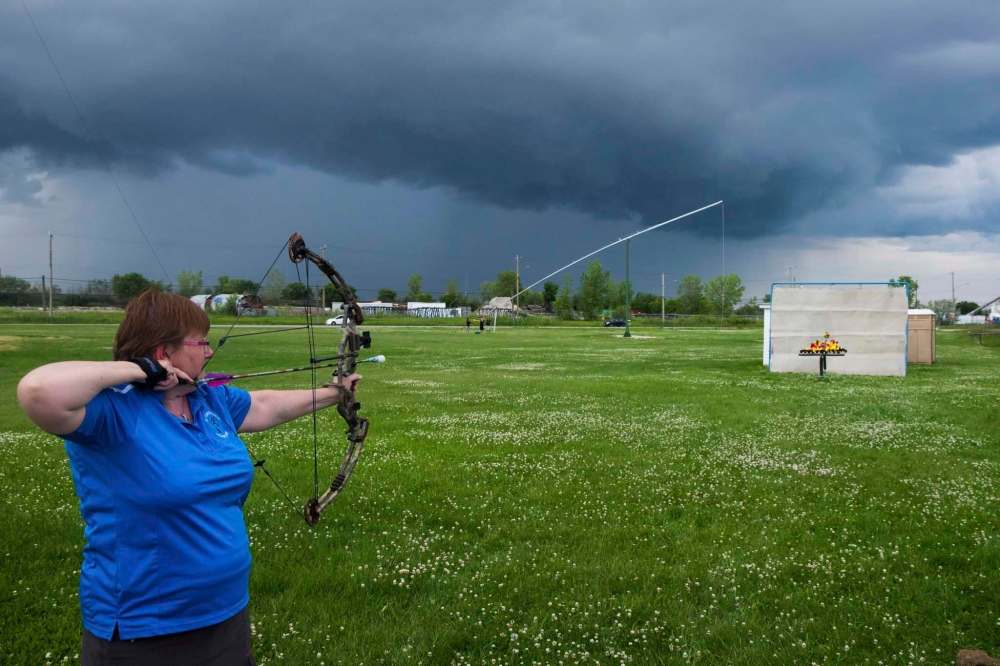
Not only is the St. Sebastianette Archery Club one of the only all-female clubs of its kind in the world, it’s one of the few clubs that employs a horizontal pole versus the vertical variety.

“With horizontal (pole archery) you have to calculate for about a six-inch drop of your arrow whereas with vertical, you’re just firing straight up,” says Deb Clark, the club’s treasurer. “When the guys come shoot at our pole during a fun shoot, they tend to have problems with it. A lot of them will kneel down so they’re shooting more the line of sight they’re used to.”
Because Clark’s father used to be a member of the Robin Hood club, she was already familiar with the sport when she spotted a pole archery display at the Belgian Pavilion four years ago during Folklorama. A person stationed at the booth mentioned there was a tournament coming up in a couple of weeks. She told Clark if she wanted to give pole archery a try, she was welcome to pop by.
“I went with my daughter Carly and one of the members was nice enough to let us use her bow. We shot one arrow each, looked at each other and said, ‘That’s it, we’re going for shopping for equipment tomorrow,’” says Clark, who also belongs to Bows, Broads and Bullseyes, an all-female archery group that hooks up at Heights Archery Range on Portage Avenue during the winter.
This year’s Manitoba Pole Archery Association Winnipeg shoot — the only event of the year when all four Manitoba clubs compete against one another — will be held at Archery Park (some maps refer to it as William Tell Park) Sept. 10-11. For more information, go to www.polearchery.ca.
david.sanderson@freepress.mb.ca
Dave Sanderson was born in Regina but please, don’t hold that against him.
Our newsroom depends on a growing audience of readers to power our journalism. If you are not a paid reader, please consider becoming a subscriber.
Our newsroom depends on its audience of readers to power our journalism. Thank you for your support.