BoJack: an anti-hero for a new age

Advertisement
Read this article for free:
or
Already have an account? Log in here »
To continue reading, please subscribe:

Digital Subscription
One year of digital access for only $205*
- Enjoy unlimited reading on winnipegfreepress.com
- Read the E-Edition, our digital replica newspaper
- Access News Break, our award-winning app
- Play interactive puzzles
*First annual payment billed as $205.00 + GST for one year. This annual subscription will automatically renew at $233.00 + GST every 52 weeks (10% off the regular annual price of $259.35). Offer available to new and qualified returning subscribers only. Cancel any time.
To continue reading, please subscribe:
Add Free Press access to your Brandon Sun subscription for only an additional
$1 for the first 4 weeks*
- Enjoy unlimited reading on winnipegfreepress.com
- Read the E-Edition, our digital replica newspaper
- Access News Break, our award-winning app
- Play interactive puzzles
*Your next Brandon Sun subscription payment will increase by $1.00 and you will be charged $17.95 plus GST for four weeks. After four weeks, your payment will increase to $24.95 plus GST every four weeks.
Read unlimited articles for free today:
or
Already have an account? Log in here »
Hey there, time traveller!
This article was published 06/08/2016 (3662 days ago), so information in it may no longer be current.
Soprano, Draper, Underwood… Horseman? The poster for the third season of the Netflix original series, which started streaming in July, places its central character in the pantheon of TV’s dark, damaged, difficult men. At the same time, it’s joshing around with the whole anti-hero idea.
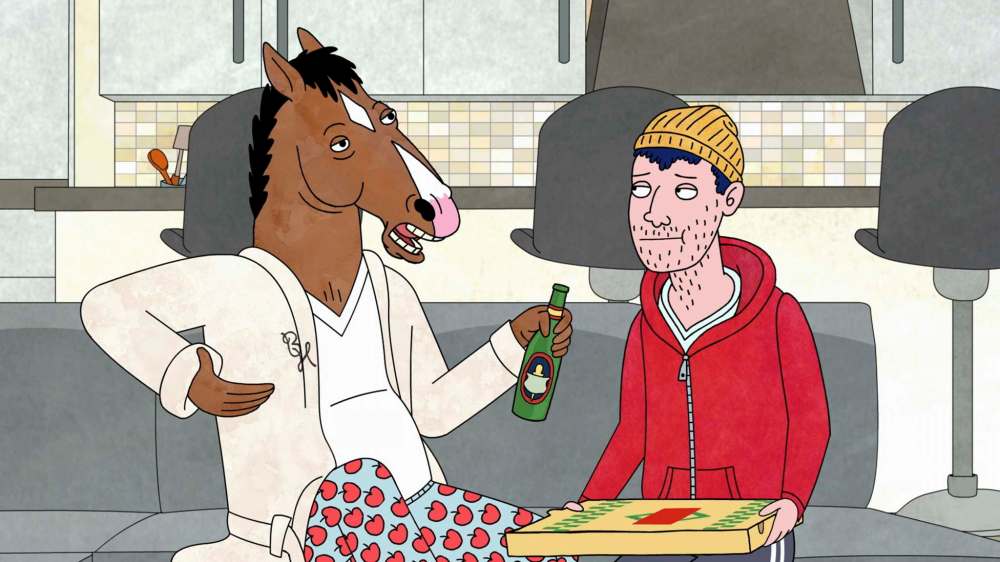
Like Tony Soprano, Don Draper and Frank Underwood, BoJack Horseman can be self-involved and self-destructive. An affection-starved childhood has left him with a self-loathing hole in his heart, and like those wounded alpha males of prestige TV, he often lashes out, letting down lovers and betraying friends.
Unlike those guys, however, BoJack is an animated half-horse, half-man who exists in a comically, colourfully surreal version of Los Angeles. That changes a lot.
Back in the golden age of The Sopranos and Mad Men, the murky unhappiness of male protagonists had a compelling dramatic context. Since then, we’ve been inundated with Low Winter Sun, Ray Donovan, True Detective 2. With their self-serious, self-satisfied wallowing in masculine angst, these lesser series have reduced the male antihero to cheap cliché.
That’s exactly why we need to trot out those over-used tropes for a sweater-wearing horse (voiced by Will Arnett). The one-time star of cheesy 1990s sitcom Horsin’ Around, BoJack now mopes around his Hollywood mansion hating himself and popping horse tranquillizers (naturally). That’s classic antihero stuff. But even when he wakes up after a night of blackout-drinking and meaningless sex, BoJack remains a talking equine in polka-dot underpants. This gives the whole “difficult man” thing an unexpected kick.
A screwy cross between The Day of the Locust and The Simpsons, the show works because of terrific vocal performances, smart writing and a deft tonal balance that encompasses the silly, the sombre and the scathing.
The show’s approach to its male anti-hero is sharpened by self-aware satire. In one episode, the action flashes back to 2007, when BoJack is collaborating with a hamster named Cuddlywhiskers on a gritty, hard-hitting television screenplay that could resurrect his career and redefine him as an actor.
“I want this character to be really edgy, like the kind of character Denis Leary would be offered and then say, ‘No way, this character’s too edgy for me,’” BoJack says. He wants his character to have a catchphrase, except it should be, you know, more like “an anti-catchphrase.”
While spoofing this kind of fetishized “realness,” BoJack Horseman is, in its own odd way, really real — poignantly real, complexly real. The animation might be 2D, but the characters and stories are fully three-dimensional. The series has dealt with abortion, addiction, depression and death, often with bleakly hilarious effectiveness.

Will Arnett’s other Netflix show, Flaked, also centres on a male anti-hero, an unhappy, alcoholic Los Angelino with a ton of emotional baggage. But that live-action dramedy struggles to transcend its stock situations, ultimately coming off as less true-to-life than BoJack Horseman, a quirky cartoon filled with pelican bartenders and meerkat accountants.
BoJack Horseman is also funny. The show is packed with sight gags and casually tossed-out jokes about the absurdities of contemporary L.A. It spoofs therapy culture (“I am hearing that you feel heard”), special snowflake children (a preschool is advertised as “a gluten-free learning experience,”) and the corrosive nature of celebrity (the reclusive — and deceased — novelist J.D. Salinger somehow ends up as a reality-TV showrunner). But the comedy always loops back around to genuine seriousness.
While comically skewering the excesses of the anti-hero genre, the show’s melancholy emotional pull and layered moral landscape also offer a chance for this devalued TV trope to regain some of its power. BoJack can be mean and bitter, blinded by pain, selfishness and general jerkiness. But he’s also a sad and lonely horse, hoping for a little redemption, occasionally gaining a bit of hard-earned insight.
Horse-face aside, BoJack actually does have a lot in common with Don Draper and Tony Soprano. And unlike, say, those poor guys in True Detective, his series actually seems to be getting better with each season.
alison.gillmor@freepress.mb.ca
Studying at the University of Winnipeg and later Toronto’s York University, Alison Gillmor planned to become an art historian. She ended up catching the journalism bug when she started as visual arts reviewer at the Winnipeg Free Press in 1992.
Our newsroom depends on a growing audience of readers to power our journalism. If you are not a paid reader, please consider becoming a subscriber.
Our newsroom depends on its audience of readers to power our journalism. Thank you for your support.
Studying at the University of Winnipeg and later Toronto’s York University, Alison Gillmor planned to become an art historian. She ended up catching the journalism bug when she started as visual arts reviewer at the Winnipeg Free Press in 1992.
Our newsroom depends on a growing audience of readers to power our journalism. If you are not a paid reader, please consider becoming a subscriber.
Our newsroom depends on its audience of readers to power our journalism. Thank you for your support.
Advertisement Advertise With Us
Advertisement Advertise With Us
History
Updated on Saturday, August 6, 2016 8:52 AM CDT: Adds photo