

Weak link in driver safety: parents

Advertisement
Read this article for free:
or
Already have an account? Log in here »
To continue reading, please subscribe:

Digital Subscription
One year of digital access for only $205*
- Enjoy unlimited reading on winnipegfreepress.com
- Read the E-Edition, our digital replica newspaper
- Access News Break, our award-winning app
- Play interactive puzzles
*First annual payment billed as $205.00 + GST for one year. This annual subscription will automatically renew at $233.00 + GST every 52 weeks (10% off the regular annual price of $259.35). Offer available to new and qualified returning subscribers only. Cancel any time.
To continue reading, please subscribe:
Add Free Press access to your Brandon Sun subscription for only an additional
$1 for the first 4 weeks*
- Enjoy unlimited reading on winnipegfreepress.com
- Read the E-Edition, our digital replica newspaper
- Access News Break, our award-winning app
- Play interactive puzzles
*Your next Brandon Sun subscription payment will increase by $1.00 and you will be charged $17.95 plus GST for four weeks. After four weeks, your payment will increase to $24.95 plus GST every four weeks.
Read unlimited articles for free today:
or
Already have an account? Log in here »
Hey there, time traveller!
This article was published 08/08/2016 (3654 days ago), so information in it may no longer be current.
If you’ve ever had a teenager involved in the Manitoba Public Insurance high school driver education program, you know road safety — something you might not have given much consideration before — becomes a top-of-mind concern.
You begin to notice just how much risk a driver faces every time he or she gets behind the wheel. How many critical moments we face as drivers. And most concerning of all, that Canada has one of the worst road-safety records in the world.
That was just one of the disturbing facts imparted in a great feature published in the Free Press over the weekend, in which automotive writer Kelly Taylor gets deep into the issue of road safety. For my family, with one teenager currently learning how to drive, the feature could not have come at a better time.
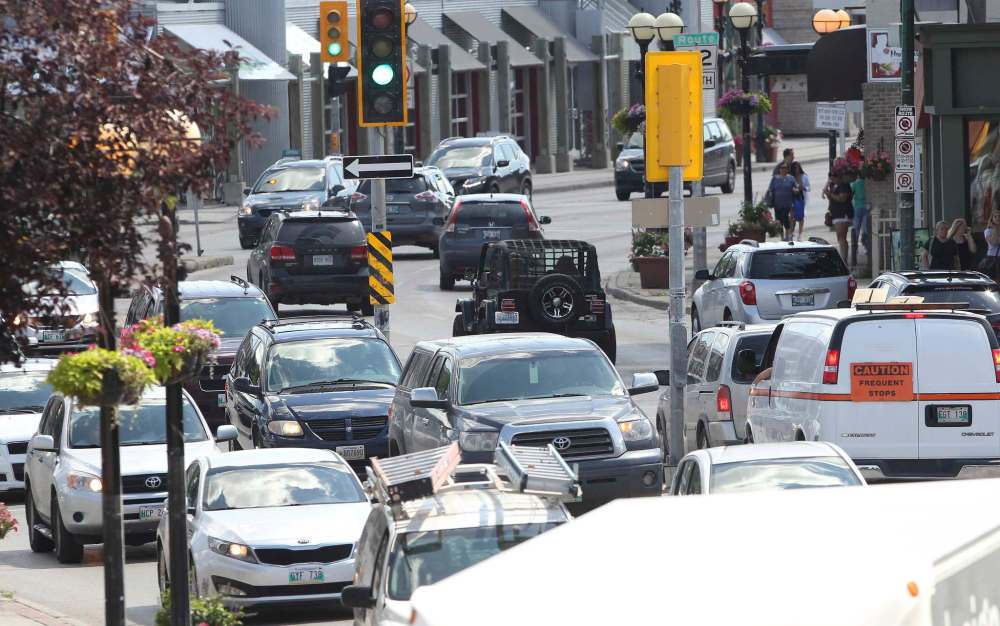
The final message was twofold: first, that Manitoba is doing more than ever before to ensure the safety of young drivers; and despite our better efforts, we’re not making any meaningful improvement in road safety.
How could that be?
The article looked in detail at the approach taken in Sweden, one of the safest places in the world to drive. There, driver education is much longer and more involved, young drivers get experience handling a car in slippery conditions, and any adult who wants to oversee a teenager has to take a course to be certified as a “supervising driver.”
After reading about the Swedish model, one aspect of it stuck out for me: the demands made on parents supervising their teenagers.
In Manitoba, driver-education participants get eight hours of actual driving with a certified instructor and another eight hours observing other participants. However, each teenager is supposed to spend a minimum of 24 hours driving with a parent. And if you’ve driven in Winnipeg, that should give you pause for concern.
There are bad drivers everywhere, but those of us who grew up in or often drive in other provinces can attest to the fact this is a tough place to drive. The anecdotal evidence is backed up by federal statistics showing Manitoba has among the highest incidence of collisions, and the highest rate of injury, in Canada.
My greatest concern has always been what appears to be a complete lack of understanding about some of the basic rules of the road, including, most notably, the four-way stop protocol. If you’re not being bullied by drivers on your left who force their way into intersections despite not having the right-of-way, you’re frantically waving at drivers who do have the right-of-way to proceed first.
And yet, the same people causing all those accidents and injuries are, remarkably, the same people who are spending the gross majority of time training young drivers. Although the certified driving instructors have some input, parents are undoubtedly the most influential driving role models for teenagers. And the simple fact is most of those role models have a poor grasp of basic road rules and the principles of road safety.
This exact problem was on full view when I attended the very first class for my son’s driver-education program. At least one parent must attend this introductory session to hear first-hand about the program and what is expected of them. However, what started out as an information session quickly turned into an impromptu refresher course for the parents.
It became clear quite quickly, from listening to the questions being asked by parents at this session, many had no idea about the rules of the road or the principles of defensive driving. Several admitted to having been involved in harrowing collisions as younger drivers but demonstrated no clear understanding of what they did wrong.
Thinking back on that, the aspect of the Swedish model that seems like it would make the biggest impact here is the requirement for a parent to undergo additional training if they want to supervise their son or daughter as they learn how to drive.

Once we obtain our licence, we do not have to prove our worthiness again unless we amass too many moving violations or collisions. However, given the lamentable road-safety record in Canada, it would be hard for anyone to argue that the gross majority of drivers don’t need to brush up on rules and defensive driving. If you look at the state of driving in Winnipeg, you could even make an argument re-testing should be mandatory for everyone, regardless of whether we have a son or daughter in driver education. Those of us who cannot pass our re-test should forfeit our licences.
We should continue to improve on the driver-education program, and in fact, MPI has pledged to continue innovating to find ways of adopting the best practices of countries with much better safety records. But as a country and province, we also need to examine the overall state of road safety, and what we can do to improve the culture of driving.
It all comes down to this: if we are really concerned about the safety of our teenagers, then perhaps the rest of us need to spend some time relearning the rules of the road and the principles of defensive driving.
And, in particular, figuring out the rules at a four-way stop.
dan.lett@freepress.mb.ca
Dan Lett is a columnist for the Free Press, providing opinion and commentary on politics in Winnipeg and beyond. Born and raised in Toronto, Dan joined the Free Press in 1986. Read more about Dan.
Dan’s columns are built on facts and reactions, but offer his personal views through arguments and analysis. The Free Press’ editing team reviews Dan’s columns before they are posted online or published in print — part of the our tradition, since 1872, of producing reliable independent journalism. Read more about Free Press’s history and mandate, and learn how our newsroom operates.
Our newsroom depends on a growing audience of readers to power our journalism. If you are not a paid reader, please consider becoming a subscriber.
Our newsroom depends on its audience of readers to power our journalism. Thank you for your support.
Dan Lett is a columnist for the Free Press, providing opinion and commentary on politics in Winnipeg and beyond. Born and raised in Toronto, Dan joined the Free Press in 1986. Read more about Dan.
Dan’s columns are built on facts and reactions, but offer his personal views through arguments and analysis. The Free Press’ editing team reviews Dan’s columns before they are posted online or published in print — part of the our tradition, since 1872, of producing reliable independent journalism. Read more about Free Press’s history and mandate, and learn how our newsroom operates.
Our newsroom depends on a growing audience of readers to power our journalism. If you are not a paid reader, please consider becoming a subscriber.
Our newsroom depends on its audience of readers to power our journalism. Thank you for your support.
Related Articles
With Canada ranked third-worst in road safety, can Sweden be a model for driver training?
Advertisement Advertise With Us
Advertisement Advertise With Us
History
Updated on Monday, August 8, 2016 7:16 AM CDT: Adds photo