

Winnipeg tops ‘unsafe’ list: poll
Canadians' perception of city slow to change but getting better, officials say

Advertisement
Read this article for free:
or
Already have an account? Log in here »
To continue reading, please subscribe:

Digital Subscription
One year of digital access for only $205*
- Enjoy unlimited reading on winnipegfreepress.com
- Read the E-Edition, our digital replica newspaper
- Access News Break, our award-winning app
- Play interactive puzzles
*First annual payment billed as $205.00 + GST for one year. This annual subscription will automatically renew at $233.00 + GST every 52 weeks (10% off the regular annual price of $259.35). Offer available to new and qualified returning subscribers only. Cancel any time.
To continue reading, please subscribe:
Add Free Press access to your Brandon Sun subscription for only an additional
$1 for the first 4 weeks*
- Enjoy unlimited reading on winnipegfreepress.com
- Read the E-Edition, our digital replica newspaper
- Access News Break, our award-winning app
- Play interactive puzzles
*Your next Brandon Sun subscription payment will increase by $1.00 and you will be charged $17.95 plus GST for four weeks. After four weeks, your payment will increase to $24.95 plus GST every four weeks.
Read unlimited articles for free today:
or
Already have an account? Log in here »
Hey there, time traveller!
This article was published 16/08/2016 (3683 days ago), so information in it may no longer be current.
It should be no surprise a recent national poll says Canadians believe — incorrectly — Winnipeg is the country’s least-safe city, an expert on the fear of crime said.
Winnipeg hasn’t been Canada’s homicide capital for years, but its former title will take a long time to live down, said University of Winnipeg criminal justice Prof. Michael Weinrath.
“One of the things that seems to stick in people’s minds are homicides,” the director of the Justice Research Institute said Tuesday. “It’s an empirical fact Winnipeg was the No. 1 homicide city for a number of years. Even when we’re not No. 1, we’re second or third.
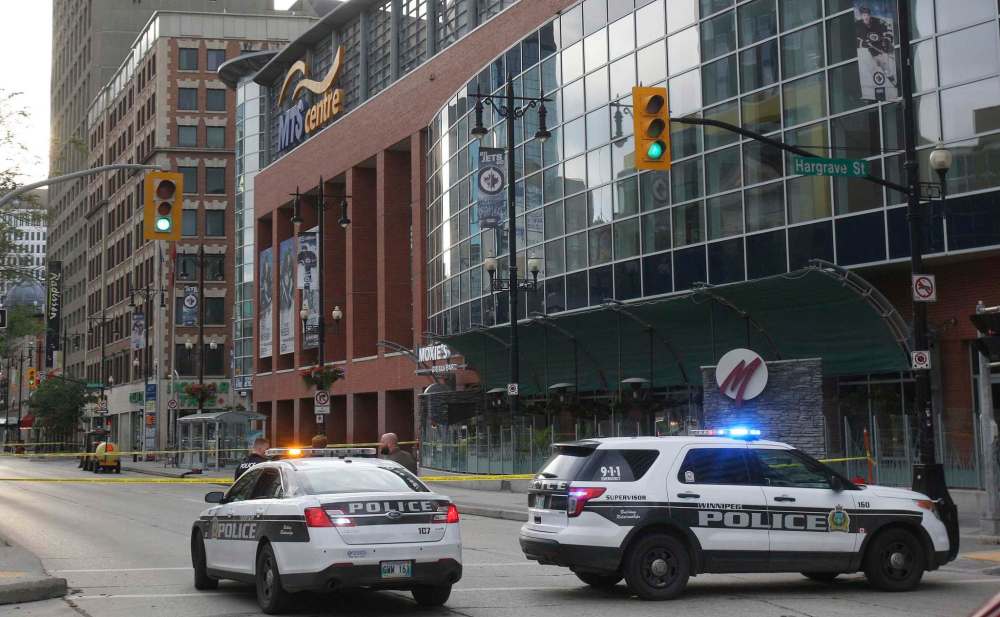
“For a long time, in the public’s mind, there’s a perception it’s a high-crime place.”
The Mainstreet/Postmedia poll of 4,231 Canadians released Tuesday shows among 15 major cities surveyed, Ottawa is seen as the safest city while Winnipeg is seen as the least safe. (The poll has a margin of error of plus or minus 1.52 per cent, 19 times out of 20.)
Recent crime statistics, however, show Saskatoon has the highest crime rate in the country.
The poll results don’t jibe with reality, Winnipeg Mayor Brian Bowman and Economic Development Winnipeg president and CEO Dayna Spiring told reporters.
“Obviously, the facts support the fact Winnipeg is attracting more visitors than ever before,” said Bowman. “What we’re seeing when we have visitors come to Winnipeg is their view is overwhelmingly improved when they arrive here. We’ve seen an increasing number of sport tourists in recent years, whether it’s FIFA, the Grey Cup, the Heritage Classic coming up this fall and, of course, the (2017) Canada Summer Games.
“These are events that provide us with an opportunity to demonstrate to Canadians from coast to coast to coast that Winnipeg is not only a great place to live but it’s a great place to visit and invest in.”
Bowman said when people visit the city for conventions or to attend sporting events, they leave with a favourable impression of Winnipeg.
Surveys of visitors repeatedly show they leave Winnipeg with a positive image of the city, said Spiring.
It is the message her organization and local residents need to spread, she said.
“We’ve got to do a better job of telling the Winnipeg story,” she said.
While Winnipeg’s crime rate was trending downward for the past 10 years, Statistics Canada reported recently police-reported crime went up by five per cent across the country in 2015, the first jump in 12 years.
Violent crime increased by six per cent across Canada, while non-violent crime increased by four per cent.
In July, the Winnipeg Police Service’s 2015 statistical report showed violent crime went up six per cent between 2014 and 2015, while property crimes rose by nine per cent.
The StatsCan report said police-reported crime was still 31 per cent lower than in 2005.
“Things have really improved in the last 20 years,” said Weinrath. “You do have to point out to people that our crime rate is going down, that most Winnipeggers are safe most of the time.”
Winnipeg police spokesman Const. Rob Carver said they can’t change perceptions at a national level.
“I don’t think there’s anything Winnipeg police can do — perceptions are complex and built up over a long period of time,” he said in an interview.
Carver said the media has been quick to pick up on negative stories while ignoring positive ones.
He pointed to all the attention paid last year to Maclean’s magazine labelling Winnipeg as Canada’s most racist city while ignoring an earlier Maclean’s article, The Manitoba miracle, which hailed positive trends and a piece that ran in January headlined, Winnipeg a leader in fixing Canada’s racism problem.
On Tuesday, Bowman highlighted National Geographic Travel recently rating Winnipeg as one of the world’s top 20 tourist destinations for 2016 — the only Canadian city named in its report.
Folklorama recently attracted almost “half-a-million visitors,” the mayor said, adding he wants to see how perceptions change over the coming years.
“Let’s have that discussion a few years from now because we know… when people come here (their perception) is improved,” Bowman said.

“Perceptions are slow to change,” agreed Carver.
“They don’t necessarily reflect reality. There’s some very positive changes taking place from a law enforcement and safety standpoint.”
The police spokesman said there’s nothing the force can do about national perceptions, but at a local and community level, perceptions are changing with people being safe and feeling safe.
“From a community level and a city level, we’re making really positive strides here.”
carol.sanders@freepress.mb.caaldo.santin@freepress.mb.ca
Carol Sanders
Legislature reporter
Carol Sanders is a reporter at the Free Press legislature bureau. The former general assignment reporter and copy editor joined the paper in 1997. Read more about Carol.
Every piece of reporting Carol produces is reviewed by an editing team before it is posted online or published in print — part of the Free Press‘s tradition, since 1872, of producing reliable independent journalism. Read more about Free Press’s history and mandate, and learn how our newsroom operates.
Our newsroom depends on a growing audience of readers to power our journalism. If you are not a paid reader, please consider becoming a subscriber.
Our newsroom depends on its audience of readers to power our journalism. Thank you for your support.
Crime scare
OTTAWA is perceived to be Canada’s safest city — 72 per cent of those recently polled by Mainstreet/Postmedia said it was either safe or very safe.
Winnipeg is perceived to be Canada’s least safe city with just 35 per cent indicating it was safe or very safe, compared with 56 per cent who said it was unsafe.
Males and females, young and old, all ranked the safest and least safe cities in the same way at the top and bottom of the 15 centres they were asked about.
Charlottetown, Moncton, N.B., St. John’s, Nfld., and Quebec City rounded out the top five among the safest.
Toronto, Montreal, Saskatoon and Edmonton rounded out the bottom five of those considered “unsafe.”
Winnipeg was perceived as the least safe city by Canadians, the poll determined.
Across the country in 2015, police-reported crime went up by five per cent in 2015 — the first jump in 12 years, StatsCan reported earlier this year. However, police-reported crime was 31 per cent lower than in 2005.
Manitoba’s crime severity index in 2015 rose by eight per cent, with mischief accounting for 24 per cent of police-reported crime in the province. Alberta’s crime severity index increased 18 per cent in 2015.
The Statistics Canada report said Alberta has been experiencing a higher number of break-and-enters, theft of $5,000 and under, and vehicle theft.
The Winnipeg Police Service’s 2015 annual statistical report said overall crime in the city went up by seven per cent from 2014. Violent crime rose by six per cent, and property crimes jumped by nine per cent.
— sources: Statistics Canada, Mainstreet/Postmedia poll, Mainstreet Research president Quito Maggi
Carol Sanders
Legislature reporter
Carol Sanders is a reporter at the Free Press legislature bureau. The former general assignment reporter and copy editor joined the paper in 1997. Read more about Carol.
Every piece of reporting Carol produces is reviewed by an editing team before it is posted online or published in print — part of the Free Press‘s tradition, since 1872, of producing reliable independent journalism. Read more about Free Press’s history and mandate, and learn how our newsroom operates.
Our newsroom depends on a growing audience of readers to power our journalism. If you are not a paid reader, please consider becoming a subscriber.
Our newsroom depends on its audience of readers to power our journalism. Thank you for your support.
Related Articles
Safety is in the eye of the beholder (and ears of pollsters)
Advertisement Advertise With Us
Advertisement Advertise With Us
History
Updated on Tuesday, August 16, 2016 7:59 PM CDT: updated story, new headline and deck