

A grief that words can’t express needs some answers

Advertisement
Read this article for free:
or
Already have an account? Log in here »
To continue reading, please subscribe:

Digital Subscription
One year of digital access for only $205*
- Enjoy unlimited reading on winnipegfreepress.com
- Read the E-Edition, our digital replica newspaper
- Access News Break, our award-winning app
- Play interactive puzzles
*First annual payment billed as $205.00 + GST for one year. This annual subscription will automatically renew at $233.00 + GST every 52 weeks (10% off the regular annual price of $259.35). Offer available to new and qualified returning subscribers only. Cancel any time.
To continue reading, please subscribe:
Add Free Press access to your Brandon Sun subscription for only an additional
$1 for the first 4 weeks*
- Enjoy unlimited reading on winnipegfreepress.com
- Read the E-Edition, our digital replica newspaper
- Access News Break, our award-winning app
- Play interactive puzzles
*Your next Brandon Sun subscription payment will increase by $1.00 and you will be charged $17.95 plus GST for four weeks. After four weeks, your payment will increase to $24.95 plus GST every four weeks.
Read unlimited articles for free today:
or
Already have an account? Log in here »
Hey there, time traveller!
This article was published 27/08/2016 (3606 days ago), so information in it may no longer be current.
Over a clickety-clack soundtrack of cameras snapping, Leon Swanson tried to find words for the pain that had happened.
Inside the small room at the Norway House Cree Nation office, a flock of reporters bore witness. To Swanson’s left and at the same table, his childhood friend David Tait Jr. sat muffling sobs. Camera shutters snapped quickly, collecting their shots.
For eight or nine seconds, those were the only sounds. Swanson raised his head to speak, but no words came out.
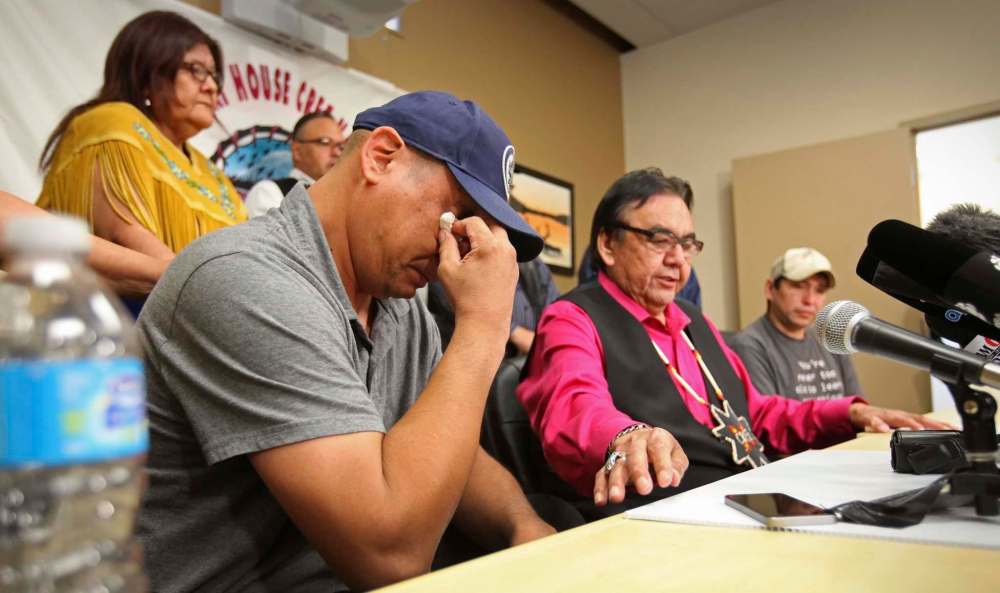
“I don’t know what to say,” he finally said, and so he just said it again. “I don’t know what to say.”
There is little that Swanson or Tait could be expected to say, at this early juncture. On Friday, the 41-year-old men from Norway House were still reeling from the discovery that they were born four days apart, but to the other one’s mother.
Whatever waves of emotion roll over them now, few of us can really comprehend them. Perhaps many adoptees can recognize parts of the struggle; we know what it is like, to balance an identity upon two parallel family lines.
In adoption, however, that separation was intended. Besides, most adoptees always knew what parts of ourselves were unknown. Unlike Swanson and Tait, our mental map of our lives wasn’t suddenly redrawn when we were grown.
To come to terms with this, the men and their families will need time to heal. While they take it, authorities and an entire community will have to wrestle with the question: how could this have happened not just once, but again?
We now know of two cases of infants switched at birth in 1975 at the same federally run northern hospital. Last winter, Garden Hill First Nation members Luke Monias and Norman Barkman learned they had been switched in June of that year.
After this new revelation, former provincial NDP cabinet minister Eric Robinson called for a federal investigation. It may be the only way to find out if enough records or staff memories survive to draw a picture of how the mistakes happened.
What is certain is that the likelihood of this happening twice at the same place, within the same narrow time window, is incredibly low. That fact alone requires that we consider it in the context of a pattern, and press for answers.
It is impossible to say how often babies are switched shortly after birth. It is nightmare fuel for parents, but rare in practice: when switches are uncovered, the usual description is that they are no more common than a “freak accident.”
Cataloguing them can be a problem. A Wikipedia page on the topic lists 11 switches since 1931, but it is missing several well-publicized cases, including Monias-Barkman and that of a baby born last year in El Salvador to a Texas couple.
Meanwhile, there are doubtless many cases that will remain undetected. Though many parents of babies switched at birth had a hunch that something wasn’t right, it was usually the luck of unrelated bloodwork that brought the truth suddenly to light.
In some cases, mothers recalled protesting at hospital that they had been given the wrong baby, but having those concerns brushed off as post-partum paranoia. (Some reflection here, perhaps, about professional hubris in medical settings.)
When they are proven right, a media storm often follows. If babies switched at birth is most often soap-opera fodder, some real-life stories are no less dramatic. In 1998, a Virginia couple was killed in a car crash on the same day a local hospital discovered it had switched their daughter at birth; the couple never knew that the three-year-old was not biologically theirs.
In 1989, a Florida couple lost their nine-year-old daughter to a congenital heart defect, only to learn the child had been switched at birth with another. The ensuing custody battle over their living biological daughter left the girl with lasting struggles; the story was intensely covered in newspapers, a TV movie and a pair of Barbara Walters specials.
The point is this: babies being switched at birth is rare and remarkable enough that having two cases emerge from the Norway House Indian Hospital in 1975 alone must be examined. The information we have does not necessarily point to any conscious misdeed or malicious intent, but it does raise deeper questions.
These four “stolen lives,” as Robinson described them on Friday, cannot be extricated from the context in which they occurred: a context of decades of neglect, substandard care or violence enacted on indigenous children.

That includes such shameful chapters as residential schools and the ’60s Scoop. It also includes the malnutrition experiments conducted in the 1940s and ‘50s by Canadian scientists on indigenous adults and children — experiments that remained little-known until 2013, when they were unearthed by University of Guelph historian Ian Mosby.
The first of those experiments was launched in Norway House in 1942, at a time when many residents were malnourished and subsisting on less than 1,500 calories a day. Three hundred Cree people were chosen as unwitting subjects for the study; researchers gave nutritional supplements to 125, and planned experiments to contrast the two groups.
Thirty-three years later, Leon Swanson and David Tait Jr. were born in that region, at a federal hospital. Somehow, their lives and that of their families were irrevocably altered. They grew up as friends, even held sleepovers, and must now come to terms with the fact that even their names were meant for the other.
The healing path may be long, but it is one they must now walk beside Monias and Barkman. Whatever lies ahead for these families on that journey, the rest of us should keep pressing for answers on how it came to be.
melissa.martin@freepress.mb.ca
Melissa Martin
Reporter-at-large
Melissa Martin reports and opines for the Winnipeg Free Press.
Every piece of reporting Melissa produces is reviewed by an editing team before it is posted online or published in print — part of the Free Press‘s tradition, since 1872, of producing reliable independent journalism. Read more about Free Press’s history and mandate, and learn how our newsroom operates.
Our newsroom depends on a growing audience of readers to power our journalism. If you are not a paid reader, please consider becoming a subscriber.
Our newsroom depends on its audience of readers to power our journalism. Thank you for your support.
Melissa Martin
Reporter-at-large
Melissa Martin reports and opines for the Winnipeg Free Press.
Every piece of reporting Melissa produces is reviewed by an editing team before it is posted online or published in print — part of the Free Press‘s tradition, since 1872, of producing reliable independent journalism. Read more about Free Press’s history and mandate, and learn how our newsroom operates.
Our newsroom depends on a growing audience of readers to power our journalism. If you are not a paid reader, please consider becoming a subscriber.
Our newsroom depends on its audience of readers to power our journalism. Thank you for your support.
Related Articles
Feds make no commitment to meet with men switched at birth
Advertisement Advertise With Us
Advertisement Advertise With Us