

Westworld’s robots certainly aren’t robotic

Advertisement
Read this article for free:
or
Already have an account? Log in here »
To continue reading, please subscribe:
Monthly Digital Subscription
$1 per week for 24 weeks*
- Enjoy unlimited reading on winnipegfreepress.com
- Read the E-Edition, our digital replica newspaper
- Access News Break, our award-winning app
- Play interactive puzzles
*Billed as $4.00 plus GST every four weeks. After 24 weeks, price increases to the regular rate of $19.95 plus GST every four weeks. Offer available to new and qualified returning subscribers only. Cancel any time.
Monthly Digital Subscription
$4.99/week*
- Enjoy unlimited reading on winnipegfreepress.com
- Read the E-Edition, our digital replica newspaper
- Access News Break, our award-winning app
- Play interactive puzzles
*Billed as $19.95 plus GST every four weeks. Cancel any time.
To continue reading, please subscribe:
Add Free Press access to your Brandon Sun subscription for only an additional
$1 for the first 4 weeks*
- Enjoy unlimited reading on winnipegfreepress.com
- Read the E-Edition, our digital replica newspaper
- Access News Break, our award-winning app
- Play interactive puzzles
*Your next Brandon Sun subscription payment will increase by $1.00 and you will be charged $17.95 plus GST for four weeks. After four weeks, your payment will increase to $24.95 plus GST every four weeks.
Read unlimited articles for free today:
or
Already have an account? Log in here »
Hey there, time traveller!
This article was published 07/10/2016 (3503 days ago), so information in it may no longer be current.
In an entertainment universe awash in reboots, retreads and re-imaginings, Westworld (HBO Canada, Sunday night) feels like the rare remake whose moment has come. Creators Lisa Joy (Pushing Daisies) and Jonathan Nolan (Christopher Nolan’s brother and frequent screenwriter) have managed to update the original 1973 movie in ways that are timely, topical and packed with meaning and menace.
THIS TIME, IT’S (MOSTLY) ABOUT THE ROBOTS
Novelist Michael Crichton made his big-screen directing debut with the odd, entertaining and influential 1973 sci-fi flick, about a theme park where paying guests play out their Wild West fantasies safely surrounded by easy-to-kill robot cowboys and easy-to-bed pleasure-bot saloon girls. Crichton focuses on the guests: he wants to see what happens to human beings in an artificial world where actions have no consequences.
In contrast, the Westworld TV series is more concerned about its abused androids than its often inhumane humans. Digging down into the mystery of consciousness and the ethics of artificial intelligence, it questions what it really means to be a person.
In the old Westworld, Yul Brynner played a robo-outlaw that malfunctions and goes on a deadly rampage. His relentlessness is unnerving — he was a big influence on The Terminator — precisely because his breakdown is mechanical, emotionless and seemingly without motivation.
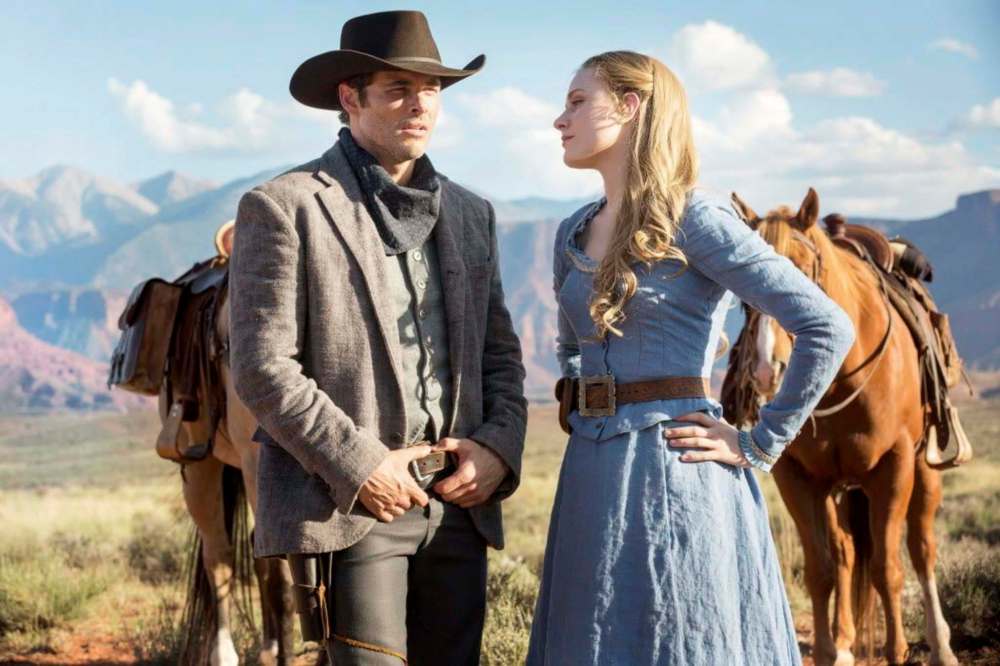
In the new Westworld, Evan Rachel Wood plays an android named Dolores, whose cyber-enslavement means she experiences a daily hell of loss, grief, rape and murder, only to wake up the next morning with her memory wiped, fresh, hopeful and virginal. When a software update provides access to deeper levels of recall, the sunny Dolores heads toward a Freudian eruption of self-awareness and trauma.
Reflecting the different technological speculations of their times, Brynner’s gunslinger is more like a pre-programmed toaster on the fritz, while Wood’s Dolores is a hybrid being on the tragic edge of sentience.
IT’S ABOUT THE WOMEN
The 1973 flick reflected the fear that men were being emasculated by modern life, with the Westworld theme park allowing them to explore their “true natures” in America’s mythologized frontier. James Brolin is the worldly man’s man, Blane, who has brought along his sensitive, sheltered friend Martin (the wonderfully neurotic Richard Benjamin). Martin is pining for his ex-wife, even though she fleeced him in a divorce, and seems hesitant about the park’s rampant possibilities for sex and violence.
Martin ends up as our protagonist, and it’s the techno breakdown at the park that helps him “man up.”
In the new Westworld, the focus shifts towards the women. Lately, some of the most provocative and effective explorations of AI have centred on female cyber-characters, including Her, Ex Machina and the British TV seriesHumans. Joy and Nolan explore what happens when women — robotic, but also, by extension, the flesh-and-blood kind — function only as stereotyped projections of male desire.
The objectification of women is literal in the Westworld universe — basically, you’re constructed as either a brothel worker or a chaste homesteader — but so is what 1970s feminists used to call “consciousness-raising.” Dolores may be a programmable artificial life form, but she is becoming conscious right before our eyes.
IT’S ABOUT POP CULTURE
In 1973, Crichton was playing around with the idea of naughty amusement parks for adults, which also included Medieval World, with its jousting and serving wenches, and Roman World, with its orgies and slave girls. A set-piece in the original film is an over-the-top barroom brawl that spoofs every cliché of the western genre. Crichton is making it clear that people didn’t want to experience the real Old West: they wanted to experience western movies.
The original film was made in a more innocent pop-culture period. The new series — which is a creation of HBO, the network known for bad men and nude (and often brutalized) women — takes the self-examination even farther. So far, the worst atrocities remain mercifully off-screen, but the suggested sex and violence seem intent on dragging us into an uncomfortable discussion about how and why we consume these things.
One of the least sympathetic human characters is the man in charge of constructing the park’s “storylines.” We see him gleefully upping the android body count in response to the guests’ darkening desires, possibly a parallel to the should-we-or-shouldn’t-we position of HBO screenwriters, locked into an atrocity spiral with audiences hungry for the next big shock.
Is it all just fake and fun, or are there real-world implications arising from this dude ranch, especially when the “dudes” are becoming increasingly vicious? It’s a question that we’ll be asking — about the theme park’s guests and maybe about ourselves, as viewers of this series — as Westworld unfolds.
alison.gillmor@freepress.mb.ca
Studying at the University of Winnipeg and later Toronto’s York University, Alison Gillmor planned to become an art historian. She ended up catching the journalism bug when she started as visual arts reviewer at the Winnipeg Free Press in 1992.
Our newsroom depends on a growing audience of readers to power our journalism. If you are not a paid reader, please consider becoming a subscriber.
Our newsroom depends on its audience of readers to power our journalism. Thank you for your support.
Studying at the University of Winnipeg and later Toronto’s York University, Alison Gillmor planned to become an art historian. She ended up catching the journalism bug when she started as visual arts reviewer at the Winnipeg Free Press in 1992.
Our newsroom depends on a growing audience of readers to power our journalism. If you are not a paid reader, please consider becoming a subscriber.
Our newsroom depends on its audience of readers to power our journalism. Thank you for your support.
Advertisement Advertise With Us
Advertisement Advertise With Us