

18 new towers for downtown?
New workers could spark construction boom: study
Advertisement
Read this article for free:
or
Already have an account? Log in here »
To continue reading, please subscribe:
Monthly Digital Subscription
$1 per week for 24 weeks*
- Enjoy unlimited reading on winnipegfreepress.com
- Read the E-Edition, our digital replica newspaper
- Access News Break, our award-winning app
- Play interactive puzzles
*Billed as $4.00 plus GST every four weeks. After 24 weeks, price increases to the regular rate of $19.95 plus GST every four weeks. Offer available to new and qualified returning subscribers only. Cancel any time.
Monthly Digital Subscription
$4.99/week*
- Enjoy unlimited reading on winnipegfreepress.com
- Read the E-Edition, our digital replica newspaper
- Access News Break, our award-winning app
- Play interactive puzzles
*Billed as $19.95 plus GST every four weeks. Cancel any time.
To continue reading, please subscribe:
Add Free Press access to your Brandon Sun subscription for only an additional
$1 for the first 4 weeks*
*Your next subscription payment will increase by $1.00 and you will be charged $16.99 plus GST for four weeks. After four weeks, your payment will increase to $23.99 plus GST every four weeks.
Read unlimited articles for free today:
or
Already have an account? Log in here »
Hey there, time traveller!
This article was published 06/03/2009 (6171 days ago), so information in it may no longer be current.
DOWNTOWN Winnipeg is doing much better as an economic engine than its reputation suggests, according to a new study of employment in the city’s core.
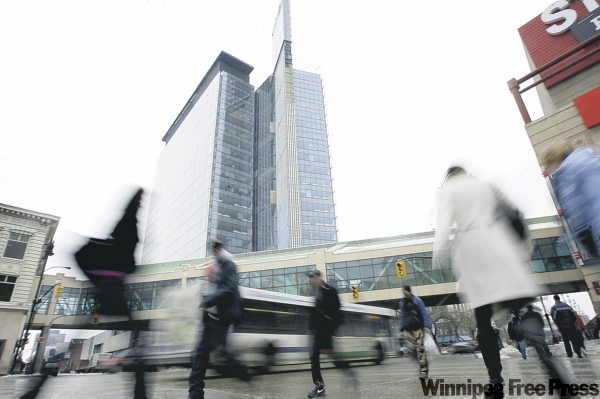
About 57,000 people work downtown and another 9,700 could join them in the next 25 years and spark the construction of 18 new office towers, according to the city-commissioned Downtown Winnipeg Employment Study. The study was completed on Feb. 26 by a pair of Toronto consultants and just made public.
Based on Statistics Canada employment data, consulting firms Altus Clayton and Urban Strategies Inc. found Winnipeg ranked third among eight Canadian metropolitan areas in terms of the concentration of jobs based in their respective core business districts. Only Regina and Calgary —
two cities with downtown reputation issues of their own — had more jobs based in their respective cores.
The results are counterintuitive, in that inner-city Winnipeg suffers from a negative reputation due to its relatively large size and relatively small population. Only about 13,000 people reside within the formal boundaries of downtown Winnipeg, giving rise to the perception the area is unsafe because few people are on the street during evenings and weekends.
But almost one in four residents of metropolitan Winnipeg, an area that includes bedroom communities for the purposes of statistical analysis, actually work in the city’s central business district, the study suggests.
Formally, the area defined as downtown Winnipeg is bounded by the Assiniboine River to the south, the Red River to the east and an irregular northwest boundary that zigzags southwest from Chinatown, past the western edges of the Exchange District and Central Park to the University of Winnipeg and then finally down to the Assiniboine at Balmoral Street. The area defined as Winnipeg’s central business district also includes the Health Sciences Centre and parts of the Centennial, West Alexander, Spence and West Broadway neighbourhoods, plus Osborne Village and the northern chunk of Old St. Boniface.
Winnipeggers tend to underestimate the importance of the city’s relatively large downtown workforce, mainly because office workers are spread throughout the central core, said Stefano Grande, executive director of the Downtown Winnipeg BIZ.
In 2008, when the BIZ asked New York City retail consultant Michael J. Berne to study downtown Winnipeg, the organization was surprised by the positive feedback. Despite the flight of shoppers to Polo Park, St. Vital and Kenaston Commons, downtown Winnipeg’s retail sector remains healthier than those found in U.S. cities of a similar size, the consultant said.
"He said, ‘Clearly your office workers are driving a lot of retail downtown and your local residential population is sustaining it," Grande said.
Forecasts of future economic growth in Winnipeg, which predict up to 9,700 downtown jobs will be added over the next 25 years, suggest the core will require another 3.7 million square feet of office space, a figure that translates into 18 new buildings.
Commercial realtors say the city could use more office space right away, given the extremely low office vacancy rates in Winnipeg, never mind even tighter supplies of retail, industrial and multi-family residential space.
"We are at the lowest vacancy we’ve ever seen," said Don White, the broker for Colliers Pratt McGarry, which pegged the city’s office-space vacancy rate at 5.4 per cent at the end of 2008.
White said Winnipeg will need new office buildings even if the economy softens as expected. But at the same time, nobody will build new office towers unless the office-space rental rates double or even triple to allow developers a better return on their investment, he said. Class A office space in downtown Winnipeg rents for $15 to $17 per square foot. New office towers won’t be feasible until those rates rise above $40 per square foot, he said.
"Our rental rates don’t really justify construction. But as we start to grow, we simply need new real estate," he said. Unlike Calgary, where risk-taking developers erected a glut of office space, Winnipeg investment firms tend to be conservative and avoid any form of office-tower speculation.
Winnipeg developers are also reluctant to build new downtown apartment towers, despite a city-wide multifamily vacancy rate pegged at only one per cent, added White, claiming the city’s apartment-vacancy rate "is at an unhealthy low."
In an unusual confluence of opinion, commercial realtors are on the same page as inner-city housing advocates who claim Winnipeg is already in the midst of a residential property crisis and could be on the verge of an explosion of homelessness.
Earlier this week, representatives from the non-profit Spence Neighbourhood Association told city council’s property and development committee that middle-class Winnipeggers are driving low-income residents out of a short supply of inner-city housing stock.
White agreed, stating a shortage of high-end and middle-class rental units is compounding Winnipeg’s affordable- housing crisis.
bartley.kives@freepress.mb.ca

Upside for downtown
Selected highlights from the city-commissioned Downtown Winnipeg Employment Study, conducted by Toronto consulting firms Altus Clayton and Urban Strategies Inc.: Approximately 57,000 people work in downtown Winnipeg, which has about 12.8 million square feet of office space. That means about a quarter of metropolitan Winnipeg’s workforce is based downtown.
Winnipeg ranks third out of eight selected Canadian metropolitan areas when it comes to the percentage of total jobs that are based downtown. Populationwise, Winnipeg ranks seventh in the data analysis, which was based on Statistics Canada data and also included Toronto, Montreal, Vancouver, Ottawa, Calgary, Edmonton and Regina.
The same analysis found Winnipeg ranked No. 1 in terms of the concentration of healthcare jobs downtown and No. 2 in finance, real estate and professions.
Over the next 25 years, downtown Winnipeg will generate up to 9,700 office jobs. The new employment supports the creation of 3.7 million more square feet of office space, which amounts to about 18 new buildings.
— Bartley Kives