Staking their claim
Female homesteaders faced uphill battle in rural Canada
Advertisement
Read this article for free:
or
Already have an account? Log in here »
To continue reading, please subscribe:
Digital Subscription
One year of digital access for only $1.44 a week*
- Enjoy unlimited reading on winnipegfreepress.com
- Read the E-Edition, our digital replica newspaper
- Access News Break, our award-winning app
- Play interactive puzzles
*Billed as $5.77 plus GST every four weeks. After 52 weeks, price increases to the regular rate of $19.95 plus GST every four weeks. Offer available to new and qualified returning subscribers only. Cancel any time.
To continue reading, please subscribe:
Add Free Press access to your Brandon Sun subscription for only an additional
$1 for the first 4 weeks*
- Enjoy unlimited reading on winnipegfreepress.com
- Read the E-Edition, our digital replica newspaper
- Access News Break, our award-winning app
- Play interactive puzzles
*Your next Brandon Sun subscription payment will increase by $1.00 and you will be charged $17.95 plus GST for four weeks. After four weeks, your payment will increase to $24.95 plus GST every four weeks.
Read unlimited articles for free today:
or
Already have an account? Log in here »
Hey there, time traveller!
This article was published 14/01/2017 (3571 days ago), so information in it may no longer be current.
The homestead — the offer of free land to those who could establish a farm on unsettled land (which had been surrendered by indigenous people) — is central to the history of the Canadian Prairies. It was this offer that brought thousands of Europeans and eastern Canadians to the West in the early years of the 20th century and established the region’s agricultural base.
Controversially, many came from eastern Europe; then-interior minister Clifford Sifton championed their presence, saying, “a stalwart peasant in a sheepskin coat, born on the soil, whose forefathers have been farmers for 10 generations, with a stout wife and a half-dozen children, is good quality.”
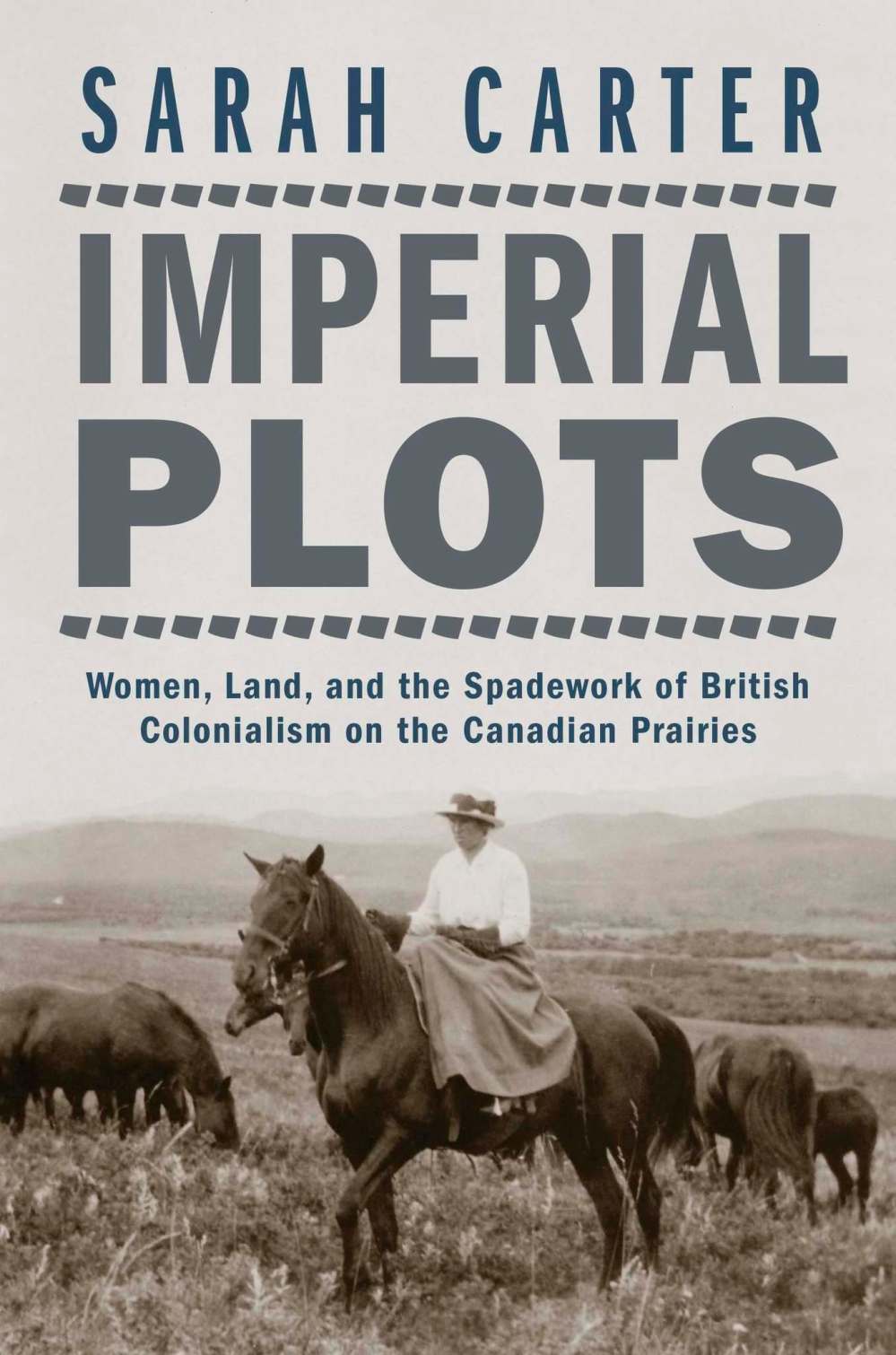
The colonization of the West was, in other words, from the outset entangled in debates over race and gender. In Imperial Plots: Women, Land, and the Spadework of British Colonialism, University of Alberta professor and historian Sarah Carter creatively draws attention to largely overlooked elements of that debate — most prominently, the degree to which women were barred from homesteading in Canada.
While the 1872 Dominion Lands Act allowed women to claim a homestead, this right was removed just four years later. From then on, women could only homestead if they were the sole head of a family — in effect, widows with dependent children.
As Winnipeg journalist and feminist Lillian Beynon Thomas wrote in 1913, the only way for a woman to claim a homestead was by “killing off any inconvenient husband they happened to own.”
Homesteading was a challenge: it was hard work, lonely and dangerous, and success was far from certain.
Historian Chester Martin once estimated only six of every 10 homesteaders succeeded in establishing their farm. Carter’s research shows during the short period when women could claim homesteads, they had a better success rate than men. They did this despite the number of advantages men enjoyed. During the winter, for example, men often left the farm to work on railway construction gangs or in lumber camps. Barred from these jobs, lucky women might find work teaching, or they might work as a housekeeper.
Many opinion-makers in Britain believed sending women (of the “right type”) to the colonies to farm would not only keep the Empire British, it would also solve the mother country’s “surplus women” problem. Carter recounts the history of a number of initiatives undertaken to recruit and train such emigrants. These efforts were bedevilled by debates about who should go (preferably “gentlewomen”), what sort of farming they should undertake (gardening, dairying and raising poultry generally topped the list), and what, of course, they should wear (journalists of the day could not get enough of this).
From the evidence Carter was able to unearth, it appears few of the women who took up farming on the Prairies during this period had been recruited or trained by the various British organizations encouraging women to take up the “spade-work of British expansion.”
Widows did homestead, and other women banned from homesteading simply bought farms. Their often too-brief stories form the heart of Carter’s book.
Some were aided by their children, others by their parents. Eleanor Bell came to Manitoba in 1882 at age 41 with five children and a 77-year-old father. There would be a lot of free labour in such a family but a great deal of caregiving as well.
Some were born in Canada. Others, such as Agnes Bedingfield, travelled circuitous routes. Raised in England, she moved to Alberta with her son after the death of her husband. She started out in a tent, worked as a housekeeper and eventually owned or controlled more than 5,000 acres of land. After 36 years in Canada,she sold and retired to England.
Not all succeeded. In some cases, the trails Carter pursues run cold; in others, they are shrouded in mystery.
The denial of homestead rights to women continued until 1930. The perennial foot-soldiers of sexism — the idea women could not understand technology, could not survive on their own and were too weak — were reinforced with racist views that no real Anglo-Saxon man would let his woman be coarsened by outdoor labour. These sturdy arguments held sway in the face of the fact women were not only farming on their own but contributed much of the labour required for the success of any farm, whether “headed” by a man or a woman. And, as Carter notes, few spared a thought for indigenous women who had for eons farmed the “unsettled” West.
This book is more than a tribute to pioneer women and a lament for lost opportunities. The present keeps peering at us through the past. Then, as now, lines drawn on maps — be they borders or homestead boundaries — determine who will and won’t have access to the resources of this world. Too much of humanity’s always-limited intelligence is devoted to plotting out the reasons why some people deserve to be one side of the line and some on the other.
Doug Smith is a Winnipeg writer. His great-grandmother operated a small farm in Rathdonnell, Ireland, in the early 20th century. Most of her children, male and female, were “surplus.”