Influx of migrants invites Mennonite comparison

Advertisement
Read this article for free:
or
Already have an account? Log in here »
To continue reading, please subscribe:

Digital Subscription
One year of digital access for only $205*
- Enjoy unlimited reading on winnipegfreepress.com
- Read the E-Edition, our digital replica newspaper
- Access News Break, our award-winning app
- Play interactive puzzles
*First annual payment billed as $205.00 + GST for one year. This annual subscription will automatically renew at $233.00 + GST every 52 weeks (10% off the regular annual price of $259.35). Offer available to new and qualified returning subscribers only. Cancel any time.
To continue reading, please subscribe:
Add Free Press access to your Brandon Sun subscription for only an additional
$1 for the first 4 weeks*
- Enjoy unlimited reading on winnipegfreepress.com
- Read the E-Edition, our digital replica newspaper
- Access News Break, our award-winning app
- Play interactive puzzles
*Your next Brandon Sun subscription payment will increase by $1.00 and you will be charged $17.95 plus GST for four weeks. After four weeks, your payment will increase to $24.95 plus GST every four weeks.
Read unlimited articles for free today:
or
Already have an account? Log in here »
Hey there, time traveller!
This article was published 25/03/2017 (3450 days ago), so information in it may no longer be current.
How should Manitobans respond to the over 200 asylum seekers that have crossed into Manitoba from the U.S. since the start of the year? That question has been on the mind of many people over the past few months.
Since most of these asylum seekers have entered Canada at Emerson, a small town of about 650 people, I found myself wondering: what are the churches in that community doing?
I decided to try to find out. The four churches in Emerson — Lutheran, Baptist, Catholic and United — are small and, it seems, served by part-time clergy or clergy who look after two or three churches in southern Manitoba.

When I called St. Andrews United Church in Emerson, I got a message from an answering machine indicating that the church had received lots of calls about how to help the migrants and refugees.
It went on to say that “none of the churches are directly involved” in helping the border-crossers, who don’t actually spend much time in Emerson; they are quickly transported to Winnipeg where they are assisted by charities such as Welcome Place.
“If you are interested in donating or offering any assistance” contact Welcome Place, the message continued.
So I did. Marchris Gladys, a manager at Welcome Place, told me that since Jan. 1, almost 200 migrants had sought assistance from the organization, which provides transitional housing and other supports and services to newcomers to Canada. Last year, they had a total of 70 people needing assistance.
What they need most, is money for food, clothing and other necessities for the unexpected flood of newcomers, she said. They have a goal of $300,000; to date, about $27,000 has been donated.
The influx of refugees has also prompted an interesting discussion in the Mennonite community — a group of people who once found themselves in need of safe haven in Canada.
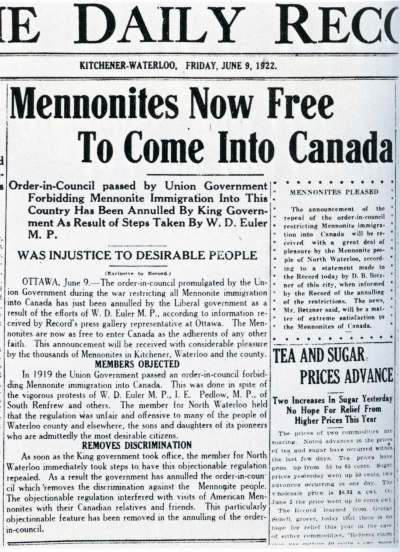
It was started by a Facebook post from Winnipeg’s Mennonite Heritage Centre Archives. On Feb. 21 the centre’s archivist, Conrad Stoesz, posted an image of a newspaper headline from 1922 announcing “Mennonites now free to come to Canada.”
The newspaper article explained that an “objectionable regulation” that “discriminated” against Mennonites had been lifted by then prime minister MacKenzie King.
“In June 1919, the Canadian government banned Mennonite, Hutterite and Doukhobor immigration into Canada due to public pressure,” Stoesz wrote, noting that banning people deemed undesirable was not a new thing, or just an American thing.
“These German-speaking (Russian-speaking for Doukhobors) people who refused military participation were considered a danger to Canada and lacked Canadian values.”
Reaction to the post was overwhelming, with more than 126,000 views and over 1,000 shares so far.
“There’s been nothing like it before,” said Stoesz, adding that most-viewed item prior to this was 10,000 views for a post about Mennonite New Year’s cookies.
The timing of the recent executive order issued by U.S. President Donald Trump, which denies citizens of six countries entry to the U.S., and migrants coming to Manitoba contributed to the interest, he said, adding that many people saw the connection.
As for why he posted the item, Stoesz said that he wanted to “raise awareness that Mennonites have suffered prejudice in Canada because of the language they spoke and for some of the values they held dear. Hopefully people will then think about this past and ask themselves how that informs their views on current situations in our world… The mirror of our past can help humble our views.”

For some people, the post and the story behind it was personal.
“The lifting of this ban allowed my great-grandparents and my grandmother to come to Canada in the mid-1920s and to flee the devastation they experienced as a result of the Russian Revolution,” said one commenter. “I will always be grateful, and will remember what was offered to them and in turn pay it forward to those fleeing war today.”
Added another: “It seems unbelievable that at one point in history Mennonites were viewed as evil,” she said, adding “no doubt in 100 years people will be amazed that anyone would fear Muslims.”
You can check out the post about the banning of Mennonites last century at facebook.com/MHCArchives/. If you want to make a donation to Welcome Place, go to miic.ca or call 204-977-1000.
jdl562000@yahoo.com
The Free Press is committed to covering faith in Manitoba through our Religion in the News project. This reporting continues because readers like you step forward to fund it.
Donate now to support our reporting on religion.
Your donation is eligible for a charitable tax receipt.
BECOME A FAITH JOURNALISM SUPPORTER
Our newsroom depends on a growing audience of readers to power our journalism. If you are not a paid reader, please consider becoming a subscriber.
Our newsroom depends on its audience of readers to power our journalism. Thank you for your support.
The Free Press is committed to covering faith in Manitoba through our Religion in the News project. This reporting continues because readers like you step forward to fund it.
Donate now to support our reporting on religion.
Your donation is eligible for a charitable tax receipt.
BECOME A FAITH JOURNALISM SUPPORTER
Our newsroom depends on a growing audience of readers to power our journalism. If you are not a paid reader, please consider becoming a subscriber.
Our newsroom depends on its audience of readers to power our journalism. Thank you for your support.
Advertisement Advertise With Us
Advertisement Advertise With Us
The Free Press acknowledges the financial support it receives from members of the city’s faith community, which makes our coverage of religion possible.